Kayanda Rosemary A, Kassim Neema, Ngure Francis M, Stoltzfus Rebecca J, Phillips Erica
Department of Food Sciences and Biotechnology, School of Life Sciences and Bioengineering, The Nelson Mandela African Institution of Science and Technology (NM-AIST), Arusha P.O. Box 447, Tanzania.
Division of Nutritional Sciences, Cornell University, 244 Garden Ave, Ithaca, NY 14853, USA.
Nutrients. 2024 Dec 31;17(1):131. doi: 10.3390/nu17010131.
The Mycotoxin Mitigation Trial (MMT) was a community-based cluster-randomized trial designed to assess the effect of dietary aflatoxin (AF) on linear growth. Similar dietary intake between arms was an important component of the trial's program theory and essential for the trial's internal validity and interpretation.
This analysis assessed and compared dietary intake by arm within a sub-sample of infants enrolled in the MMT.
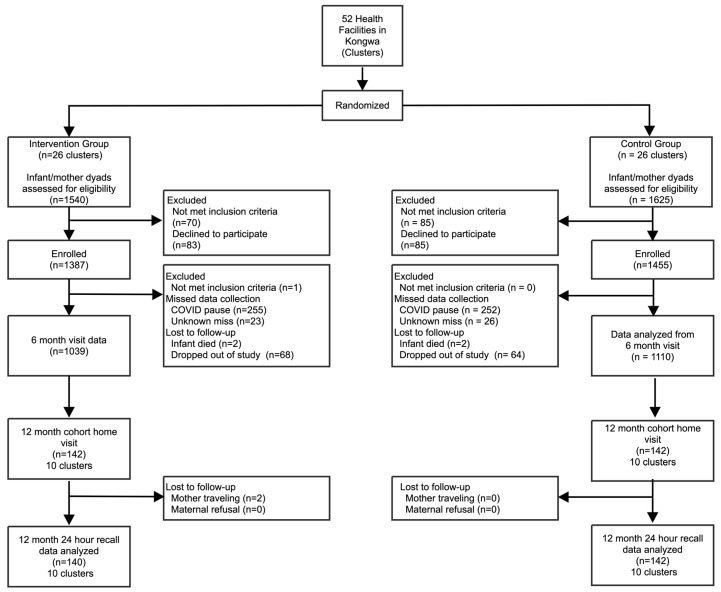
Twenty paired clusters (10 per trial arm) out of the 52 MMT clusters were included in this sub-sample. Up to 15 maternal/infant dyads per cluster were randomly selected for a one-time, structured, multi-pass 24 h dietary recall. Data were collected at the midpoint of the trial, when infants were 12 months of age, over 8 calendar months. We evaluated and compared infant nutrient intake and adequacy of energy, protein, lipid, iron, zinc, calcium, and vitamin A between study arms. Nutrient intake by arm was estimated using mixed-level regression models.
A total of 282 mothers participated (n = 140 intervention arm and 142 standard of care (SoC) arm). The mean daily intakes of energy and lipid fed to infants were 505 kcal/day (SD = 225.9) and 13 g/day (SD = 6.9), respectively, in the intervention and SoC arms, with no difference between arms. Intervention infants consumed slightly more protein than SoC infants (13.7 v. 12.3 g/day, = 0.02). Consumption of iron, zinc, calcium, and vitamin A were low and did not differ between arms.
At the midpoint of the MMT, energy, lipid, and micronutrient intake did not differ between arms. Protein consumption was slightly greater in the intervention arm. Guided by the trial's program theory, this analysis advances the interpretation of the MMT trial findings.
霉菌毒素缓解试验(MMT)是一项基于社区的整群随机试验,旨在评估膳食黄曲霉毒素(AF)对线性生长的影响。两组之间相似的饮食摄入量是该试验方案理论的一个重要组成部分,对于试验的内部有效性和解释至关重要。
本分析评估并比较了参与MMT的婴儿子样本中两组的饮食摄入量。
52个MMT整群中的20对整群(每组10个)被纳入该子样本。每个整群中最多随机选择15对母婴进行一次性、结构化、多轮24小时饮食回顾。数据在试验中点收集,即婴儿12个月大时,跨越8个日历月。我们评估并比较了研究组之间婴儿的营养摄入量以及能量、蛋白质、脂质、铁、锌、钙和维生素A的充足程度。使用混合水平回归模型估计每组的营养摄入量。
共有282名母亲参与(干预组n = 140,标准护理(SoC)组n = 142)。干预组和SoC组喂养婴儿的能量和脂质平均每日摄入量分别为505千卡/天(标准差 = 225.9)和13克/天(标准差 = 6.9),两组之间无差异。干预组婴儿摄入的蛋白质略多于SoC组婴儿(13.7克/天对12.3克/天,P = 0.02)。铁、锌、钙和维生素A的摄入量较低,两组之间无差异。
在MMT的中点,两组之间的能量、脂质和微量营养素摄入量没有差异。干预组的蛋白质摄入量略高。在该试验方案理论的指导下,本分析推进了对MMT试验结果的解释。