Seyithanoğlu Muhammed, Meşen Selma, Comez Aysegul, Meşen Ali, Beyoğlu Abdullah, Baykişi Yaşarcan, Alkan Baylan Filiz
Department of Biochemistry, Kahramanmaraş Sütçü İmam University Faculty of Medicine, Kahramanmaraş, Turkey.
Department of Ophthalmology, Kahramanmaraş Sütçü İmam University Faculty of Medicine, Kahramanmaraş, Turkey.
PeerJ. 2025 Jan 8;13:e18841. doi: 10.7717/peerj.18841. eCollection 2025.
The aim of this study is to examine the relationship between elabela (ELA), a recently identified peptide also known as Toddler and Apela, and diabetic retinopathy (DR). ELA, produced in various tissues, acts as a natural ligand for the apelin receptor (APJ). Upon reviewing the existing literature, only one study was found investigating ELA, one of the APJ ligands, in the pathogenesis of DR.
In our study the patient group comprising individuals diagnosed with type 2 diabetes mellitus (DM), categorized into three subgroups based on detailed fundus examination: those without DR (non-DR) ( = 20), non-proliferative DR (NPDR) ( = 20), and proliferative DR (PDR) ( = 20). A control group ( = 20) consisted of individuals without DM. Blood samples were collected during outpatient clinic admission to measure serum ELA levels, which were determined using a commercial ELISA kit.
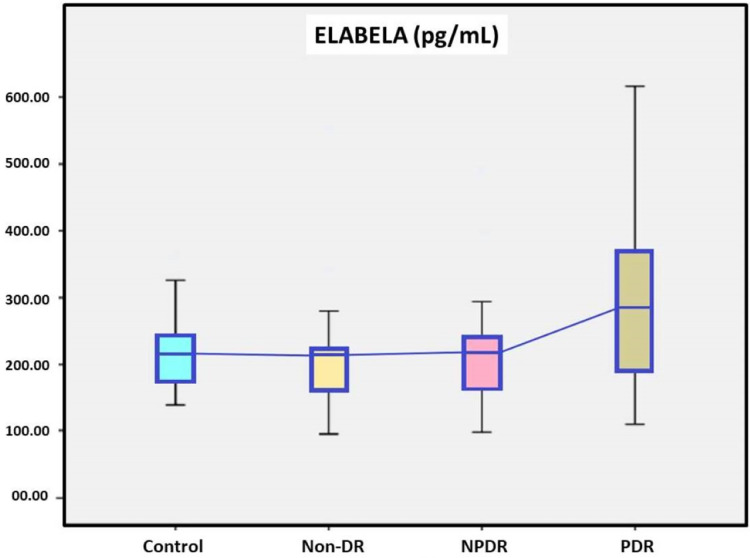
The age, sex, and body mass index of the between groups were similar ( = 0.905, 0.985 and 0.241, respectively). The HbA1c levels of the between DM subgroups were similar ( = 0.199). Serum ELA levels were 217.19 ± 97.54 pg/mL in the non-DR group, 221.76 ± 93.12 pg/mL in the NPDR group, 302.35 ± 146.17 pg/mL in the PDR group and 216.49 ± 58.85 pg/mL in the control group. While ELA levels were higher in DM patients compared to the control group, this elevation did not reach statistical significance. Further analysis dividing DM patients into subgroups (non-DR, NPDR, and PDR) revealed higher ELA levels in the PDR group compared to the other subgroups, but this increase was not statistically significant.
Despite the absence of a significant difference in our study, the identification of elevated ELA levels in the PDR group offers valuable insights for future investigations exploring the association between DR and ELA.
本研究旨在探讨新近发现的一种名为elabela(ELA)(也称为Toddler和Apela)的肽与糖尿病视网膜病变(DR)之间的关系。ELA在多种组织中产生,是apelin受体(APJ)的天然配体。在查阅现有文献时,仅发现一项研究在DR的发病机制中研究了APJ配体之一ELA。
在我们的研究中,患者组包括被诊断为2型糖尿病(DM)的个体,根据详细的眼底检查分为三个亚组:无DR(非DR)组(n = 20)、非增殖性DR(NPDR)组(n = 20)和增殖性DR(PDR)组(n = 20)。对照组(n = 20)由无DM的个体组成。在门诊入院时采集血样以测量血清ELA水平,使用商用ELISA试剂盒进行测定。
各组之间的年龄、性别和体重指数相似(分别为P = 0.905、0.985和0.241)。DM亚组之间的HbA1c水平相似(P = 0.199)。非DR组的血清ELA水平为217.19±97.54 pg/mL,NPDR组为221.76±93.12 pg/mL,PDR组为302.35±146.17 pg/mL,对照组为216.49±58.85 pg/mL。虽然DM患者的ELA水平高于对照组,但这种升高未达到统计学意义。将DM患者进一步分为亚组(非DR、NPDR和PDR)的分析显示,PDR组的ELA水平高于其他亚组,但这种升高无统计学意义。
尽管在我们的研究中没有显著差异,但PDR组中ELA水平升高的发现为未来探索DR与ELA之间关联的研究提供了有价值的见解。