Pouliopoulou Dimitra V, Billias Nicole, MacDermid Joy C, Miller Erin, O'Brien Kelly K, Quinn Kieran L, Malvankar-Mehta Monali S, Pereira Tiago V, Cheung Angela M, Razak Fahad, Stranges Saverio, Bobos Pavlos
School of Physical Therapy, Faculty of Health Science, Western University, London, Ontario, Canada.
Department of Physical Therapy, Temerty Faculty of Medicine, University of Toronto, Toronto, Ontario, Canada.
EClinicalMedicine. 2024 Dec 17;79:102993. doi: 10.1016/j.eclinm.2024.102993. eCollection 2025 Jan.
Given the chronic immune activation and inflammatory milieu associated with Long COVID and HIV, we assessed the prevalence of Long COVID in adults living with HIV; and investigated whether adults living with HIV were associated with increased chance of developing Long COVID compared to adults living without HIV.
In this systematic review and meta-analysis, we searched Medline, EMBASE, CINHAL, PubMed and CENTRAL from inception until June 14th, 2024, for observational studies that measured the prevalence of Long COVID in adults living with HIV and the odds of developing Long COVID following a SARS-CoV-2 infection in people living with HIV compared to people living without HIV. Reviews, case reports, randomised control trials and editorials were excluded. The search was conducted without language restrictions. We performed meta-analysis of proportions to synthesise prevalence estimates using logit transformation and a sensitivity analysis using mixed-effects logistic regression. We used random-effects meta-analyses to summarize the odds ratio (OR) of developing Long COVID in adults living with HIV compared to adults living without HIV and conducted a sensitivity analysis including only studies with covariate-adjusted estimates that was planned a-priori. We used ROBINS-E for the risk of bias assessment and GRADE to rate the certainty of evidence. We identified statistical heterogeneity using Cochran's Q test and quantified it using the I statistic. For the Q test, a < 0.10 was considered statistically significant. PROSPERO registration: CRD42024577616.
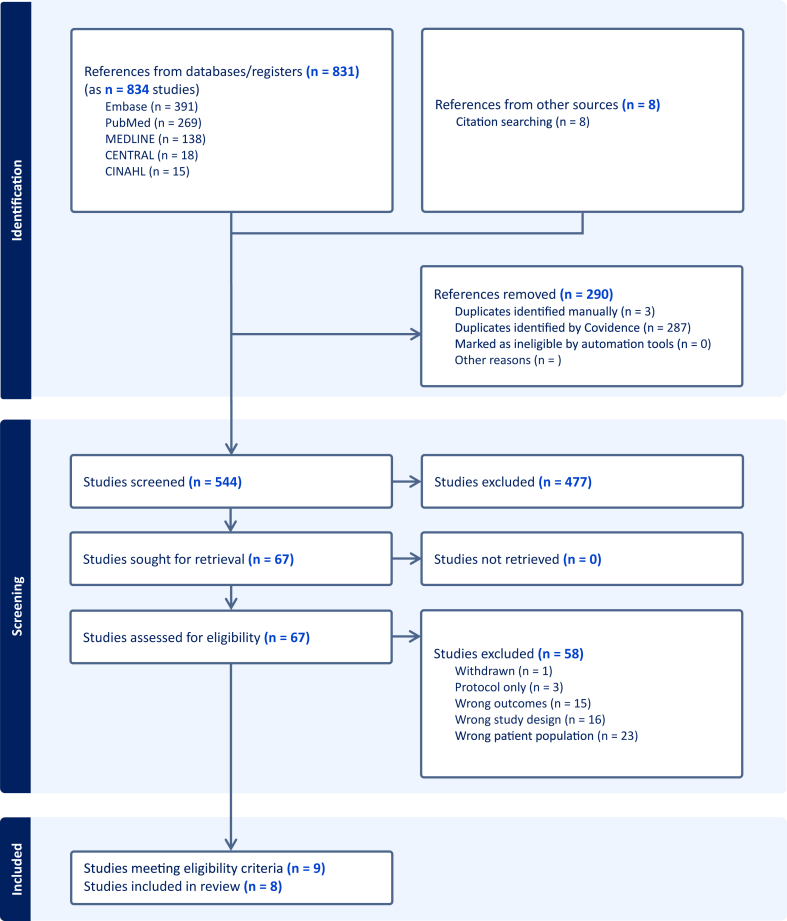
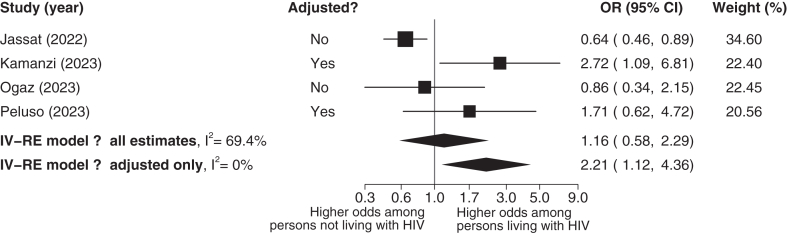
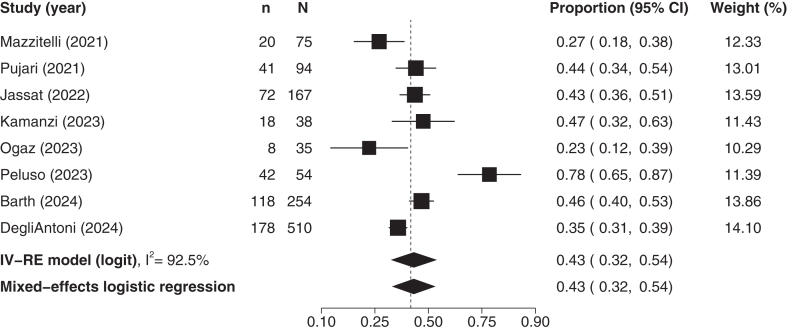
Our search returned 831 results, of which 8 studies (4489 participants) were deemed eligible for inclusion in the systematic review and meta-analysis. The prevalence of Long COVID in adults with HIV was 43% (95% CI: 32-54%, 8 studies; 1227 participants; low certainty, I < 0.0001). The association of HIV status with Long COVID was inconclusive, with wide confidence intervals (OR: 1.16, 95% CI: 0.58-2.29; 4 studies; 3556 participants, low certainty, I = 0.013). When the analysis was restricted to studies reporting covariate-adjusted estimates, adults living with HIV were associated with a higher odds of Long COVID than those not living with HIV (OR: 2.21, 95% CI: 1.12-4.36; 2 studies; 374 participants, low certainty, I = 0.51).
Current evidence indicates that the prevalence of Long COVID in adults living with HIV may be high, suggesting the need for increased awareness and education of healthcare providers and policy makers. Evidence on whether HIV positivity increases the risk of Long COVID is limited and inconclusive, highlighting a need for further research to clarify this potential association.
None.
鉴于与新冠长期症状和艾滋病毒相关的慢性免疫激活和炎症环境,我们评估了艾滋病毒感染者中新冠长期症状的患病率;并调查了与未感染艾滋病毒的成年人相比,艾滋病毒感染者发生新冠长期症状的几率是否更高。
在这项系统评价和荟萃分析中,我们检索了从起始至2024年6月14日的Medline、EMBASE、CINHAL、PubMed和CENTRAL数据库,以查找测量艾滋病毒感染者中新冠长期症状患病率以及与未感染艾滋病毒者相比,艾滋病毒感染者在感染SARS-CoV-2后发生新冠长期症状几率的观察性研究。排除综述、病例报告、随机对照试验和社论。检索不受语言限制。我们使用对数变换进行比例的荟萃分析以综合患病率估计值,并使用混合效应逻辑回归进行敏感性分析。我们使用随机效应荟萃分析总结与未感染艾滋病毒的成年人相比,艾滋病毒感染者发生新冠长期症状的优势比(OR),并进行了一项敏感性分析,该分析仅包括事先计划的具有协变量调整估计值的研究。我们使用ROBINS-E进行偏倚风险评估,并使用GRADE对证据的确定性进行评级。我们使用Cochran's Q检验识别统计异质性,并使用I统计量对其进行量化。对于Q检验,P<0.10被认为具有统计学意义。PROSPERO注册号:CRD42024577616。
我们的检索返回了831条结果,其中8项研究(4489名参与者)被认为符合纳入系统评价和荟萃分析的条件。艾滋病毒感染者中新冠长期症状的患病率为43%(95%CI:32-54%,8项研究;1227名参与者;低确定性,I<0.0001)。艾滋病毒感染状态与新冠长期症状之间的关联尚无定论,置信区间较宽(OR:1.16,95%CI:0.58-2.29;4项研究;3556名参与者,低确定性,I=0.