Kim Soeun, Lee Hayeon, Woo Selin, Lee Hyeri, Park Jaeyu, Kim Tae, Fond Guillaume, Boyer Laurent, Rahmati Masoud, Smith Lee, López Sánchez Guillermo F, Dragioti Elena, Nehs Christa J, Lee Jinseok, Kim Hyeon Jin, Kang Jiseung, Yon Dong Keon
Center for Digital Health, Medical Science Research Institute, Kyung Hee University College of Medicine, Seoul, South Korea.
Department of Precision Medicine, Kyung Hee University College of Medicine, Seoul, South Korea.
EClinicalMedicine. 2024 Dec 17;79:102985. doi: 10.1016/j.eclinm.2024.102985. eCollection 2025 Jan.
Drug use disorder (DUD) poses a major public health crisis globally, necessitating immediate attention to global trends and future projections to develop effective health policies and interventions. Thus, we aimed to estimate the global trends in DUD mortality rates from 1990 to 2021 and future projections of DUD deaths until 2040 across 73 countries.
In this time-series analysis and modelling study, we investigated the global trends in DUD mortality rates from 1990 to 2021 using the WHO Mortality Database and forecasted future trends through 2040. Global trend analysis was analysed using a locally weighted scatter plot smoother (LOESS) curve, and future projections were calculated based on a Bayesian age-period-cohort analysis. In addition, we performed a decomposition analysis to identify the variations in DUD deaths, specifically examining factors such as population growth, ageing, and epidemiological changes.
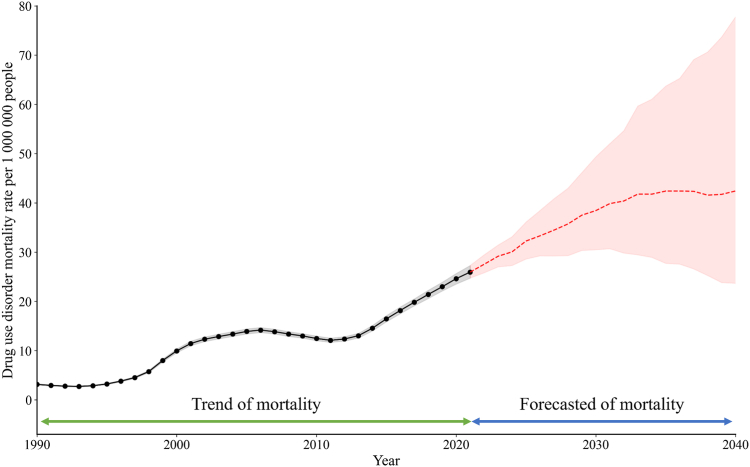
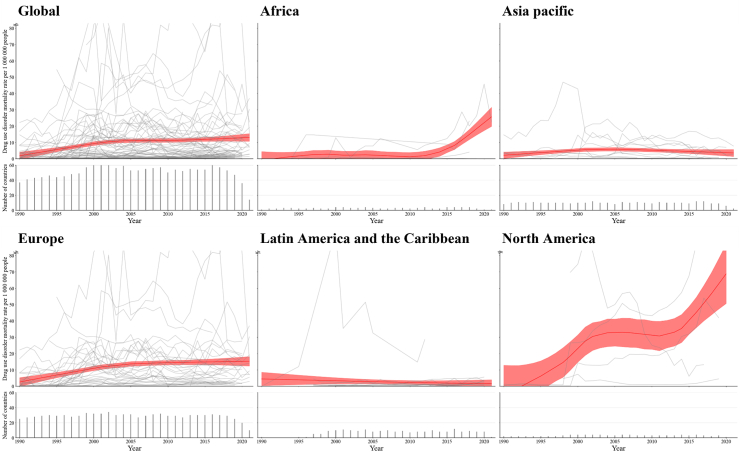
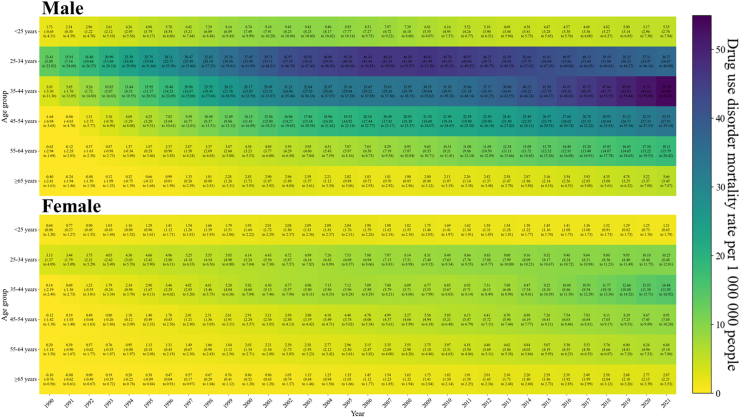
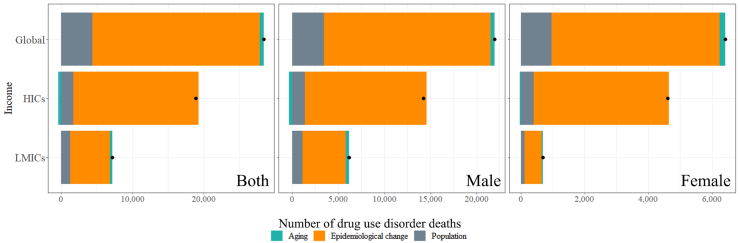
Of the 73 countries included in the analysis of DUD mortality, 45 were high-income countries (HICs), and 28 were low to middle-income countries (LMICs). The LOESS estimates of the global DUD mortality rate were 1.84 deaths per 1,000,000 people (95% CI, -0.44 to 4.12) in 1990 and 13.09 deaths per 1,000,000 people (95% CI, 10.74-15.43) in 2021. Notably, HICs showed a significant increase in DUD mortality from 1.43 deaths per 1,000,000 people (95% CI, -1.55 to 4.42) in 1990 to 17.19 deaths per 1,000,000 people (95% CI, 13.84-20.53) in 2021. A significant increase in DUD mortality was observed among individuals aged 25-64 and males. Our analysis also identified associations between DUD mortality rates and several log-transformed parameters, including Human Development Index (β, 14.92; p < 0.0001), Socio-demographic Index (β, 11.80; p < 0.0001), reverse Gender Gap Index (β, -12.02; p < 0.0001), and Gini coefficient (β, -1.84; p < 0.0001). From 1990 to 2021, the increase in the number of DUD deaths globally can be attributed to two prominent factors: epidemiological change and population growth. In HICs, the impacts of epidemiological changes for increasing DUD mortality rates were particularly prominent compared to other factors. In the Bayesian age-period-cohort models, the predicted number of global DUD deaths up to 2040 were estimated to increase from 25.95 deaths per 1,000,000 people (95% credible interval [CrI], 24.72-27.28) in 2021 to 38.45 (95% CrI, 30.48-49.33) in 2030, and 42.43 (95% CrI, 23.67-77.77) in 2040.
An increasing trend in global DUD mortality was observed from 1990 to 2021, especially in HICs. Future DUD deaths were also predicted to increase until 2040 at the global level. Therefore, these findings suggest urgent and proactive strategies for DUD to reduce the mortality rates related to DUD are needed. However, further prospective research that accounts for potential confounding factors, such as socioeconomic variables and the quality of reporting data from individual countries, is imperative for more accurate estimation.
National Research Foundation and Ministry of Science and ICT of South Korea.
药物使用障碍(DUD)在全球范围内构成了重大的公共卫生危机,需要立即关注全球趋势和未来预测,以制定有效的卫生政策和干预措施。因此,我们旨在估计1990年至2021年全球DUD死亡率的趋势以及到2040年73个国家DUD死亡的未来预测。
在这项时间序列分析和建模研究中,我们使用世界卫生组织死亡率数据库调查了1990年至2021年全球DUD死亡率的趋势,并预测了到2040年的未来趋势。使用局部加权散点图平滑法(LOESS)曲线进行全球趋势分析,并基于贝叶斯年龄-时期-队列分析计算未来预测。此外,我们进行了分解分析,以确定DUD死亡的变化,特别考察了人口增长、老龄化和流行病学变化等因素。
在纳入DUD死亡率分析的73个国家中,45个是高收入国家(HICs),28个是低收入和中等收入国家(LMICs)。1990年全球DUD死亡率的LOESS估计值为每100万人中有1.84人死亡(95%置信区间,-0.44至4.12),2021年为每100万人中有13.09人死亡(95%置信区间,10.74 - 15.43)。值得注意的是,HICs的DUD死亡率从1990年的每100万人中有1.43人死亡(95%置信区间,-1.55至4.42)显著增加到2021年的每100万人中有17.19人死亡(95%置信区间,13.84 - 20.53)。在25 - 64岁的人群和男性中观察到DUD死亡率显著增加。我们的分析还确定了DUD死亡率与几个对数转换参数之间的关联,包括人类发展指数(β,14.92;p < 0.0001)、社会人口指数(β,11.80;p < 0.0001)、反向性别差距指数(β,-12.02;p < 0.0001)和基尼系数(β,-1.84;p < 0.0001)。从1990年到2021年,全球DUD死亡人数的增加可归因于两个突出因素:流行病学变化和人口增长。在HICs中,与其他因素相比,流行病学变化对DUD死亡率增加的影响尤为突出。在贝叶斯年龄-时期-队列模型中,预计到2040年全球DUD死亡人数将从2021年的每100万人中有25.95人死亡(95%可信区间[CrI],24.72 - 27.28)增加到2030年的38.45人(95% CrI,30.48 - 49.33),2040年为42.43人(95% CrI,23.67 - 77.77)。
1990年至2021年观察到全球DUD死亡率呈上升趋势,尤其是在HICs中。预计到2040年全球DUD死亡人数在全球层面也将增加。因此,这些发现表明需要针对DUD采取紧急和积极的策略,以降低与DUD相关的死亡率。然而,为了进行更准确的估计,必须进行进一步的前瞻性研究,考虑潜在的混杂因素,如社会经济变量和各个国家报告数据的质量。
韩国国家研究基金会和科学与信息通信技术部。