Sayed Gehad H El, Fadel Mohamed, Fouad Rasha, Ahmed Hend M, Hamed Ahmed A
Microbial Chemistry Department, Biotechnology Research Institute, National Research Center, Dokki, Giza, Egypt.
Medicinal and Aromatic Plants Research Department, National Research Centre, Dokki, Giza, Egypt.
BMC Microbiol. 2025 Jan 13;25(1):19. doi: 10.1186/s12866-024-03697-4.
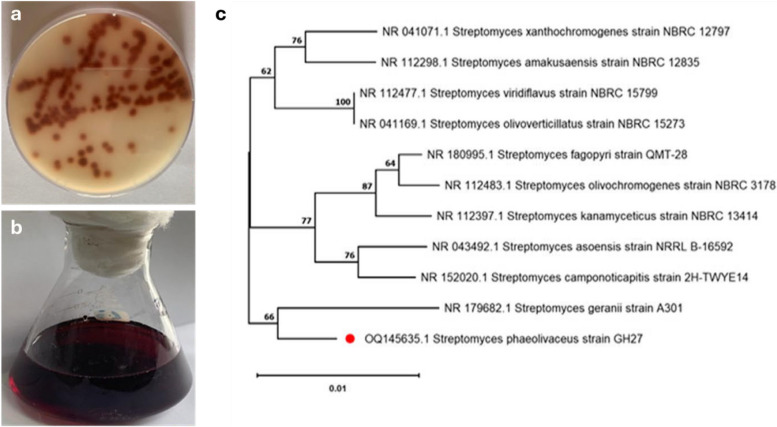
The red pigment was recovered from the S. phaeolivaceus GH27 isolate, which was molecularly identified using 16S rRNA gene sequencing and submitted to GenBank as OQ145635.1. The ideal growth conditions included 1% (w/v) starch, diammonium citrate, dibasic sodium phosphate, 5% (v/v) inoculum, pH 8, a rotation speed of 150 rpm, a temperature of 37 °C, and an incubation period of 9 days. Using ethanol as a solvent, the red pigment was effectively recovered. Data indicates that pigment content remained steady at 40 and 50 °C. Heating the pigment extract to 60, 70, 80, 90, and 100 °C for one hour results in pigment retention of 98%, 96.5%, 95.5%, 94.6%, and 92.6% of its pigment density, respectively. Studies indicate that the pigment extracts exhibited optimal stability at alkaline pH levels. The findings demonstrate that the red pigment extract has a peak absorbance range of 280-340 nm, with a λmax of 300 nm. GC/MS analysis revealed that the primary components of the pigment extract were linolenic acid methyl ester and oleic acid methyl ester, constituting 26.41% and 25.25%, respectively. Fabrics dyed with extracted red pigment exhibit excellent fastness when using the comprehensive green method. In comparison to conventional and nanotechnological attributes, printed samples exhibit significant color strength without environmental repercussions. The treatment of cotton, wool, and polyester samples suppressed pathogen growth to differing extents. Polyester had the most important inhibitory effects on Staphylococcus aureus (50.03%) and Bacillus cereus (39.49%). The ADME physicochemical properties of the predominant medication were assessed, together with its bioavailability. The radar plot demonstrated ideal parameters for size, polarity, lipophilicity, solubility, and saturation, excluding flexibility. It exhibited intermediate synthetic accessibility, exceptional permeability and absorption, elevated gastrointestinal absorption, and blood-brain barrier penetration; nonetheless, it did not adhere to the medicinal chemistry rule of three.
从橄榄色链霉菌GH27分离株中提取出红色色素,该菌株通过16S rRNA基因测序进行分子鉴定,并以OQ145635.1的名称提交至GenBank。理想的生长条件包括1%(w/v)淀粉、柠檬酸二铵、磷酸氢二钠、5%(v/v)接种量、pH 8、150 rpm的转速、37°C的温度以及9天的培养期。以乙醇为溶剂,可有效提取出红色色素。数据表明,色素含量在40°C和50°C时保持稳定。将色素提取物分别加热至60°C、70°C、80°C、90°C和100°C一小时后,色素保留率分别为其色素密度的98%、96.5%、95.5%、94.6%和92.6%。研究表明,色素提取物在碱性pH值水平下表现出最佳稳定性。研究结果表明,红色色素提取物的最大吸收峰范围为28~340 nm,λmax为300 nm。气相色谱/质谱分析显示,色素提取物的主要成分是亚麻酸甲酯和油酸甲酯,分别占26.41%和25.25%。采用综合绿色方法时,用提取的红色色素染色的织物具有优异的色牢度。与传统和纳米技术特性相比,印花样品具有显著的色强度且无环境影响。对棉、羊毛和聚酯样品的处理在不同程度上抑制了病原体的生长。聚酯对金黄色葡萄球菌(50.03%)和蜡样芽孢杆菌(39.49%)具有最重要的抑制作用。评估了主要药物的ADME理化性质及其生物利用度。雷达图显示了除柔韧性外,在大小、极性、亲脂性、溶解度和饱和度方面的理想参数。它表现出中等的合成可及性、优异的渗透性和吸收性、较高的胃肠道吸收以及血脑屏障穿透性;然而,它不符合药物化学的“规则三”。