
在中级护理单元使用中线导管输注去甲肾上腺素治疗休克:一项回顾性队列研究。
Treating shock with norepinephrine administered in midline catheters in an intermediary care unit: a retrospective cohort study.
作者信息
Karlsson Hanna, Afrasiabi Ajnaz, Ohlsson Marcus, Månsson Viktor, Hartman Hannes, Torisson Gustav
机构信息
Department of Infectious Diseases, Skånes universitetssjukhus Malmö, Malmö, Skåne, Sweden.
Department of Internal Medicine, Skånes universitetssjukhus Malmö, Malmö, Skåne, Sweden.
出版信息
BMJ Open. 2024 Dec 30;14(12):e091311. doi: 10.1136/bmjopen-2024-091311.
OBJECTIVES
A rising incidence of septic shock as well as recommendations for early vasopressor initiation has increased the number of patients eligible for norepinephrine (NE). Traditionally, NE has been administered through central lines, in intensive care units, due to the risk of extravasation in peripheral lines. The aim of the current study is to determine the rate of complications and patient outcomes when NE is administered through midline catheters (MCs) in intermediary care units (IMCUs).
DESIGN
Retrospective cohort study.
SETTING
Three IMCUs in southern Sweden PARTICIPANTS: Patients with septic shock who received NE through a MC from September 2020 through March 2023.
PRIMARY AND SECONDARY OUTCOME MEASURES
The primary outcome was a major complication to treatment, defined as extravasation of NE, catheter-associated venous thromboembolism and catheter-associated bloodstream infection (BSI). Secondary outcomes included patient outcomes after intermediary care (either deceased, discharged to regular ward care or intensive care) and the need for additional central lines.
RESULTS
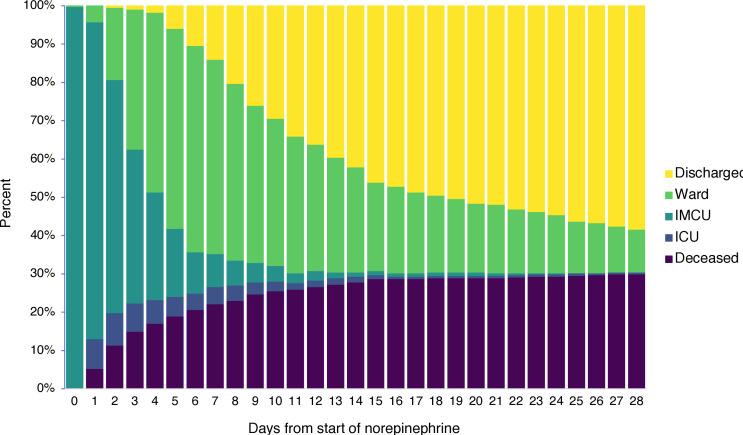
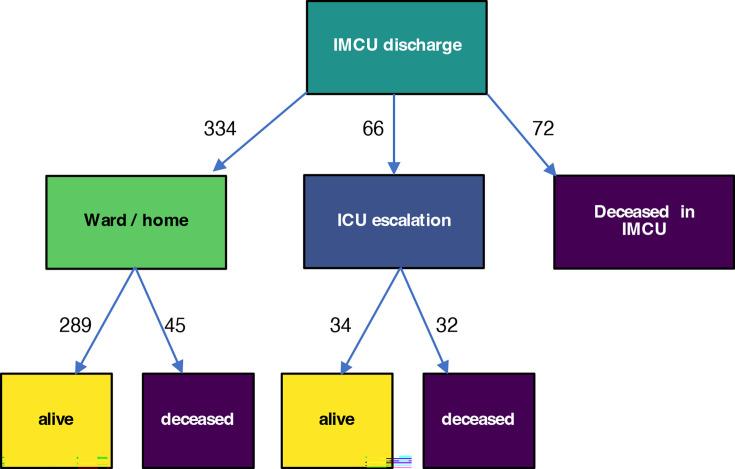
Of 474 eligible patients, 472 were included, with a median (IQR) age of 73.5 (65-80) years, with 281 (60%) men. The median (IQR) duration of NE infusion was 21 (9-38) hours, with a median (IQR) dosage of 0.12 (0.08-0.20) µg/kg/min. Major complications occurred in 12 cases (2.5%), with one suspected extravasation, seven thromboembolic events and four catheter-related BSIs. After intermediary care, 334 patients (71%) were discharged to regular ward care, 66 patients (14%) were escalated to intensive care and 72 (15%) died in intermediary care, of whom 69 had a documented ceiling of care decision. 100 patients (21%) received a central line.
CONCLUSION
NE administration in MCs was associated with a low rate of short-term complications and could decrease the need for central lines. MCs can enable the initial management of circulatory failure outside intensive care, but more studies are needed to determine the long-term value of IMCUs.
TRIAL REGISTRATION NUMBER
NCT06121115.
目的
感染性休克发病率上升以及早期使用血管升压药的建议使得符合使用去甲肾上腺素(NE)治疗的患者数量增加。传统上,由于外周静脉置管有外渗风险,NE一直是在重症监护病房通过中心静脉置管给药。本研究的目的是确定在中级护理单元(IMCU)通过中线导管(MC)给予NE时的并发症发生率和患者预后。
设计
回顾性队列研究。
地点
瑞典南部的三个IMCU
参与者
2020年9月至2023年3月期间通过MC接受NE治疗的感染性休克患者。
主要和次要结局指标
主要结局是治疗的主要并发症,定义为NE外渗、导管相关静脉血栓栓塞和导管相关血流感染(BSI)。次要结局包括中级护理后的患者结局(死亡、出院至普通病房护理或重症监护)以及是否需要额外的中心静脉置管。
结果
在474名符合条件的患者中,纳入了472名,中位(IQR)年龄为73.5(65 - 80)岁,男性281名(60%)。NE输注的中位(IQR)持续时间为21(9 - 38)小时,中位(IQR)剂量为0.12(0.08 - 0.20)µg/kg/min。12例(2.5%)发生主要并发症,其中1例疑似外渗,7例血栓栓塞事件,4例导管相关BSI。中级护理后,334例患者(71%)出院至普通病房护理,66例患者(14%)升级至重症监护,72例(15%)在中级护理期间死亡,其中69例有记录在案的治疗上限决定。100例患者(21%)接受了中心静脉置管。
结论
通过MC给予NE与短期并发症发生率低相关,且可减少中心静脉置管的需求。MC可实现重症监护室外循环衰竭的初始管理,但需要更多研究来确定IMCU的长期价值。
试验注册号
NCT06121115
 Zotero 插件