Rathinam Chandrasekar, Farr William, Ray Daniel, Gupta Rajat
College of Medical and Dental Sciences, University of Birmingham, Birmingham, UK
Therapy Service, Birmingham Women's and Children's NHS Foundation Trust, Birmingham, UK.
BMJ Open. 2025 Jan 15;15(1):e083120. doi: 10.1136/bmjopen-2023-083120.
Upper limb movement difficulties in children with acquired brain injury (ABI) result in longer recovery times compared with lower limb. Intensive neurorehabilitation promotes a good long-term functional outcome. Virtual reality (VR) and video game technologies are invaluable adjuncts to traditional neurological rehabilitation as they help to motivate, engage and gain children's compliance in goal-directed therapy. However, this technology is not routinely used in the National Health Service, UK; it requires embedding to benefit children and their families. VR implementation in rehabilitation practice requires development. The associated influencing factors require further exploration before routine use can be established. This project aimed to understand the factors influencing the use of VR in upper limb rehabilitation in children.VR implementation in rehabilitation practice requires development. The associated influencing factors require further exploration before routine use can be established. This project aims to understand the factors influencing the use of VR in upper limb rehabilitation in children.
An interpretative qualitative study used focus groups and 1:1 semi-structured interviews conducted in person and online to explore participants' experiences. These were analysed for inductive overarching themes, particularly focusing on the views of professionals and young people regarding the use of VR in upper limb rehabilitation.
Two neurorehabilitation services located in two children's hospitals in England, UK.
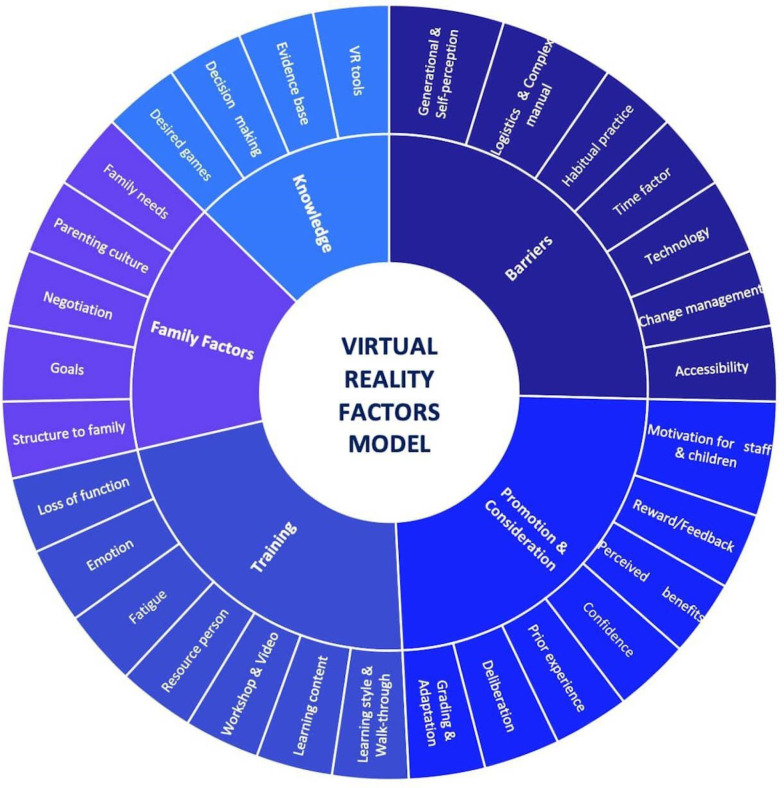
Three physiotherapists, five occupational therapists, a play worker and four members from the Young Persons' Advisory Group took part. Four focus groups with 2-4 participants in each group and two 1:1 semi-structured interviews were conducted. Thematic analysis was used to create the model participants described as the factors that influenced the use of VR in neurorehabilitation.
Five closely related major themes and thirty associated subthemes were developed: training, knowledge, promotion, consideration of barriers and family factors. There is a lack of knowledge and understanding about the use of VR, its limitations, and the clinicians' motivation to use it. Training packages with available VR equipment, clinical indicators and scientific evidence are required. Staff need frequent training, logistics (uninterrupted Wi-Fi, software, hardware) and simple instruction manuals.
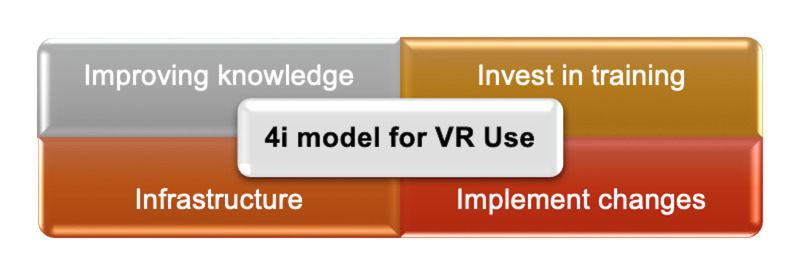
To introduce VR into the routine rehabilitation of children with ABI, investment in improving knowledge, frequent training and positive behaviour change among health professionals is needed.
与下肢相比,获得性脑损伤(ABI)儿童的上肢运动困难导致恢复时间更长。强化神经康复可促进良好的长期功能结局。虚拟现实(VR)和视频游戏技术是传统神经康复的宝贵辅助手段,因为它们有助于激发、吸引儿童并使其在目标导向治疗中配合。然而,这项技术在英国国民医疗服务体系中并非常规使用;它需要融入才能使儿童及其家庭受益。VR在康复实践中的应用需要发展。在常规使用确立之前,相关影响因素需要进一步探索。本项目旨在了解影响VR在儿童上肢康复中应用的因素。VR在康复实践中的应用需要发展。在常规使用确立之前,相关影响因素需要进一步探索。本项目旨在了解影响VR在儿童上肢康复中应用的因素。
一项解释性定性研究,采用焦点小组以及面对面和在线进行的一对一的半结构化访谈来探索参与者的经历。对这些内容进行分析以归纳出总体主题,特别关注专业人员和年轻人对VR在上肢康复中应用的看法。
位于英国英格兰两家儿童医院的两个神经康复服务机构。
三名物理治疗师、五名职业治疗师、一名游戏工作者和四名青年咨询小组的成员参与其中。进行了四个每组有2 - 4名参与者的焦点小组和两个一对一的半结构化访谈。采用主题分析来构建参与者所描述的影响VR在神经康复中应用的因素模型。
形成了五个密切相关的主要主题和三十个相关子主题:培训、知识、推广、障碍考量和家庭因素。对VR的使用、其局限性以及临床医生使用它的动机缺乏了解。需要配备可用VR设备、临床指标和科学证据的培训包。工作人员需要频繁培训、后勤保障(不间断的Wi-Fi、软件、硬件)和简单的使用手册。
要将VR引入ABI儿童的常规康复中,需要在提高知识水平、频繁培训以及促使卫生专业人员形成积极行为改变方面进行投入。