Hagger Martin S, Hamilton Kyra
Department of Psychological Sciences, University of California, Merced, USA.
Health Sciences Research Institute, University of California, Merced, USA.
J Behav Med. 2025 Feb;48(1):43-56. doi: 10.1007/s10865-024-00545-8. Epub 2025 Jan 20.
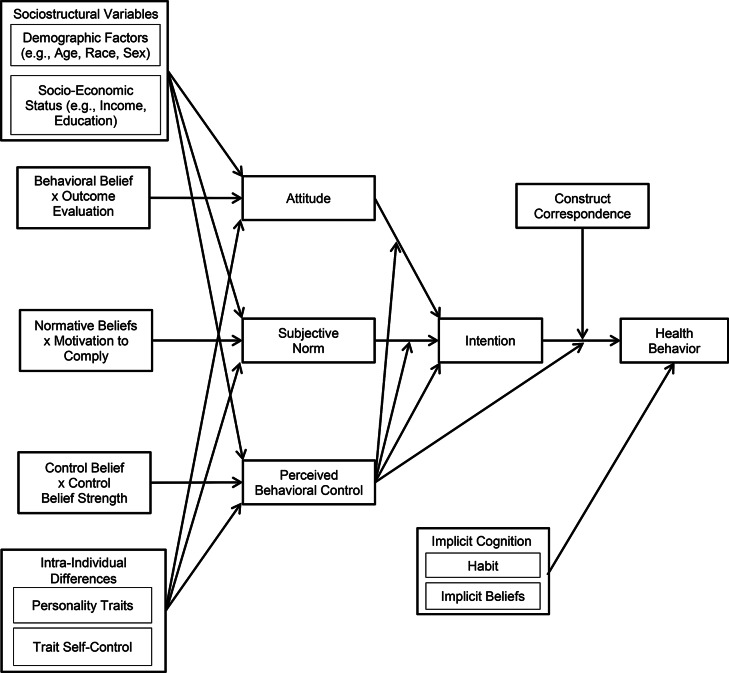
The theory of planned behavior is a social cognition theory that has been widely applied to identify the psychological determinants of intentions and behavior in health contexts. Our 2015 meta-analysis of theory applications in chronic illness contributed to a burgeoning evidence base comprising syntheses supporting theory predictions in health behavior. In this review, we identify limitations of prior meta-analyses of theory applications in health behavior and highlight salient evidence gaps, summarize how recent meta-analyses of the theory have addressed some of the limitations, outline outstanding research questions, and suggest future research syntheses, including those currently in progress, to resolve them. We point to recent and ongoing meta-analyses addressing theory hypotheses and assumptions not tested in previous syntheses, such as perceived behavioral control moderating effects and indirect effects of environmental (e.g., sociostructural variables) and intrapersonal (e.g., personality traits) determinants on health behavior mediated by theory constructs. We also highlight meta-analyses examining behavioral effects of constructs representing extended processes (e.g., habit, implicit cognition) in the context of the theory. Further, we summarize recent meta-analyses addressing directional and causal inferences in theory effects, including meta-analyses of longitudinal studies and experimental and intervention research. We also highlight attempts to test the mechanisms of action of interventions based on the theory including the change meta-analysis method and mediation analyses. We conclude by summarizing the advances that recent meta-analyses of the theory have made to the evidence base of health behavior determinants and interventions and highlighting suggestions for meta-analyses that will further progress the evidence base.
计划行为理论是一种社会认知理论,已被广泛应用于确定健康领域中意图和行为的心理决定因素。我们在2015年对慢性病理论应用进行的荟萃分析,为一个不断发展的证据库做出了贡献,该证据库包含支持健康行为理论预测的综合研究。在本综述中,我们确定了先前健康行为理论应用荟萃分析的局限性,突出了显著的证据空白,总结了该理论最近的荟萃分析如何解决了一些局限性,概述了未解决的研究问题,并提出了未来的研究综合建议,包括目前正在进行的研究,以解决这些问题。我们指出了最近和正在进行的荟萃分析,这些分析涉及先前综合研究中未测试的理论假设和假设,例如感知行为控制的调节效应以及环境(如社会结构变量)和个人内部(如人格特质)决定因素通过理论结构对健康行为的间接效应。我们还强调了在该理论背景下检验代表扩展过程(如习惯、内隐认知)的结构的行为效应的荟萃分析。此外,我们总结了最近针对理论效应中的方向性和因果推断的荟萃分析,包括纵向研究以及实验和干预研究的荟萃分析。我们还强调了基于该理论测试干预作用机制的尝试,包括变化荟萃分析方法和中介分析。我们通过总结该理论最近的荟萃分析对健康行为决定因素和干预证据库所取得的进展,并突出对将进一步推动证据库发展的荟萃分析的建议来结束本文。