Nan Haiwang, Gao Zhenhao, Song Limei, Zheng Qiang
School of Computer and Control Engineering, Yantai University, Yantai, China.
School of Medical Imaging, Shandong Second Medical University, Weifang, China.
Quant Imaging Med Surg. 2025 Jan 2;15(1):867-881. doi: 10.21037/qims-24-1451. Epub 2024 Dec 17.
Skin lesion segmentation plays a significant role in skin cancer diagnosis. However, due to the complex shapes, varying sizes, and different color depths, precise segmentation of skin lesions is a challenging task. Therefore, the aim of this study was to design a customized deep learning (DL) model for the precise segmentation of skin lesions, particularly for complex shapes and small target lesions.
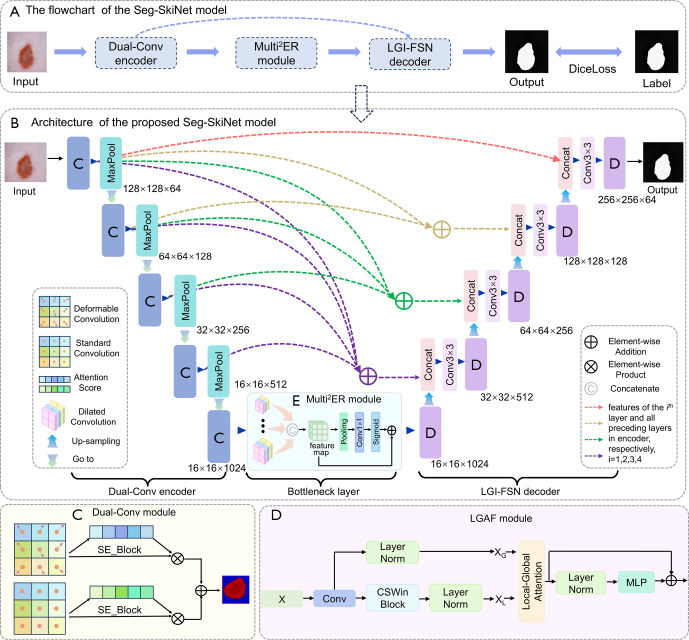
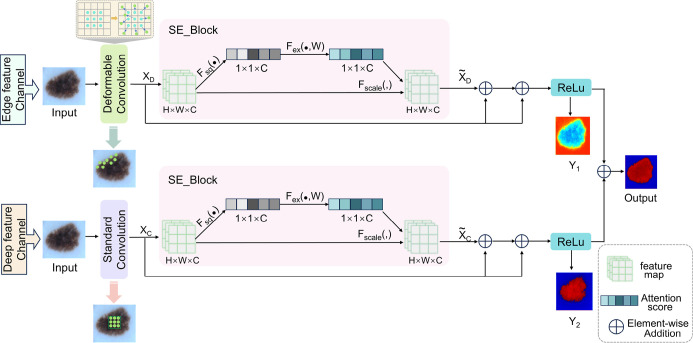
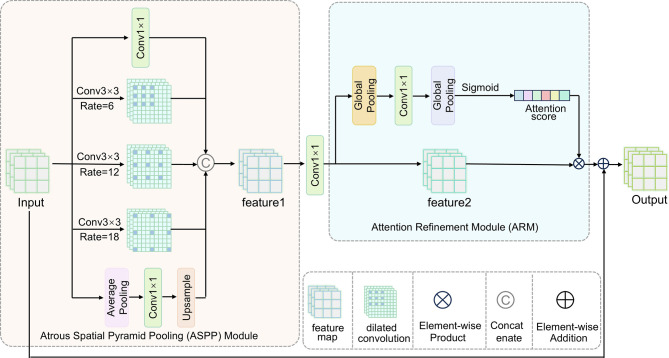
In this study, an adaptive deformable fusion convolutional network (Seg-SkiNet) was proposed. Seg-SkiNet integrated dual-channel convolution encoder (Dual-Conv encoder), Multi-Scale-Multi-Receptive Field Extraction and Refinement (MultiER) module, and local-global information interaction fusion decoder (LGI-FSN decoder). In the Dual-Conv encoder, a Dual-Conv module was proposed and cascaded with max pooling in each layer to capture the features of complex-shaped skin lesions. The design of the Dual-Conv module not only effectively captured edge features of the lesions but also learned deep internal features of the lesions. The MultiER module was composed of an Atrous Spatial Pyramid Pooling (ASPP) module and an Attention Refinement Module (ARM), and integrated multi-scale features of small target lesions by expanding the receptive field of the convolutional kernel, thereby improving the learning and accurately segmentation of small target lesions. In the LGI-FSN decoder, we integrated convolution and Local-Global Attention Fusion (LGAF) module in each layer to enable interactive fusion of local-global information in feature maps while eliminating redundant feature information. Additionally, we designed a densely connected architecture that fuses the feature maps from a specific layer of the Dual-Conv encoder and all of its preceding layers into the corresponding layer of the LGI-FSN decoder, preventing information loss caused by pooling operations.
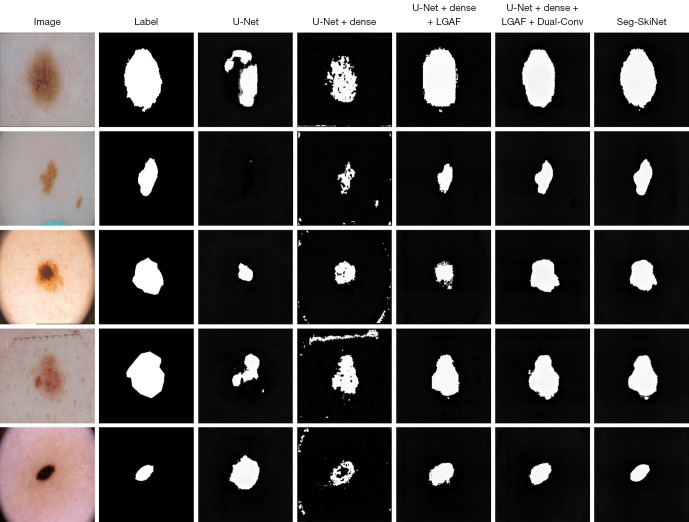
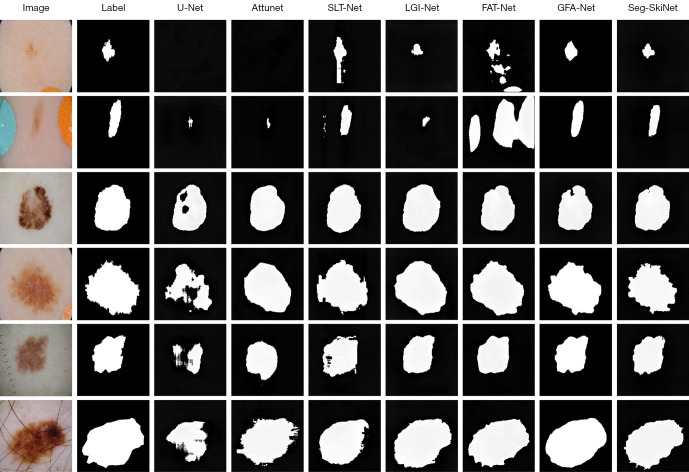
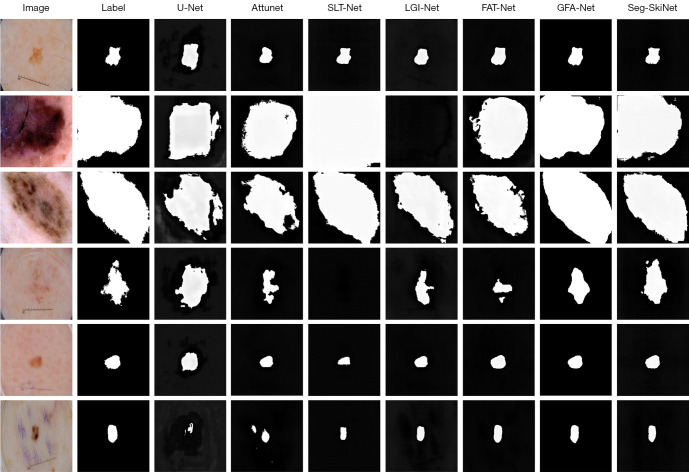
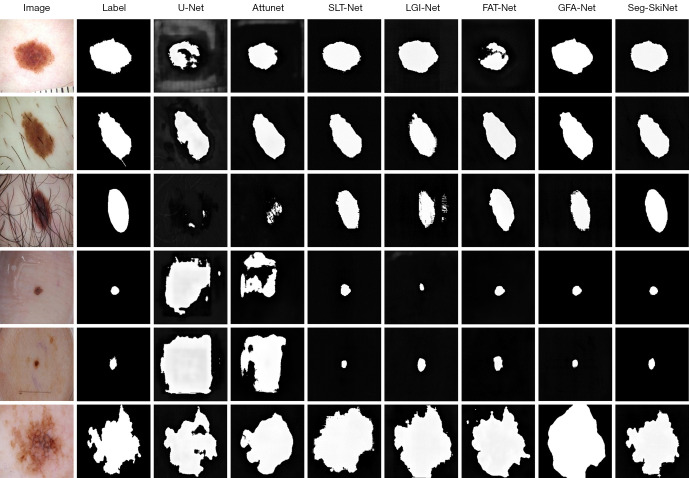
We validated the performance of Seg-SkiNet for skin lesion segmentation on three public datasets: International Skin Imaging Collaboration (ISIC)-2016, ISIC-2017, and ISIC-2018. The experimental results demonstrated that Seg-SkiNet achieved a Dice coefficient (DICE) of 93.66%, 89.44% and 92.29%, respectively.
The Seg-SkiNet model performed excellently in segmenting complex-shaped lesions and small target lesions.
皮肤病变分割在皮肤癌诊断中起着重要作用。然而,由于皮肤病变形状复杂、大小各异且颜色深度不同,精确分割皮肤病变是一项具有挑战性的任务。因此,本研究的目的是设计一种定制的深度学习(DL)模型,用于精确分割皮肤病变,特别是针对复杂形状和小目标病变。
在本研究中,提出了一种自适应可变形融合卷积网络(Seg-SkiNet)。Seg-SkiNet集成了双通道卷积编码器(Dual-Conv编码器)、多尺度多感受野提取与细化(MultiER)模块以及局部-全局信息交互融合解码器(LGI-FSN解码器)。在Dual-Conv编码器中,提出了一个Dual-Conv模块,并在每一层与最大池化层级联,以捕捉复杂形状皮肤病变的特征。Dual-Conv模块的设计不仅有效地捕捉了病变的边缘特征,还学习了病变的深层内部特征。MultiER模块由空洞空间金字塔池化(ASPP)模块和注意力细化模块(ARM)组成,通过扩大卷积核的感受野来整合小目标病变的多尺度特征,从而提高对小目标病变的学习和精确分割。在LGI-FSN解码器中,我们在每一层集成了卷积和局部-全局注意力融合(LGAF)模块,以实现特征图中局部-全局信息的交互融合,同时消除冗余特征信息。此外,我们设计了一种密集连接架构,将Dual-Conv编码器特定层及其所有前层的特征图融合到LGI-FSN解码器的相应层,防止池化操作导致的信息丢失。
我们在三个公共数据集上验证了Seg-SkiNet在皮肤病变分割方面的性能:国际皮肤成像协作组织(ISIC)-2016、ISIC-2017和ISIC-2018。实验结果表明,Seg-SkiNet的骰子系数(DICE)分别达到了93.66%、89.44%和92.29%。
Seg-SkiNet模型在分割复杂形状病变和小目标病变方面表现出色。