Edwards Charles C, Byrnes Julia M, Broussard Camille A, Azola Alba M, Swope Meghan E, Marden Colleen L, Swope Renee L, Lum Ying Wei, Violand Richard L, Rowe Peter C
Division of Adolescent and Young Adult Medicine, Departments of Pediatrics, Johns Hokins University School of Medicine, 200 N. Wolfe St., Room 2077, Baltimore, MD, 21287, USA.
Division of Adolescent and Young Adult Medicine, Departments of Pediatrics, Department of Physical Medicine and Rehabilitation, Johns Hokins University School of Medicine, 200 N. Wolfe St., Room 2077, Baltimore, MD, 21287, USA.
J Transl Med. 2025 Jan 22;23(1):106. doi: 10.1186/s12967-025-06137-7.
We have noted that some adolescents and young adults with myalgic encephalomyelitis/chronic fatigue syndrome (ME/CFS) report difficulty with arms-overhead activities, suggestive of brachial plexus dysfunction or thoracic outlet syndrome (TOS). In the TOS literature, diagnostic maneuvers focus on the provocation of upper limb symptoms (arm fatigue and heaviness, paresthesias, neck and upper back pain), but not on elicitation of systemic symptoms.
To estimate the proportion of patients with fatiguing illness who experience local and systemic symptoms during a common maneuver used in evaluating TOS-the elevated arm stress test (EAST).
Patients were eligible for this retrospective study if they had been referred to the Johns Hopkins Chronic Fatigue Clinic between January 2020 and July 2023 and (a) reported difficulty maintaining arms-overhead postures, (b) were evaluated with an abbreviated one-minute EAST, and (c) had not undergone surgery in the upper limb, neck, or skull base. Modified EAST procedure: patients sat with their arms in a "hands up" or "candlestick" position while opening and closing their hands every 2-3 s repeatedly for 1 min, rather than the customary 3 min. The test was considered abnormal for local symptoms if the participant experienced pain, fatigue, heaviness, paresthesias, warmth or tremulousness in the upper limb, shoulder, neck, head, or upper back. The test was considered abnormal for systemic symptoms if the participant experienced overall fatigue, cognitive fogginess, lightheadedness, racing heart, diaphoresis, dyspnea, overall warmth, or nausea.
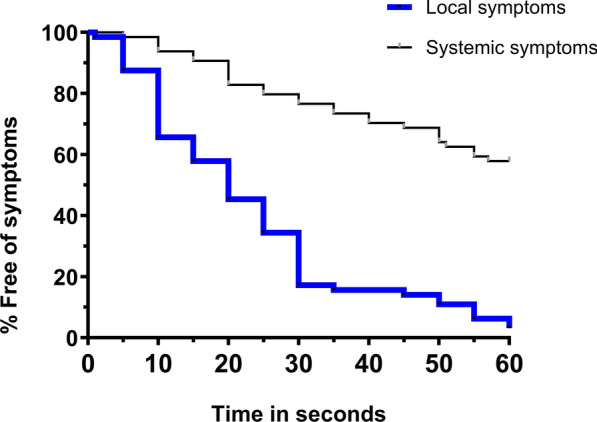
Of 154 patients evaluated during the study period, 64 (42%) met the eligibility criteria (61/64 female, median age 18 years [range, 13 to 50]). Of the 64, 50 (78%) had ME/CFS, 13 (20%) had idiopathic chronic fatigue with associated orthostatic intolerance (OI), and one had idiopathic chronic fatigue without OI. Of the 64, 58% had evidence of joint hypermobility. Local symptoms were provoked by EAST in 62/64 (97%) within a median of 20 s. During EAST, 26/64 (41%) reported systemic symptoms (1 had only systemic but no upper limb symptoms), most commonly lightheadedness (19%) and generalized fatigue (11%).
Even with an abbreviated test duration, the EAST maneuver provoked local and systemic symptoms in a substantial proportion of patients with chronic fatigue, OI, and ME/CFS who had reported difficulty with arms-overhead postures. Further studies are needed to explore the prevalence of brachial plexus or TOS symptoms in unselected individuals with ME/CFS or OI, and the proportion with systemic symptoms during and after EAST.
我们注意到,一些患有肌痛性脑脊髓炎/慢性疲劳综合征(ME/CFS)的青少年和年轻人报告称,进行手臂上举活动存在困难,这提示臂丛神经功能障碍或胸廓出口综合征(TOS)。在TOS的文献中,诊断手法主要关注上肢症状(手臂疲劳和沉重感、感觉异常、颈部和上背部疼痛)的激发,而非全身症状的引出。
评估在用于评估TOS的一项常用手法——抬高手臂压力测试(EAST)过程中,患有疲劳性疾病的患者出现局部和全身症状的比例。
如果患者在2020年1月至2023年7月期间被转诊至约翰霍普金斯慢性疲劳诊所,并且(a)报告难以维持手臂上举姿势,(b)接受了简化的1分钟EAST评估,(c)上肢、颈部或颅底未接受过手术,则符合这项回顾性研究的条件。改良EAST程序:患者坐在椅子上,手臂呈“举手”或“烛台”姿势,每2 - 3秒反复开合双手,持续1分钟,而非常规的3分钟。如果参与者在上肢、肩部、颈部、头部或上背部出现疼痛、疲劳、沉重感、感觉异常、发热或震颤,则该测试因局部症状被视为异常。如果参与者出现全身疲劳、认知模糊、头晕、心跳加速、出汗、呼吸困难、全身发热或恶心,则该测试因全身症状被视为异常。
在研究期间评估的154例患者中,64例(42%)符合纳入标准(61/64为女性,中位年龄18岁[范围,13至50岁])。在这64例患者中,50例(78%)患有ME/CFS,13例(20%)患有特发性慢性疲劳伴体位性不耐受(OI),1例患有无OI的特发性慢性疲劳。在这64例患者中,58%有关节活动过度的证据。62/64(97%)的患者在EAST过程中在中位时间20秒内出现局部症状。在EAST期间,26/64(41%)报告有全身症状(1例仅有全身症状但无上肢症状),最常见的是头晕(19%)和全身疲劳(11%)。
即使测试时间缩短,EAST手法仍在很大比例的报告有手臂上举姿势困难的慢性疲劳、OI和ME/CFS患者中引发了局部和全身症状。需要进一步研究来探讨在未经过选择的ME/CFS或OI个体中臂丛神经或TOS症状的患病率,以及在EAST期间和之后出现全身症状的比例。