van Campen C Linda M C, Rowe Peter C, Verheugt Freek W A, Visser Frans C
Stichting CardioZorg, Hoofddorp, Netherlands.
Department of Pediatrics, Johns Hopkins University School of Medicine, Baltimore, MD, United States.
Front Med (Lausanne). 2021 Jan 27;7:602894. doi: 10.3389/fmed.2020.602894. eCollection 2020.
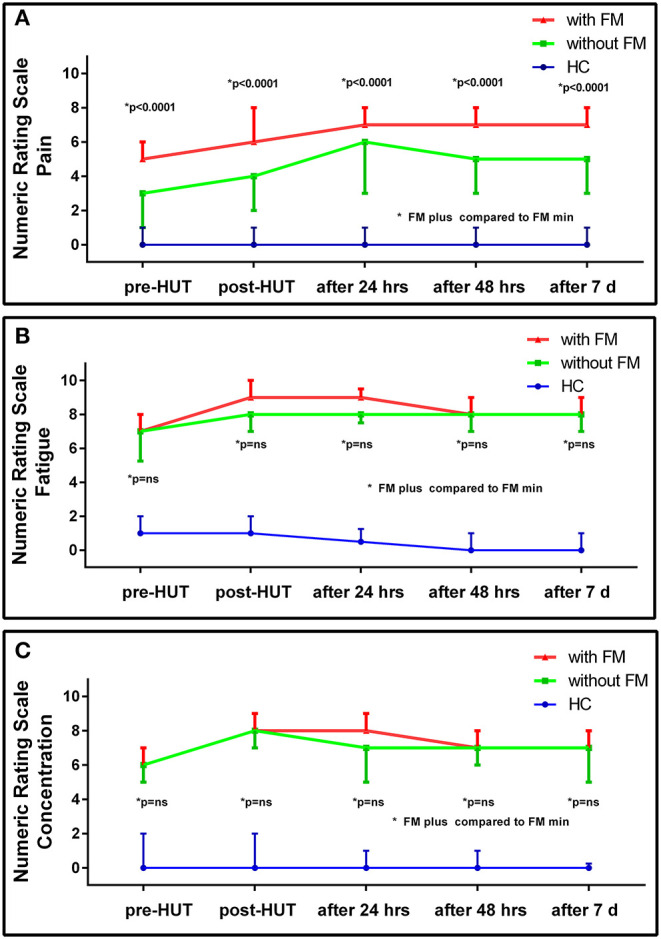
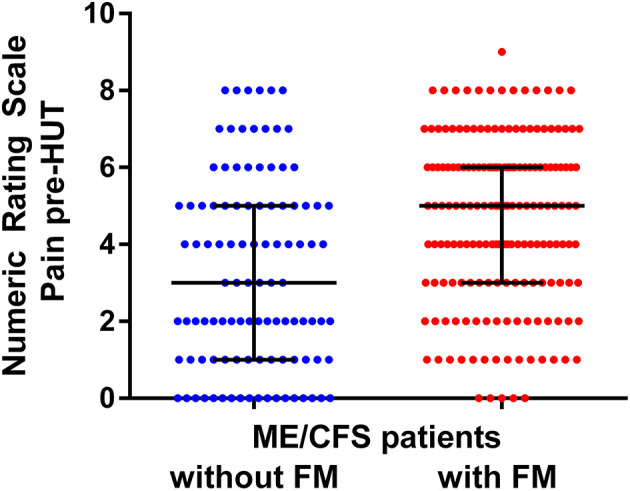
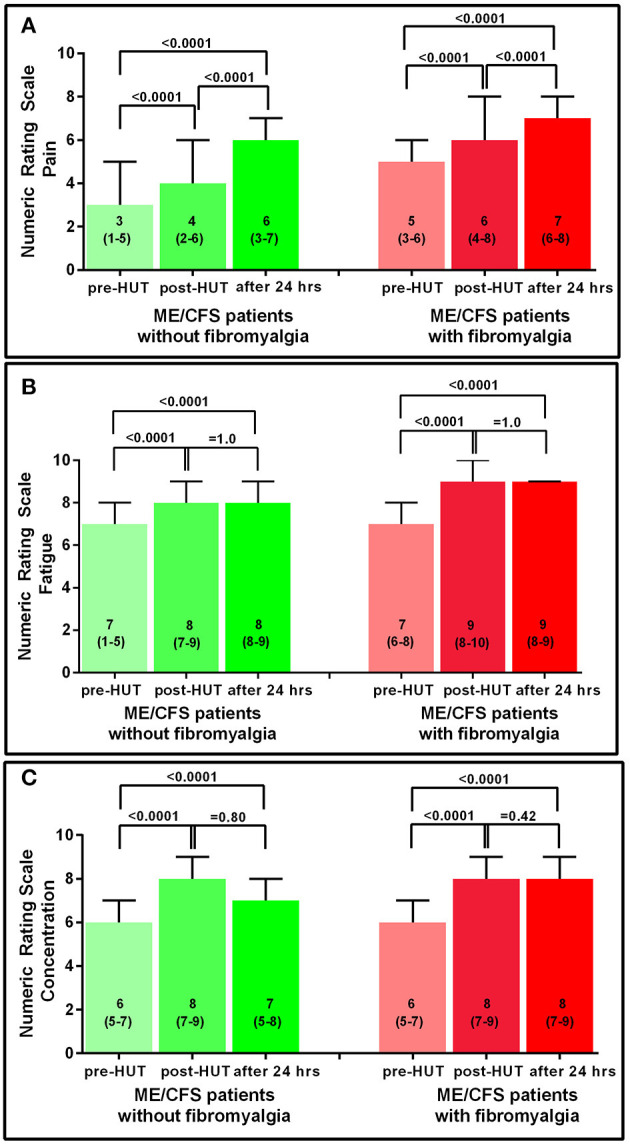
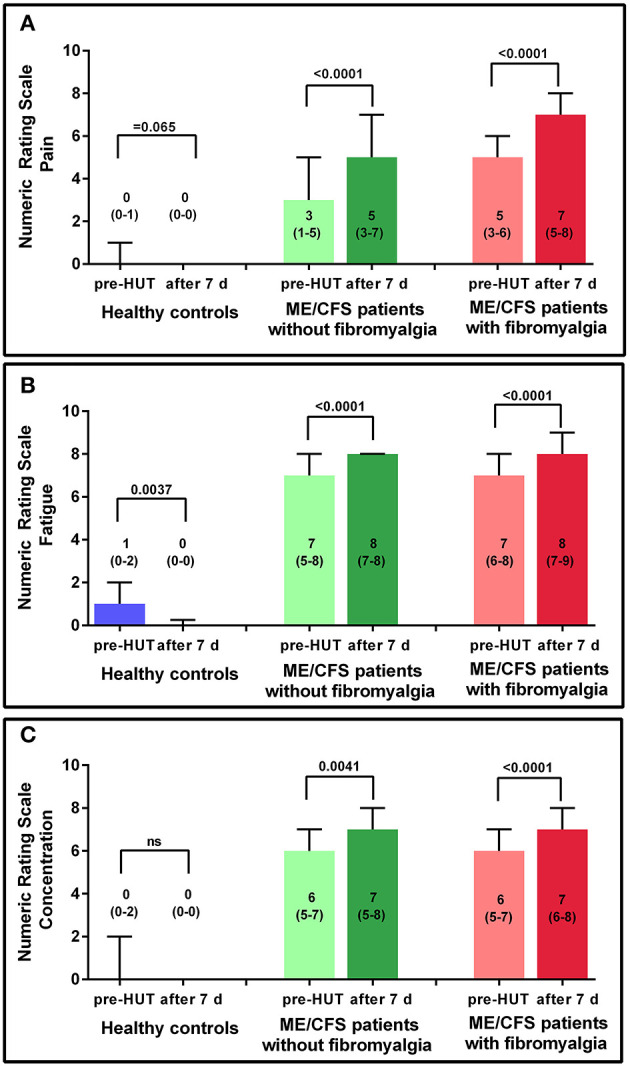
Muscle pain, fatigue, and concentration problems are common among individuals with myalgic encephalomyelitis/chronic fatigue syndrome (ME/CFS). These symptoms are commonly increased as part of the phenomenon of postexertional malaise (PEM). An increase in the severity of these symptoms is described following physical or mental exercise in ME/CFS patients. Another important symptom of ME/CFS is orthostatic intolerance, which can be detected by head-up tilt testing (HUT). The effect of HUT on PEM has not been studied extensively. For this purpose, we assessed numeric rating scales (NRS) for pain, fatigue, and concentration pre- and post-HUT. As pain is a core symptom in fibromyalgia (FM), we subgrouped ME/CFS patients by the presence or absence of FM. In eligible ME/CFS patients who underwent HUT, NRS of pain, fatigue, and concentration were obtained pre-HUT, immediately after HUT, at 24 and 48 h, and at 7 days posttest. We studied 174 ME/CFS patients with FM, 104 without FM, and 30 healthy controls (HC). Values for all symptoms were unchanged for HC pre- and post-HUT. Compared with pre-HUT, the three NRS post-HUT were significantly elevated in both ME/CFS patient groups even after 7 days. NRS pain was significantly higher at all time points measured in the ME/CFS patients with FM compared with those without FM. In ME/CFS patients, the maximum fatigue and concentration scores occurred directly post-HUT, whereas pain perception reached the maximum 24 h post-HUT. NRS scores of pain, fatigue, and concentration were significantly increased even at 7 days post-HUT compared with pre-HUT in ME/CFS patients with and without FM, suggesting that orthostatic stress is an important determinant of PEM.
肌肉疼痛、疲劳和注意力不集中问题在肌痛性脑脊髓炎/慢性疲劳综合征(ME/CFS)患者中很常见。这些症状通常会作为运动后不适(PEM)现象的一部分而加重。ME/CFS患者在进行体力或脑力锻炼后,这些症状的严重程度会增加。ME/CFS的另一个重要症状是直立性不耐受,可通过头高位倾斜试验(HUT)检测出来。HUT对PEM的影响尚未得到广泛研究。为此,我们评估了HUT前后疼痛、疲劳和注意力的数字评分量表(NRS)。由于疼痛是纤维肌痛(FM)的核心症状,我们根据是否存在FM对ME/CFS患者进行了分组。在接受HUT的符合条件的ME/CFS患者中,在HUT前、HUT后立即、24小时和48小时以及试验后7天获得疼痛、疲劳和注意力的NRS。我们研究了174例伴有FM的ME/CFS患者、104例不伴有FM的患者和30名健康对照(HC)。HC在HUT前后所有症状的值均未改变。与HUT前相比,两个ME/CFS患者组在HUT后的三个NRS即使在7天后也显著升高。在所有测量时间点,伴有FM的ME/CFS患者的NRS疼痛评分均显著高于不伴有FM的患者。在ME/CFS患者中,最大疲劳和注意力得分在HUT后立即出现,而疼痛感知在HUT后24小时达到最大值。伴有和不伴有FM的ME/CFS患者在HUT后7天的疼痛、疲劳和注意力NRS评分与HUT前相比仍显著增加,表明直立性应激是PEM的一个重要决定因素。