Seo Sumin, Jeong Do-Won, Sul Sooyoung, Lee Jong-Hoon
Department of Food Science and Biotechnology, Kyonggi University, Suwon 16227, Republic of Korea.
Department of Food and Nutrition, Dongduk Women's University, Seoul 02748, Republic of Korea.
J Microbiol Biotechnol. 2024 Dec 2;35:e2411038. doi: 10.4014/jmb.2411.11038.
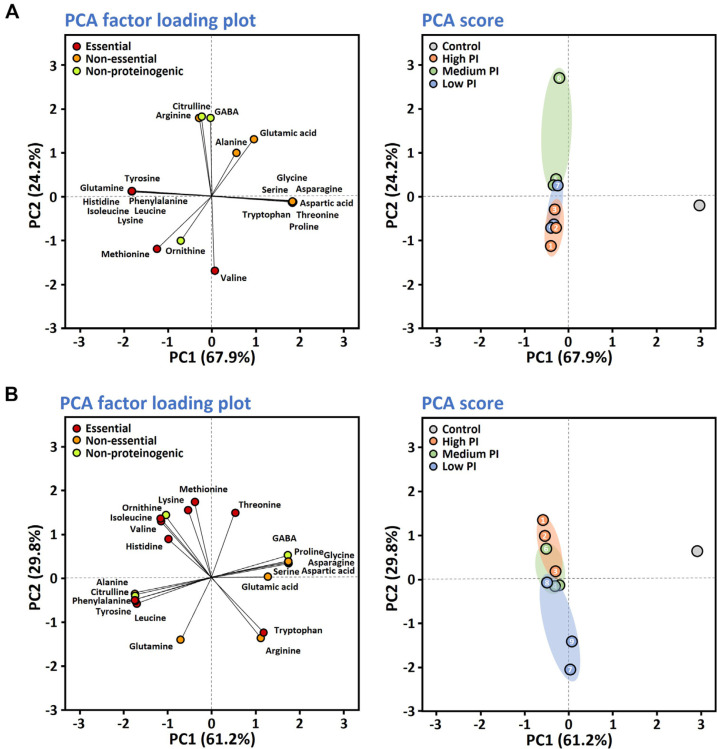
We compared the salt tolerance and proteolytic activity of 120 strains of each of , , and . Most strains exhibited growth in 12% (w/v) NaCl and showed proteolytic activity in 10% or 11% NaCl. The majority of strains grew in 14% NaCl and showed proteolytic activity in 12% or 13% NaCl. Most strains grew in 14% NaCl and exhibited proteolytic activity in 5%-7% NaCl. We selected nine representative strains of each species based on their proteolytic activities and analyzed the free amino acid (FAA) profiles produced by culture of the bacteria on soybean. Statistical analyses of the 22 FAAs quantified in the cultures revealed clustering of FAA production profiles at the species level. The FAA production profiles of and were similar, and both differed from that of . These trends persisted in cultures containing 7% NaCl. These results suggest that FAA production profiles are characteristic of each species. Specifically, in soybean cultures compared with uninoculated soybeans, increased the amounts of leucine and phenylalanine; increased the amounts of leucine, phenylalanine, and tyrosine; and increased the amounts of alanine, glutamic acid, tyrosine, and ornithine, and dramatically decreased the amount of arginine. The proteolytic activity of strains correlated with the quantity of FAAs in their soybean cultures. Considering its salt tolerance and proteolytic activity, showed high potential for contributing to the ripening of high-salt fermented soybean foods. Our results regarding the specific production of amino acids at the species level and correlations between proteolytic activities and produced amino acid quantities will facilitate the determination and selection of target strains for functional -fermented foods.
我们比较了[具体菌种1]、[具体菌种2]和[具体菌种3]各120株菌株的耐盐性和蛋白水解活性。大多数[具体菌种1]菌株能在12%(w/v)NaCl中生长,并在10%或11% NaCl中表现出蛋白水解活性。大多数[具体菌种2]菌株能在14% NaCl中生长,并在12%或13% NaCl中表现出蛋白水解活性。大多数[具体菌种3]菌株能在14% NaCl中生长,并在5%-7% NaCl中表现出蛋白水解活性。我们根据其蛋白水解活性从每个菌种中挑选了9株具有代表性的菌株,并分析了这些细菌在大豆上培养所产生的游离氨基酸(FAA)谱。对培养物中定量的22种FAA进行的统计分析表明,FAA产生谱在菌种水平上聚类。[具体菌种1]和[具体菌种2]的FAA产生谱相似,且均与[具体菌种3]的不同。这些趋势在含有7% NaCl的培养物中依然存在。这些结果表明,FAA产生谱是每个[具体菌种]的特征。具体而言,与未接种大豆的大豆培养物相比,[具体菌种1]增加了亮氨酸和苯丙氨酸的含量;[具体菌种2]增加了亮氨酸、苯丙氨酸和酪氨酸的含量;[具体菌种3]增加了丙氨酸、谷氨酸、酪氨酸和鸟氨酸的含量,并显著降低了精氨酸的含量。[具体菌种3]菌株的蛋白水解活性与其大豆培养物中FAA的量相关。考虑到其耐盐性和蛋白水解活性,[具体菌种3]在促进高盐发酵大豆食品成熟方面具有很高的潜力。我们关于菌种水平上氨基酸的特定产生以及蛋白水解活性与产生的氨基酸量之间相关性的结果,将有助于确定和选择功能性[具体菌种]发酵食品的目标菌株。