
用于识别通过体外微电极阵列记录的癫痫样模式的时间序列分割
Time series segmentation for recognition of epileptiform patterns recorded via microelectrode arrays in vitro.
作者信息
Galeote-Checa Gabriel, Panuccio Gabriella, Canal-Alonso Angel, Linares-Barranco Bernabe, Serrano-Gotarredona Teresa
机构信息
Instituto de Microelectrónica de Sevilla (IMSE-CNM), Consejo Superior de Investigaciones Científicas (CSIC) and Universidad de Sevilla, Sevilla, Spain.
Enhanced Regenerative Medicine Lab, Instituto Italiano di Tecnologia, Genoa, Italy.
出版信息
PLoS One. 2025 Jan 24;20(1):e0309550. doi: 10.1371/journal.pone.0309550. eCollection 2025.
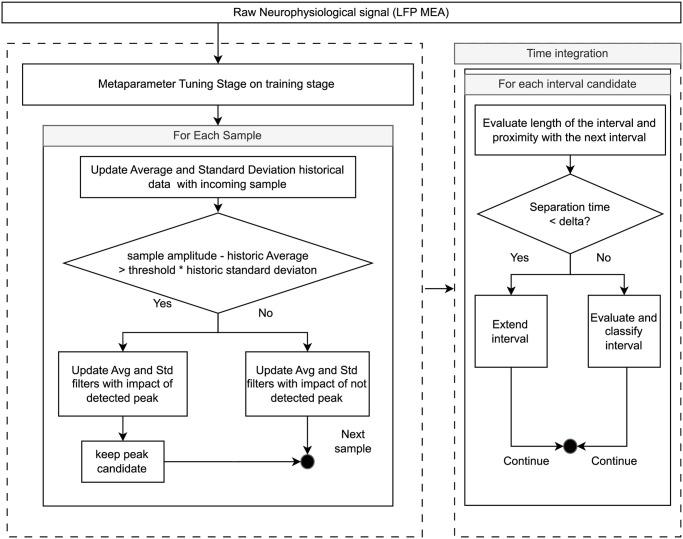
Epilepsy is a prevalent neurological disorder that affects approximately 1% of the global population. Approximately 30-40% of patients respond poorly to antiepileptic medications, leading to a significant negative impact on their quality of life. Closed-loop deep brain stimulation (DBS) is a promising treatment for individuals who do not respond to medical therapy. To achieve effective seizure control, algorithms play an important role in identifying relevant electrographic biomarkers from local field potentials (LFPs) to determine the optimal stimulation timing. In this regard, the detection and classification of events from ongoing brain activity, while achieving low power consumption through computationally inexpensive implementations, represents a major challenge in the field. To address this challenge, we here present two algorithms, the ZdensityRODE and the AMPDE, for identifying relevant events from LFPs by utilizing time series segmentation (TSS), which involves extracting different levels of information from the LFP and relevant events from it. The algorithms were validated validated against epileptiform activity induced by 4-aminopyridine in mouse hippocampus-cortex (CTX) slices and recorded via microelectrode array, as a case study. The ZdensityRODE algorithm showcased a precision and recall of 93% for ictal event detection and 42% precision for interictal event detection, while the AMPDE algorithm attained a precision of 96% and recall of 90% for ictal event detection and 54% precision for interictal event detection. While initially trained specifically for detecting ictal activity, these algorithms can be fine-tuned for improved interictal detection, aiming at seizure prediction. Our results suggest that these algorithms can effectively capture epileptiform activity, supporting seizure detection and, possibly, seizure prediction and control. This opens the opportunity to design new algorithms based on this approach for closed-loop stimulation devices using more elaborate decisions and more accurate clinical guidelines.
癫痫是一种常见的神经系统疾病,影响着全球约1%的人口。约30-40%的患者对抗癫痫药物反应不佳,这对他们的生活质量产生了重大负面影响。闭环深部脑刺激(DBS)是一种对药物治疗无反应的个体有前景的治疗方法。为了实现有效的癫痫发作控制,算法在从局部场电位(LFP)中识别相关的电图生物标志物以确定最佳刺激时机方面发挥着重要作用。在这方面,从持续的脑活动中检测和分类事件,同时通过计算成本低的实现方式实现低功耗,是该领域的一个重大挑战。为了应对这一挑战,我们在此提出两种算法,即ZdensityRODE和AMPDE,用于通过利用时间序列分割(TSS)从LFP中识别相关事件,这涉及从LFP中提取不同层次的信息以及从中提取相关事件。作为一个案例研究,这些算法针对由4-氨基吡啶在小鼠海马-皮层(CTX)切片中诱导并通过微电极阵列记录的癫痫样活动进行了验证。ZdensityRODE算法在发作期事件检测中的精度和召回率为93%,在发作间期事件检测中的精度为42%,而AMPDE算法在发作期事件检测中的精度为96%,召回率为90%,在发作间期事件检测中的精度为54%。虽然这些算法最初是专门为检测发作期活动而训练的,但可以进行微调以改善发作间期检测,目标是癫痫发作预测。我们的结果表明,这些算法可以有效地捕捉癫痫样活动,支持癫痫发作检测,并且可能支持癫痫发作预测和控制。这为基于这种方法设计用于闭环刺激设备的新算法提供了机会,这些算法使用更精细的决策和更准确的临床指南。




 Zotero 插件