Chen Gongwei, Zhang Dandan, Chen Fengyuan, Zhou Yixiao, Cai Hongyu, Gu Heng, Yue Yuanzheng, Wang Lianggui, Liu Guohua
School of Landscape Architecture, Jiangsu Vocational College of Agriculture and Forestry, No. 19 Wenchang East Road, Jurong, 212400, China.
Key Laboratory of Landscape Architecture, College of Landscape Architecture, Nanjing Forestry University, No. 159 Longpan Road, Nanjing, 210037, China.
Sci Rep. 2025 Jan 24;15(1):3036. doi: 10.1038/s41598-025-86328-w.
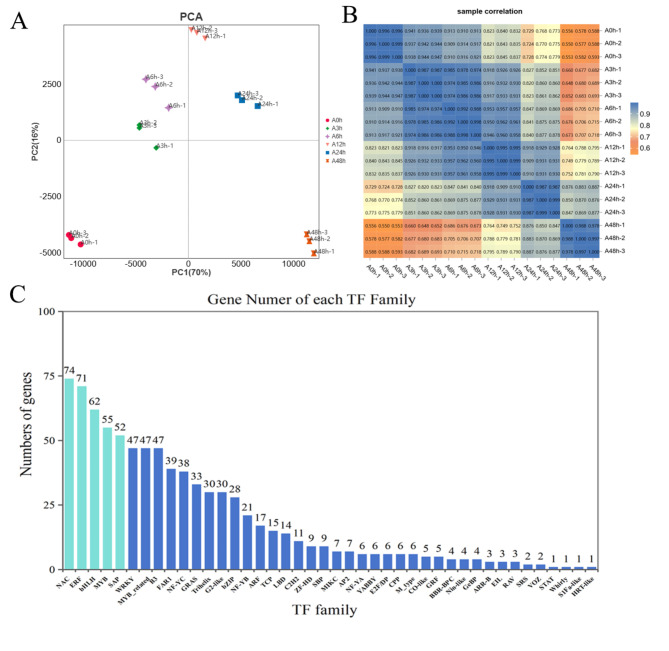
Acer fabri is an excellent color-leaf tree species, with high ornamental value. Low temperatures are known to limit the growth and geographical distribution of A. fabri. The molecular mechanism of A. fabri in response to low-temperature stress was rarely reported. To understand the molecular mechanism of A. fabri in response to low-temperature stress, relevant physiological changes were identified and the transcriptome sequencing was conducted under different stress durations. The results showed that the proline, the soluble sugar (SS) and the soluble protein (SP) content increased in A. fabri leaves under low-temperature stress, while the peroxidase (POD) and activating superoxide dismutase (SOD) activity increased first and then decreased. It was also found by the OPLS-DA analysis that SOD is the most important physiological indicator of A. fabri in response to low-temperature stress. By transcriptome sequencing, a total of 56,732 genes were identified, including 832 transcription factors (TFs). Differentially expressed genes (DEGs) were significantly enriched in metabolic pathways, phytohormone signaling, and plant mitogen-activated protein kinase (MAPK) signaling pathways. Moreover, the analysis of gene co-expression networks, specifically weighted gene co-expression network analysis (WGCNA), indicates that Af0048792 and Af0026061 could be significant in the response to stress from low temperatures. Furthermore, it was observed that NAC (Af0033429) and MIKC (Af0004917) might have interactions with Af0048792, and MIKC (Af0004917) may additionally interact with Af0026061. These findings could enhance our understanding of the molecular mechanisms of A. fabri in response to low-temperature stress.
罗浮槭是一种优良的彩叶树种,具有较高的观赏价值。已知低温会限制罗浮槭的生长和地理分布。关于罗浮槭响应低温胁迫的分子机制鲜有报道。为了解罗浮槭响应低温胁迫的分子机制,鉴定了相关生理变化,并在不同胁迫持续时间下进行了转录组测序。结果表明,低温胁迫下罗浮槭叶片中脯氨酸、可溶性糖(SS)和可溶性蛋白(SP)含量增加,而过氧化物酶(POD)和活性超氧化物歧化酶(SOD)活性先升高后降低。通过OPLS-DA分析还发现,SOD是罗浮槭响应低温胁迫最重要的生理指标。通过转录组测序,共鉴定出56732个基因,其中包括832个转录因子(TFs)。差异表达基因(DEGs)在代谢途径、植物激素信号传导和植物丝裂原活化蛋白激酶(MAPK)信号传导途径中显著富集。此外,基因共表达网络分析,特别是加权基因共表达网络分析(WGCNA)表明Af0048792和Af0026061在响应低温胁迫中可能具有重要作用。此外,观察到NAC(Af0033429)和MIKC(Af0004917)可能与Af0048792相互作用,并且MIKC(Af0004917)可能还与Af0026061相互作用。这些发现有助于我们加深对罗浮槭响应低温胁迫分子机制的理解。