Atieh Ornina, Daher Joviane, Durieux Jared C, Abboud Marc, Labbato Danielle, Baissary Jhony, Koberssy Ziad, Ailstock Kate, Cummings Morgan, Funderburg Nicholas T, McComsey Grace A
School of Medicine, Case Western Reserve University, Cleveland, OH 44106, USA.
Clinical Research Center, University Hospitals Cleveland Medical Center, Cleveland, OH 44106, USA.
Nutrients. 2025 Jan 16;17(2):304. doi: 10.3390/nu17020304.
Long COVID (LC) is characterized by persistent symptoms at least 3 months after a SARS-COV-2 infection. LC has been associated with fungal translocation, gut dysfunction, and enhanced systemic inflammation. Currently, there is no approved treatment for this condition. The anti-inflammatory effect of vitamins K2 and D3 was shown to help attenuate the course of acute COVID-19 infection.
This trial aims to investigate the effects of vitamins K2/D3 on LC symptoms, as well as gut and inflammatory markers, in people with established long COVID. Our hypothesis is that by attenuating systemic inflammation, vitamins K2/D3 will improve long COVID symptoms.
This single-site randomized controlled study enrolled adults experiencing ≥2 moderate LC symptoms at least 3 months after a COVID-19 infection. The RECOVER Long COVID Research Index and number and type of LC symptoms were considered. Participants were randomized 2:1 to daily 240 µg K2 (pure MK-7 form) and 2000 UI vitamin D3 or standard of care (SOC) for 24 weeks. The endpoints were changes in symptomatology and in select inflammatory, metabolic, and gut biomarkers at 24 weeks.
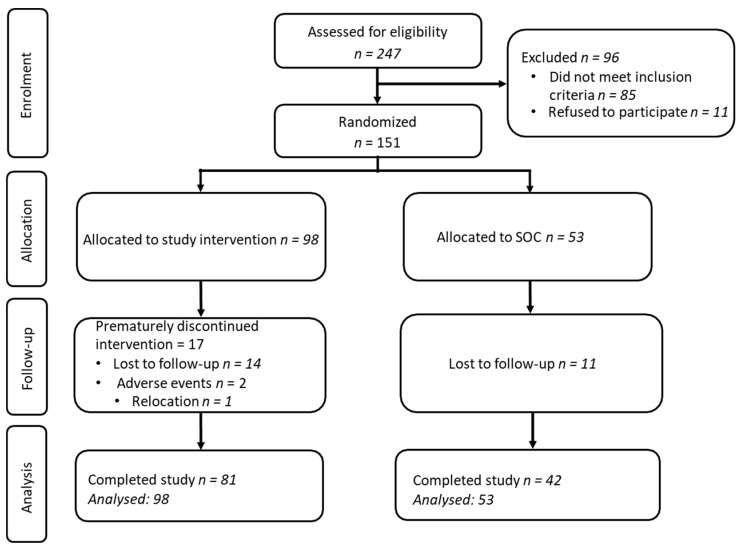
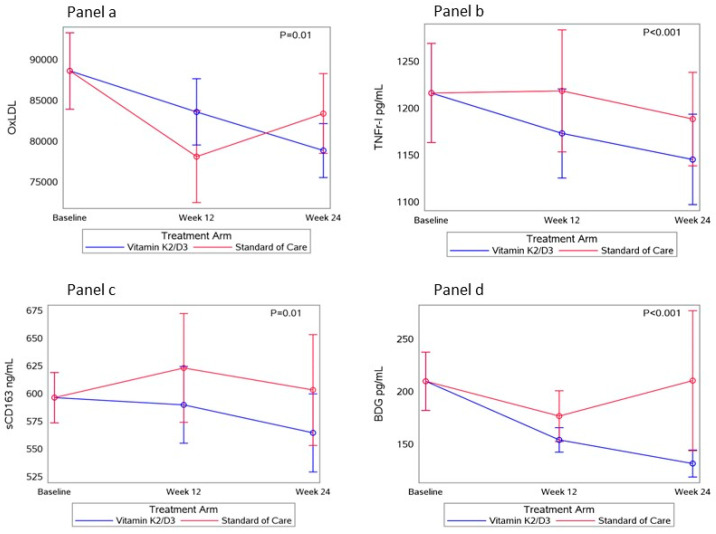
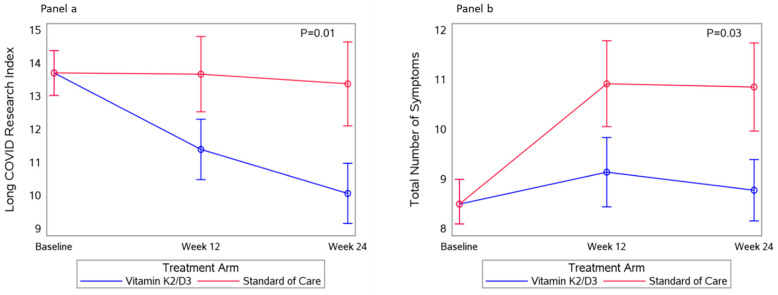
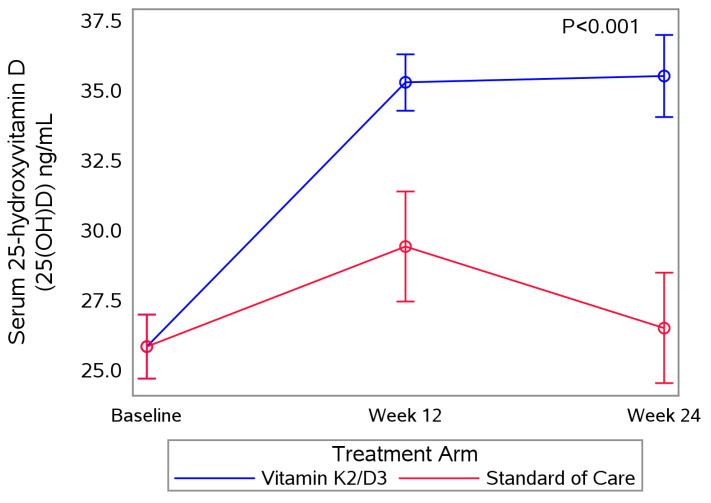
We enrolled 151 participants ( = 98 received vit K2/D3 and 53 received SOC). The median age was 46 years; 71% were female and 29% were non-white. Baseline demographics were balanced between groups. At 24 weeks, the active treatment group only had a sharp increase in 25(OH) D, indicating good treatment adherence. In the vitamin K2/D3 arm, there was a 7.1% decrease in the proportion who had an LC Index ≥12 (vs. a 7.2% increase in the SOC group; = 0.01). The average number of LC symptoms remained stable in the vitamin K2/D3 arm but increased in the SOC arm ( = 0.03). Additionally, reductions in oxidized LDL, inflammatory markers sTNF-RI and sCD163, and fungal translocation marker (1,3)-β-d-glucan were observed in the vitamin K2/D3 arm compared to the SOC arm ( < 0.01) over 24 weeks.
Vitamins K2/D3 improved the RECOVER Long COVID Index, the number of LC symptoms, and several gut and inflammatory markers. Vitamins K2/D3 provide a promising safe intervention for people suffering from long COVID.
长期新冠(LC)的特征是在感染SARS-CoV-2后至少3个月出现持续症状。长期新冠与真菌易位、肠道功能障碍及全身炎症增强有关。目前,针对这种情况尚无获批的治疗方法。维生素K2和D3的抗炎作用已被证明有助于减轻急性新冠感染的病程。
本试验旨在研究维生素K2/D3对已确诊长期新冠患者的LC症状以及肠道和炎症标志物的影响。我们的假设是,通过减轻全身炎症,维生素K2/D3将改善长期新冠症状。
这项单中心随机对照研究纳入了在新冠感染后至少3个月出现≥2种中度LC症状的成年人。考虑了RECOVER长期新冠研究指数以及LC症状的数量和类型。参与者按2:1随机分组,分别每日服用240μg K2(纯MK-7形式)和2000IU维生素D3或接受标准治疗(SOC),为期24周。终点指标是24周时症状学以及某些炎症、代谢和肠道生物标志物的变化。
我们招募了151名参与者(98人接受维生素K2/D3治疗,53人接受SOC治疗)。中位年龄为46岁;71%为女性,29%为非白人。两组之间的基线人口统计学特征均衡。在24周时,活性治疗组的25(OH)D仅急剧增加,表明治疗依从性良好。在维生素K2/D3组中,LC指数≥12的比例下降了7.1%(而SOC组增加了7.2%;P = 0.01)。维生素K2/D3组中LC症状的平均数量保持稳定,而SOC组有所增加(P = 0.03)。此外,与SOC组相比,在24周内维生素K2/D3组中氧化型低密度脂蛋白、炎症标志物sTNF-RI和sCD163以及真菌易位标志物(1,3)-β-d-葡聚糖均有所降低(P < 0.01)。
维生素K2/D3改善了RECOVER长期新冠指数、LC症状数量以及几种肠道和炎症标志物。维生素K2/D3为长期新冠患者提供了一种有前景的安全干预措施。