Diergaarde Brenda, Young Greg, Hall David W, Mazloom Amin, Costa Gina L, Subramaniam Soma, Palomares Melanie R, Garces Jorge, Baehner Frederick L, Schoen Robert E
Department of Human Genetics, School of Public Health, University of Pittsburgh, UPMC Hillman Cancer Center, Pittsburgh, Pennsylvania, USA.
Exact Sciences Corporation, Madison, Wisconsin, USA.
J Surg Oncol. 2025 Jul;132(1):175-186. doi: 10.1002/jso.27989. Epub 2025 Jan 25.
Identification of colorectal cancer (CRC) patients at high risk of recurrence could be of substantial clinical use. We evaluated the association of ctDNA status, using a tumor-informed assay, with recurrence-free survival (RFS).
Stage III CRC patients were enrolled between 2016 and 2020. Tumor tissue and serial (every 3 months for years 1-3, biannually for years 4-5) blood samples were collected. Utilizing whole-exome sequencing and selection of 50-200 variants for tumor informed assays, ctDNA status was determined using plasma cell-free DNA.
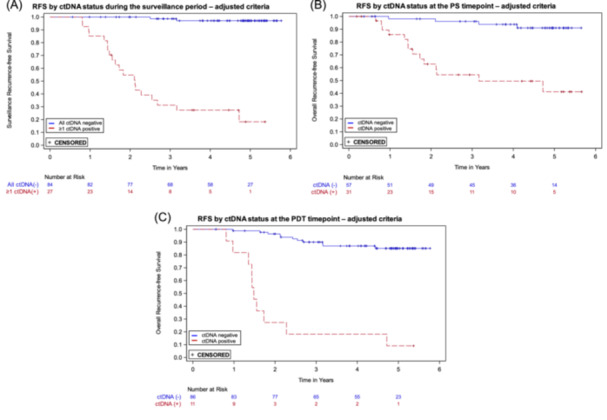
Of 137 patients enrolled, 124 with 1029 ctDNA results were included in the analyses. Median follow-up was 4.8 years. Plasma ctDNA status was strongly associated with risk of recurrence during the surveillance period (hazard ratio (HR) 49.6, 95% CI: 16.6-148.3; p < 0.0001), and at the postsurgical (HR 9.6, 95% CI: 3.2-29.5) and postdefinitive therapy timepoints (HR: 16.7, 95% CI: 6.9-40.3). The estimated 3-year RFS for ctDNA positive and ctDNA negative patients were, respectively, 54.5% and 96.1% after surgery, and 18.2% and 90.0% after definitive therapy. Multivariable analysis indicated ctDNA but not CEA was strongly prognostic for recurrence.
Our tumor-informed ctDNA assay was strongly prognostic for recurrence in patients with stage III colorectal cancer at all timepoints.
识别具有高复发风险的结直肠癌(CRC)患者可能具有重大临床意义。我们使用肿瘤个体化检测方法评估了循环肿瘤DNA(ctDNA)状态与无复发生存期(RFS)之间的关联。
2016年至2020年期间纳入III期CRC患者。收集肿瘤组织和系列(第1 - 3年每3个月一次,第4 - 5年每半年一次)血样。利用全外显子测序并选择50 - 200个变异用于肿瘤个体化检测,通过血浆游离DNA确定ctDNA状态。
纳入的137例患者中,124例有1029份ctDNA检测结果纳入分析。中位随访时间为4.8年。血浆ctDNA状态与监测期内的复发风险密切相关(风险比(HR)49.6,95%置信区间:16.6 - 148.3;p < 0.0001),以及术后(HR 9.6,95%置信区间:3.2 - 29.5)和根治性治疗后时间点(HR:16.7,95%置信区间:6.9 - 40.3)。ctDNA阳性和ctDNA阴性患者术后估计的3年无复发生存率分别为54.5%和96.1%,根治性治疗后分别为18.2%和90.0%。多变量分析表明ctDNA而非癌胚抗原(CEA)对复发具有强烈的预后价值。
我们的肿瘤个体化ctDNA检测方法在所有时间点对III期结直肠癌患者的复发均具有强烈的预后价值。