Komada Yoko, Kawakami Sho-Ichi, Furuie Satoko, Mori Rena, Ikegami Azusa
School of Environment and Society, Institute of Science Tokyo, Tokyo, Japan.
Fukuda Hospital, Kumamoto, Japan.
J Obstet Gynaecol Res. 2025 Feb;51(2):e16219. doi: 10.1111/jog.16219.
Pregnancy-related anatomic, physiologic, and hormonal factors can occur at different stages of pregnancy and affect sleep disturbances. The relationship between sleep problems during pregnancy and postpartum depressive symptoms as well as neonatal condition at delivery have not been well described. This study hypothesized that sleep problems are associated with postpartum depressive symptoms and adverse neonatal outcomes at delivery.
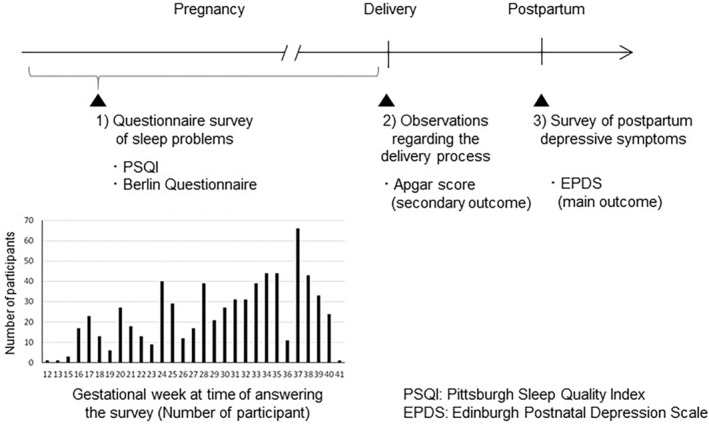
This study conducted a prospective study for perinatal women (n = 683, 30.54 ± 5.11 years old) to evaluate sleep problems during pregnancy using the Pittsburgh sleep quality index (PSQI) and Berlin questionnaire, postpartum depressive symptoms using Edinburgh postnatal depression scale (EPDS), and clinical signs of neonatal condition at delivery using the Apgar score.
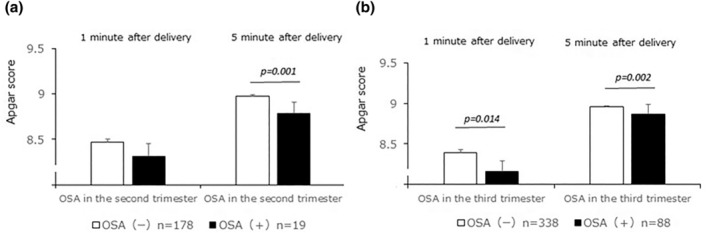
PSQI total score during pregnancy were significantly higher in those with postpartum depressive symptoms than those without 1 month after delivery. PSQI score in the third trimester was significantly associated with postpartum depressive symptoms even after adjustment for relevant confounding factors and self-reported lifetime depression (odds ratio = 1.19, 95% confidence interval = 1.03-1.36, p = 0.015). The Apgar score at 5 min after birth was significantly lower in those with obstructive sleep apnea (OSA) than those without OSA in the second and third trimesters, although mean scores were within the normal range.
This study revealed that sleep problems during pregnancy influence postpartum depression 1 month after delivery. OSA during pregnancy may lead to risks of delivery. Attention should be paid to sleep health during pregnancy to ensure the mental health of mothers and a safe delivery.
与妊娠相关的解剖、生理和激素因素可在妊娠的不同阶段出现,并影响睡眠障碍。妊娠期间睡眠问题与产后抑郁症状以及分娩时新生儿状况之间的关系尚未得到充分描述。本研究假设睡眠问题与产后抑郁症状以及分娩时不良新生儿结局有关。
本研究对围产期妇女(n = 683,年龄30.54±5.11岁)进行了一项前瞻性研究,使用匹兹堡睡眠质量指数(PSQI)和柏林问卷评估妊娠期间的睡眠问题,使用爱丁堡产后抑郁量表(EPDS)评估产后抑郁症状,并使用阿普加评分评估分娩时新生儿状况的临床体征。
产后抑郁症状的妇女产后1个月时妊娠期间的PSQI总分显著高于无产后抑郁症状的妇女。即使在调整了相关混杂因素和自我报告的终生抑郁后,孕晚期的PSQI评分仍与产后抑郁症状显著相关(比值比=1.19,95%置信区间=1.03 - 1.36,p = 0.015)。尽管平均评分在正常范围内,但在妊娠第二和第三阶段,患有阻塞性睡眠呼吸暂停(OSA)的妇女出生后5分钟时的阿普加评分显著低于无OSA的妇女。
本研究表明,妊娠期间的睡眠问题会影响产后1个月的抑郁情况。妊娠期间的OSA可能会导致分娩风险。应关注妊娠期间的睡眠健康,以确保母亲的心理健康和安全分娩。