Lao Zhoujie, Tao Kehao, Xiao Xiao, Qu Haotian, Wu Xinru, Han Zhiyuan, Gao Runhua, Wang Jian, Wu Xian, Chen An, Shi Lei, Chang Chengshuai, Song Yanze, Wang Xiangyu, Li Jinjin, Zhu Yanfei, Zhou Guangmin
Shenzhen Geim Graphene Center, Tsinghua-Berkeley Shenzhen Institute & Tsinghua Shenzhen International Graduate School, Tsinghua University, Shenzhen, P. R. China.
National Key Laboratory of Advanced Micro and Nano Manufacture Technology, Shanghai Jiao Tong University, Shanghai, China.
Nat Commun. 2025 Jan 27;16(1):1075. doi: 10.1038/s41467-024-55633-9.
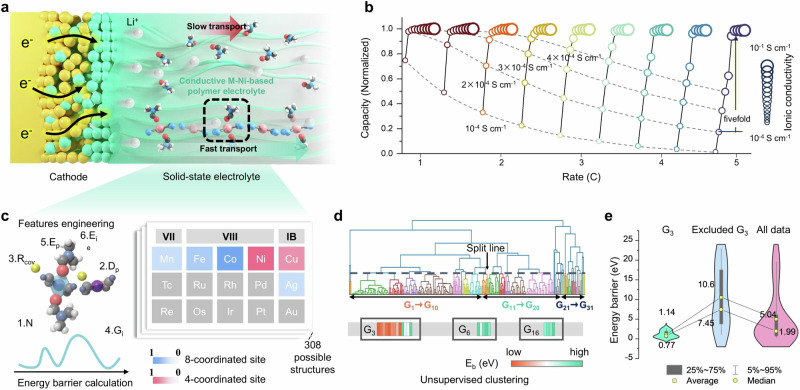
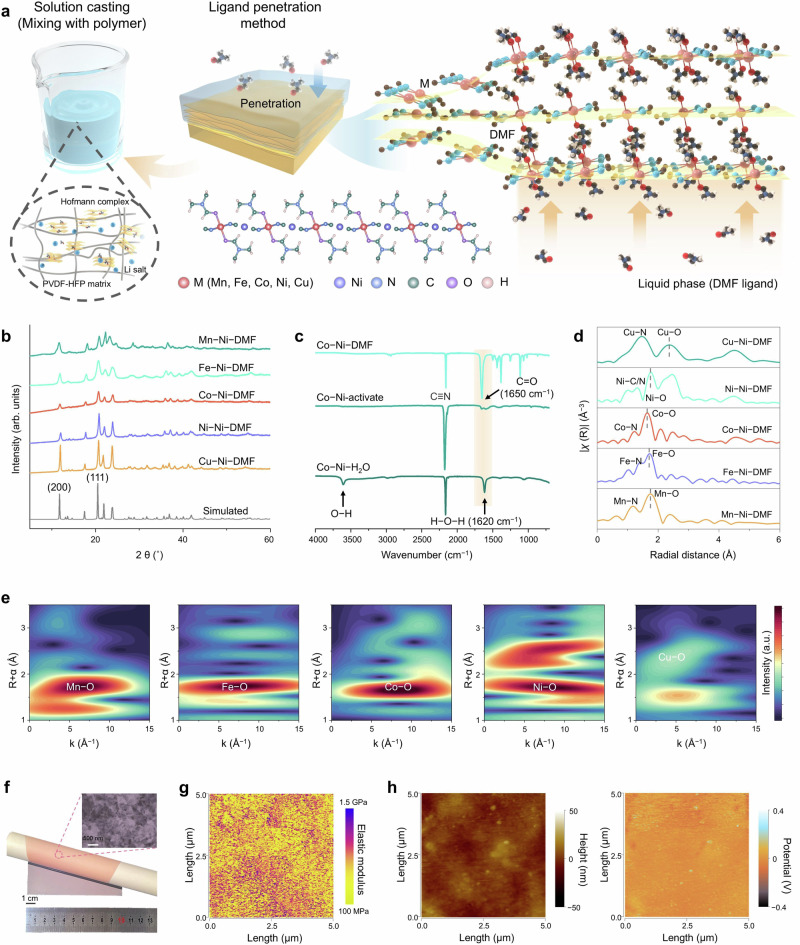
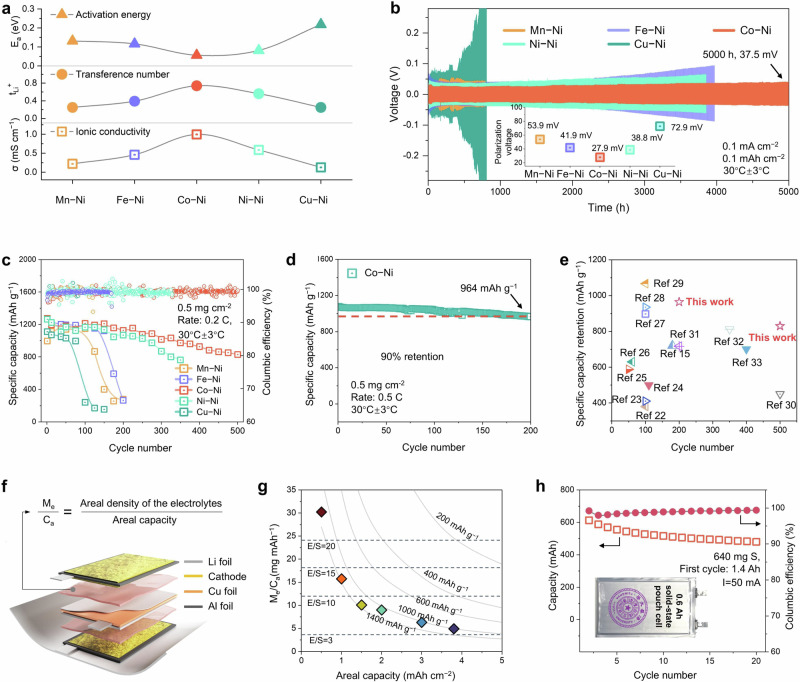
The unsatisfactory ionic conductivity of solid polymer electrolytes hinders their practical use as substitutes for liquid electrolytes to address safety concerns. Although various plasticizers have been introduced to improve lithium-ion conduction kinetics, the lack of microenvironment understanding impedes the rational design of high-performance polymer electrolytes. Here, we design a class of Hofmann complexes that offer continuous two-dimensional lithium-ion conduction channels with functional ligands, creating highly conductive electrolytes. Assisting with unsupervised learning, we use Climbing Image-Nudged Elastic Band simulations to screen lithium-ion conductors and screen out five potential candidates that elucidate the impact of lithium coordination environment on conduction behavior. By adjusting the covalency competition between Metal-O and Li-O bonds within Hofmann complexes, we can manipulate weak coordination environment of lithium-ion for rapid conduction kinetics. Li | |sulfurized polyacrylonitrile (SPAN) cell using solid-state polymer electrolytes with predicted Co(dimethylformamide)Ni(CN) delivers an initial discharge capacity of 1264 mAh g with a capacity retention of 65% after 500 cycles at 0.2 C (335 mA g), at 30 °C ± 3 °C. The assembled 0.6 Ah Li | |SPAN pouch cell delivers an areal discharge capacity of 3.8 mAh cm at the second cycle with a solid electrolyte areal mass loading of 18.6 mg cm (mass-to-capacity ratio of 4.9).
固体聚合物电解质不理想的离子电导率阻碍了它们作为液体电解质替代品以解决安全问题的实际应用。尽管已引入各种增塑剂来改善锂离子传导动力学,但对微环境缺乏了解阻碍了高性能聚合物电解质的合理设计。在此,我们设计了一类霍夫曼配合物,其通过功能性配体提供连续的二维锂离子传导通道,从而制得高导电性电解质。借助无监督学习,我们使用爬山图像推挤弹性带模拟来筛选锂离子导体,并筛选出五个潜在候选物,以阐明锂配位环境对传导行为的影响。通过调节霍夫曼配合物中金属 - 氧键和锂 - 氧键之间的共价竞争,我们可以操控锂离子的弱配位环境以实现快速传导动力学。使用预测的Co(二甲基甲酰胺)Ni(CN)的固态聚合物电解质的锂||硫化聚丙烯腈(SPAN)电池在30°C±3°C下以0.2 C(335 mA g)进行500次循环后,初始放电容量为1264 mAh g,容量保持率为65%。组装的0.6 Ah锂||SPAN软包电池在第二个循环时的面积放电容量为3.8 mAh cm,固体电解质的面积质量负载为18.6 mg cm(质量与容量比为4.9)。