Roamcharern Napaporn, Matthew Saphia A L, Brady Daniel J, Parkinson John A, Rattray Zahra, Seib F Philipp
Strathclyde Institute of Pharmacy and Biomedical Sciences, University of Strathclyde, 161 Cathedral St., Glasgow G4 0RE,Scotland,U.K.
Branch Bioresources, Fraunhofer Institute for Molecular Biology and Applied Ecology, Ohlebergsweg 12, Giessen 35392, Germany.
ACS Biomater Sci Eng. 2025 Mar 10;11(3):1847-1856. doi: 10.1021/acsbiomaterials.4c02175. Epub 2025 Jan 30.
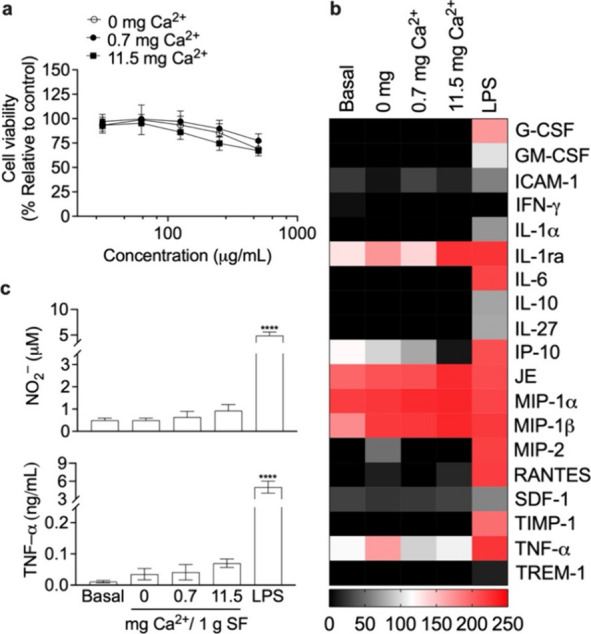
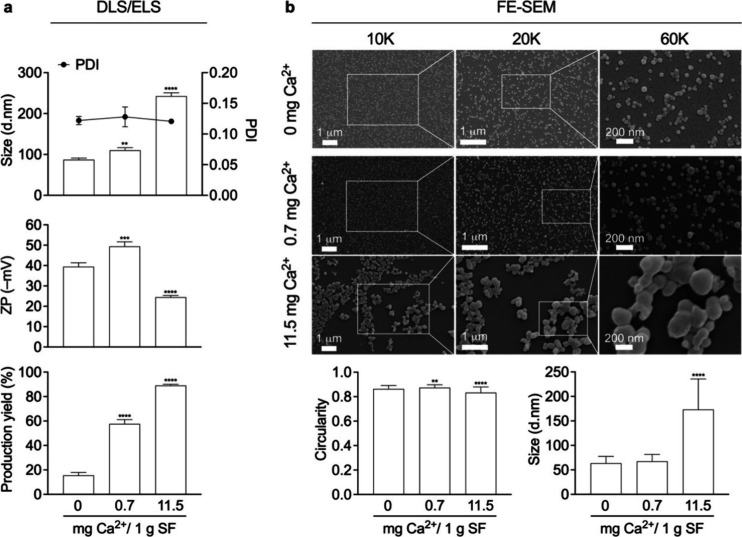
Silk has emerged as an interesting candidate among protein-based nanocarriers due to its favorable properties, including biocompatibility and a broad spectrum of processing options to tune particle critical quality attributes. The silk protein conformation during storage in the middle silk gland of the silkworm is modulated by various factors, including the most abundant metallic ion, calcium ion (Ca). Here, we report spiking of liquid silk with calcium ions to modulate the silk nanoparticle size. Conformational and structural analyses of silk demonstrated Ca-induced silk assemblies that resulted in a liquid crystalline-like state, with the subsequent generation of β-sheet-enriched silk nanoparticles. Thioflavin T studies demonstrated that Ca effectively induces self-assembly and conformation changes that also increased model drug loading. Ca incorporation in the biopolymer feed significantly increased the nanoparticle production yield from 16 to 89%, while simultaneously enabling Ca concentration-dependent particle-size tuning with a narrow polydispersity index and altered zeta potential. The resulting silk nanoparticles displayed high biocompatibility in macrophages with baseline levels of cytotoxicity and cellular inflammation. Our strategy for manufacturing biomimetic silk nanoparticles enabled overall tuning of particle size and improved yields─features that are critical for particle-based nanomedicines.
由于其良好的特性,包括生物相容性和多种用于调节颗粒关键质量属性的加工选项,丝绸已成为基于蛋白质的纳米载体中一个有趣的候选者。家蚕中部丝腺储存期间的丝蛋白构象受多种因素调节,包括最丰富的金属离子钙离子(Ca)。在此,我们报道向液态丝中加入钙离子以调节丝纳米颗粒的大小。丝的构象和结构分析表明,钙离子诱导丝组装形成液晶样状态,随后生成富含β-折叠的丝纳米颗粒。硫黄素T研究表明,钙离子有效地诱导了自组装和构象变化,这也增加了模型药物的负载量。在生物聚合物原料中加入钙离子显著提高了纳米颗粒的产率,从16%提高到89%,同时能够进行钙离子浓度依赖性的粒径调节,具有窄的多分散指数和改变的zeta电位。所得的丝纳米颗粒在巨噬细胞中表现出高生物相容性,细胞毒性和细胞炎症处于基线水平。我们制造仿生丝纳米颗粒的策略能够全面调节粒径并提高产率,这些特性对于基于颗粒的纳米药物至关重要。