Fan Ka Siu, Manoli Antonios, Baumann Petra M, Shojaee-Moradie Fariba, Jeivad Fereshteh, Koehler Gerd, Cigler Monika, Umpleby A Margot, Russell-Jones David, Mader Julia K
Discipline of Nutrition, Exercise, Sleep and Chronobiology, University of Surrey, Guildford, UK.
CEDAR Centre, Royal Surrey County Hospital, Guildford, UK.
Diabetologia. 2025 May;68(5):940-947. doi: 10.1007/s00125-025-06364-z. Epub 2025 Jan 31.
AIM/HYPOTHESIS: Pilots with type 1 diabetes are required to perform capillary glucose monitoring regularly during flights. Continuous glucose monitoring (CGM) may be an effective and more practical alternative. This study aimed to assess the accuracy of CGM systems against self-monitoring of blood glucose (SMBG) during a hypobaric flight simulation.
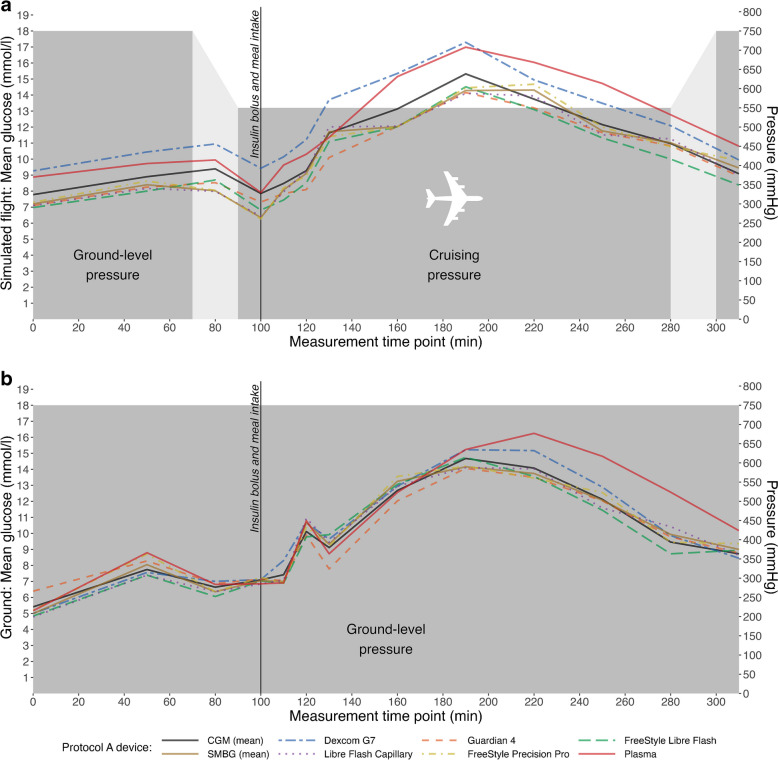
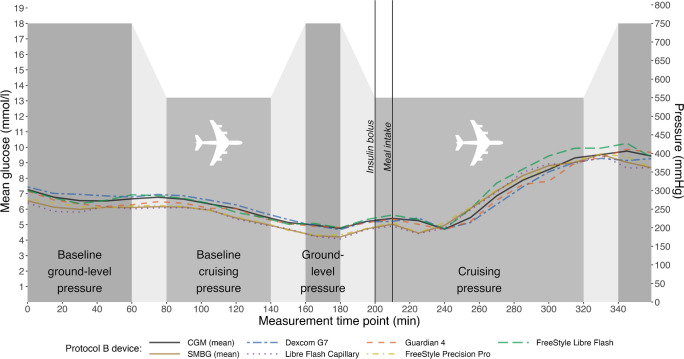
Twelve insulin pump users with type 1 diabetes were studied using two simulation protocols. Protocol A consisted of a ground phase, ascent, a 190 min cruise with ingestion of a liquid meal, descent and then ground. Protocol B consisted of a ground phase, ascent, a 60 min cruise while fasting, descent, a 20 min ground phase, ascent, a second flight of 120 min with ingestion of a meal, followed by descent and ground. Insulin was administered with or before the meal according to the participants' carbohydrate-counting regimen during both protocols. In Protocol A, capillary, interstitial and plasma glucose were measured during flight and at ground, while in Protocol B, glucose and oxygen were measured. Measurements from three CGM brands and two SMBG devices were recorded during the flight simulations. Findings at cabin pressures during flight (550 mmHg) and ground (750 mmHg) were compared. Fasted and postprandial glucose measurements were analysed using Spearman's correlations and mean absolute relative differences (MARDs).
Eleven men and one woman (n=6 men in Protocol A; n=5 men and n=1 woman in Protocol B) were studied. A total of 1533 data points were recorded. During flight vs ground level, Spearman's correlations for CGM system- and SMBG-derived glucose values were very strong in both Protocol A (r=0.96 during flight vs r=0.94 at ground) and Protocol B (r=0.85 during flight vs r=0.69 at ground). The differences in aggregated CGM MARDs during flight vs ground level were minimal across Protocol A (11.85%; 95% CI [9.78, 13.92] vs 9.08%; 95% CI [7.02, 11.14]) and Protocol B (12.01%; 95% CI [3.34, 20.69] vs 12.97%; 95% CI [4.30, 21.65]).
CONCLUSIONS/INTERPRETATION: The performance of CGM systems and SMBG are comparable during flight-associated atmospheric pressure changes. All tested measurement devices for CGM and SMBG were suitable for diabetes-care-based decisions during flight simulation.
目的/假设:1型糖尿病飞行员在飞行期间需要定期进行毛细血管血糖监测。持续葡萄糖监测(CGM)可能是一种有效且更实用的替代方法。本研究旨在评估在低压飞行模拟过程中CGM系统相对于自我血糖监测(SMBG)的准确性。
使用两种模拟方案对12名使用胰岛素泵的1型糖尿病患者进行研究。方案A包括一个地面阶段、上升阶段、进食流质餐食的190分钟巡航阶段、下降阶段,然后是地面阶段。方案B包括一个地面阶段、上升阶段、禁食60分钟的巡航阶段、下降阶段、20分钟地面阶段、上升阶段、进食餐食的120分钟第二次飞行阶段,随后是下降阶段和地面阶段。在两个方案中,根据参与者的碳水化合物计数方案在进餐时或进餐前给予胰岛素。在方案A中,在飞行中和地面时测量毛细血管、组织间液和血浆葡萄糖,而在方案B中,测量葡萄糖和氧气。在飞行模拟期间记录了来自三个CGM品牌和两个SMBG设备的测量值。比较了飞行期间(550 mmHg)和地面(750 mmHg)舱内压力下的测量结果。使用Spearman相关性和平均绝对相对差异(MARD)分析空腹和餐后血糖测量值。
研究了11名男性和1名女性(方案A中有6名男性;方案B中有5名男性和1名女性)。总共记录了1533个数据点。在飞行与地面水平期间,方案A(飞行时r = 0.96,地面时r = 0.94)和方案B(飞行时r = 0.85,地面时r = 0.69)中,CGM系统和SMBG得出的葡萄糖值的Spearman相关性都非常强。在方案A(11.85%;95% CI [9.78, 13.92] 与9.08%;95% CI [7.02, 11.14])和方案B(12.01%;95% CI [3.34, 20.69] 与12.97%;95% CI [4.30, 21.65])中,飞行与地面水平期间汇总的CGM MARD差异最小。
结论/解读:在与飞行相关的大气压力变化期间,CGM系统和SMBG的性能相当。所有测试的CGM和SMBG测量设备都适用于飞行模拟期间基于糖尿病护理的决策。