Borck Patricia C, Boyle Isabella, Jankovic Kristina, Bick Nolan, Foster Kyla, Lau Anthony C, Parker-Burns Lucy I, Lubicki Daniel A, Li Tianxia, Borah Ashir A, Lofaso Nicholas J, Das Sharma Sohani, Chan Tessla, Kishen Riya V, Adeagbo Anisah, Raghavan Srivatsan, Aquilanti Elisa, Prensner John R, Krill-Burger J Michael, Golub Todd R, Campbell Catarina D, Dempster Joshua M, Chan Edmond M, Vazquez Francisca
Broad Institute of MIT and Harvard, Cambridge, MA, USA.
Herbert Irving Comprehensive Cancer Center, Columbia University Irving Medical Center, New York, NY, USA.
Nature. 2025 Feb;638(8052):1104-1111. doi: 10.1038/s41586-024-08509-3. Epub 2025 Feb 5.
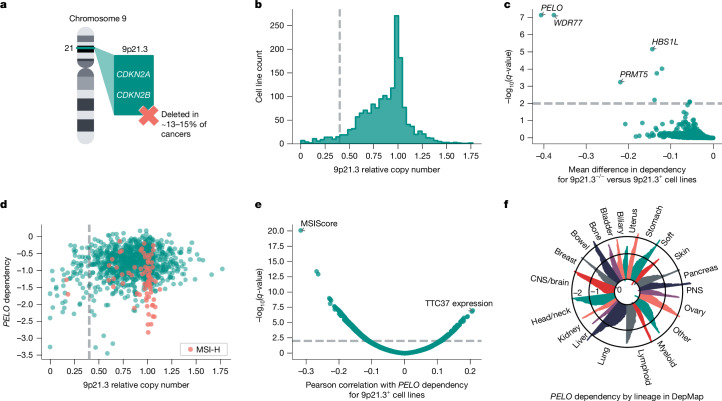
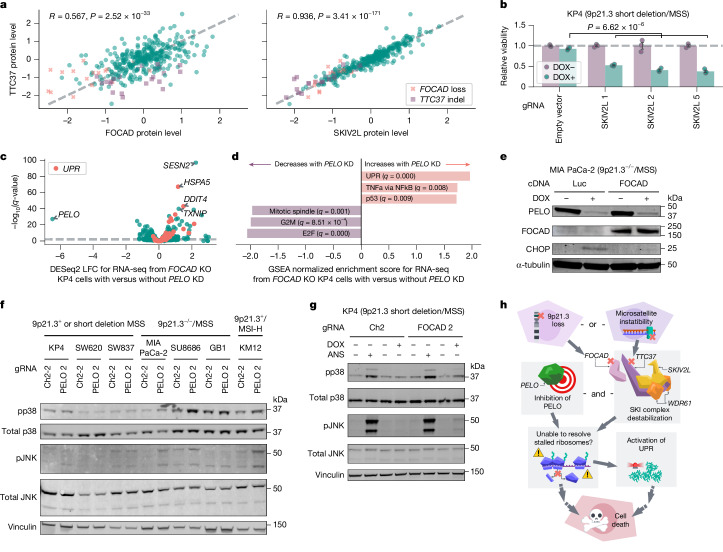
Cancer genome alterations often lead to vulnerabilities that can be used to selectively target cancer cells. Various inhibitors of such synthetic lethal targets have been approved by the FDA or are in clinical trials, highlighting the potential of this approach. Here we analysed large-scale CRISPR knockout screening data from the Cancer Dependency Map and identified a new synthetic lethal target, PELO, for two independent molecular subtypes of cancer: biallelic deletion of chromosomal region 9p21.3 or microsatellite instability-high (MSI-H). In 9p21.3-deleted cancers, PELO dependency emerges from biallelic deletion of the 9p21.3 gene FOCAD, a stabilizer of the superkiller complex (SKIc). In MSI-H cancers, PELO is required owing to MSI-H-associated mutations in TTC37 (also known as SKIC3), a critical component of the SKIc. We show that both cancer subtypes converge to destabilize the SKIc, which extracts mRNA from stalled ribosomes. In SKIc-deficient cells, PELO depletion induces the unfolded protein response, a stress response to accumulation of misfolded or unfolded nascent polypeptides. Together, our findings indicate PELO as a promising therapeutic target for a large patient population with cancers characterized as MSI-H with deleterious TTC37 mutations or with biallelic 9p21.3 deletions involving FOCAD.
癌症基因组改变通常会导致一些脆弱性,这些脆弱性可被用于选择性地靶向癌细胞。多种针对此类合成致死靶点的抑制剂已获美国食品药品监督管理局(FDA)批准或正处于临床试验阶段,凸显了这种方法的潜力。在此,我们分析了来自癌症依赖性图谱的大规模CRISPR基因敲除筛选数据,并为两种独立的癌症分子亚型确定了一个新的合成致死靶点——PELO:染色体区域9p21.3的双等位基因缺失或微卫星高度不稳定(MSI-H)。在9p21.3缺失的癌症中,PELO依赖性源于9p21.3基因FOCAD(超级杀手复合体(SKIc)的一种稳定剂)的双等位基因缺失。在MSI-H癌症中,由于SKIc的关键组分TTC37(也称为SKIC3)中与MSI-H相关的突变,PELO是必需的。我们表明,这两种癌症亚型都会导致SKIc不稳定,SKIc可从停滞的核糖体中提取mRNA。在SKIc缺陷的细胞中,PELO缺失会诱导未折叠蛋白反应,这是对错误折叠或未折叠新生多肽积累的一种应激反应。总之,我们的研究结果表明,对于大量具有MSI-H且伴有有害TTC37突变或9p21.3双等位基因缺失且涉及FOCAD的癌症患者群体而言,PELO是一个有前景的治疗靶点。