Buback Laura, Martin Shayanne, Pardo Esbeydy, Massoud Farah, Formigo Jesus, Bonyani Atousa, Farag Noha H, Almayahi Zayid K, Ishii Kenta, Welty Susie, Schneider Dana
University of California San Francisco (UCSF), San Francisco, USA.
U.S. Centers for Disease Control and Prevention (CDC), Middle East & North Africa Regional Office, Muscat, Oman.
Int J Equity Health. 2025 Feb 6;24(1):38. doi: 10.1186/s12939-025-02393-7.
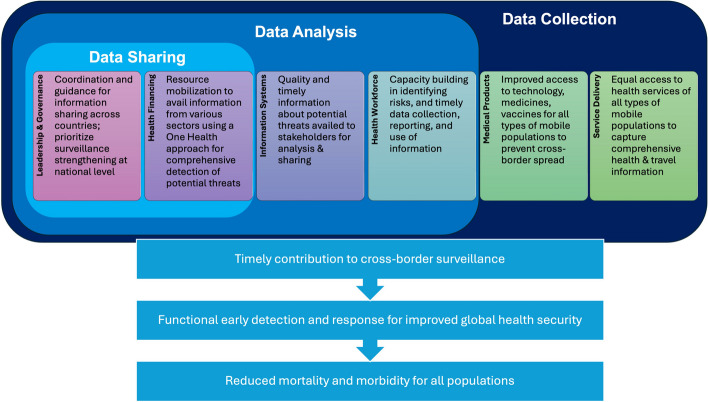
The introduction of the Sustainable Development Goals by the United Nations has set a global target for achieving Universal Health Coverage, requiring resilient health systems capable of addressing public health emergencies and ensuring health security. Public health surveillance, crucial for detecting and responding to infectious disease outbreaks, is key to building health system resilience. Due to the high levels of mobility and political instability in the Middle East and North Africa (MENA) region, unique challenges arise in cross-border health surveillance. This review aims to highlight the importance of cross-border public health surveillance in strengthening health systems across MENA to achieve equitable health outcomes.A mixed-methods approach was utilized, combining a systematic literature review with semi-structured in-depth interviews (IDIs) involving 28 stakeholders from seven MENA countries. The literature review adhered to PRISMA guidelines, while the IDIs provided qualitative insights into current surveillance practices and challenges. Findings from the literature review and IDIs were triangulated and analyzed using the WHO Health Systems Strengthening (HSS) Building Blocks Framework to identify key challenges and recommendations for improving cross-border surveillance.Results indicate that existing cross-border surveillance systems in MENA face challenges in data collection, analysis, and sharing, with disparities across countries based on income levels and political contexts. Key challenges include delayed and incomplete data sharing, insufficient funding across sectors, inadequate training, inconsistent data definitions, and limited integration of health data for mobile populations. Recommendations emphasize strengthened governance and leadership to facilitate regional cooperation and information sharing, sustainable financing for implementing a One Health approach, utilizing innovative information systems, workforce development to enhance data collection and analysis, and secure supply chains for medicines and vaccines and equitable service delivery for all mobile populations.In conclusion, the WHO HSS Building Block Framework provides a comprehensive approach to assessing and improving cross-border public health surveillance and enhancing health security and equity in MENA. Strengthening cross-border surveillance systems may help MENA countries meet IHR requirements, achieve greater health security, and advance health equity among all types of mobile populations. Despite limitations, the study offers critical insights for improving cross-border surveillance strategies in the region.
联合国可持续发展目标的推出为实现全民健康覆盖设定了全球目标,这需要具备应对突发公共卫生事件能力并确保卫生安全的韧性卫生系统。公共卫生监测对于检测和应对传染病疫情至关重要,是构建卫生系统韧性的关键。由于中东和北非(MENA)地区人员流动性高且政治不稳定,跨境卫生监测面临独特挑战。本综述旨在强调跨境公共卫生监测对于加强中东和北非地区卫生系统以实现公平健康结果的重要性。
采用了混合方法,将系统文献综述与对来自七个中东和北非国家的28名利益相关者进行的半结构化深入访谈(IDI)相结合。文献综述遵循PRISMA指南,而深入访谈则为当前监测实践和挑战提供了定性见解。使用世卫组织卫生系统强化(HSS)构建模块框架对文献综述和深入访谈的结果进行三角测量和分析,以确定改善跨境监测的关键挑战和建议。
结果表明,中东和北非地区现有的跨境监测系统在数据收集、分析和共享方面面临挑战,各国在收入水平和政治背景方面存在差异。关键挑战包括数据共享延迟和不完整、各部门资金不足、培训不够、数据定义不一致以及针对流动人群的卫生数据整合有限。建议强调加强治理和领导力以促进区域合作和信息共享,为实施“同一个健康”方法提供可持续资金,利用创新信息系统,开展劳动力培训以加强数据收集和分析,确保药品和疫苗的供应链安全以及为所有流动人群提供公平的服务。
总之,世卫组织卫生系统强化构建模块框架为评估和改善跨境公共卫生监测以及加强中东和北非地区的卫生安全和公平性提供了全面方法。加强跨境监测系统可能有助于中东和北非国家满足《国际卫生条例》要求,实现更高的卫生安全,并促进各类流动人群的健康公平。尽管存在局限性,但该研究为改进该地区的跨境监测策略提供了重要见解。