Bates J, Morrison K D, Madella M, Hill A C, Whitehouse N J, Abro T, Ajithprasad P, Anupama K, Casile A, Chandio A, Chatterjee S, Gangopadhyay K, Hammer E, Haricharan S, Hazarika M, Korisettar R, Kumar A, Lancelotti C, Pappu S, Parque O, Petrie C A, Premathilake R, Selvakumar V, Sen S, Spate M, Trivedi M, Veesar G M, Vinayak V
Department of Archaeology and Art History, Seoul National University, Seoul, South Korea.
Department of Anthropology, University of Pennsylvania, Philadelphia, PA, United States of America.
PLoS One. 2025 Feb 12;20(2):e0313409. doi: 10.1371/journal.pone.0313409. eCollection 2025.
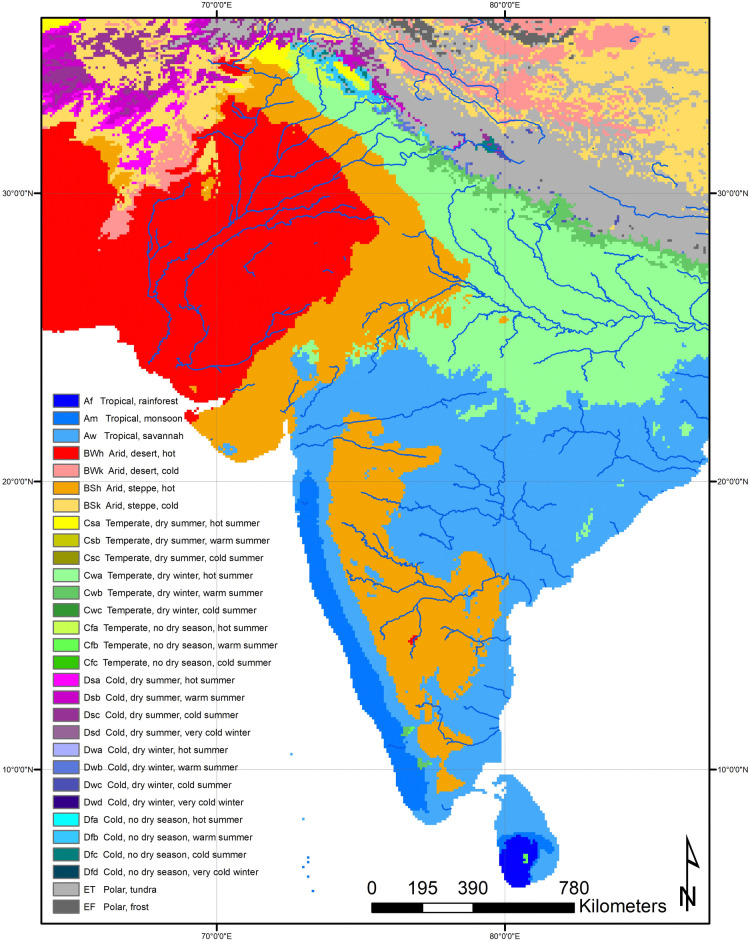
While it is clear that current human impact on the earth system is unprecedented in scope and scale, much less is known about the long-term histories of human land use and their effects on vegetation, carbon cycling, and other factors relevant to climate change. Current debates over the possible importance of human activities since the mid second millennium CE cannot be effectively resolved without evidence-based reconstructions of past land use and its consequences. The goal of the PAGES LandCover 6K working group is to reconstruct human land use and land cover over the past 12,000 years. In this paper, we present the first large-scale synthesis of archaeological evidence for human land use in South Asia at 12 and 6kya, a critical period for the transition to agriculture, arguably one of the land use transitions most consequential in terms of human impact on the Earth system. Perhaps the most important narrative we can pick out is that while there are some shifts in land use across these time windows, hunter-gatherer-fisher-foraging remained the dominant land use, and within this there was a mosaic of strategies exploiting diverse and complex landscapes and ecologies. This is not necessarily a new conclusion-it is not new to state that South Asia is comprised of many niches, but demonstrating the deep time history of how people have adapted to these and adapted them is an important step for modelling the impacts of human populations and thinking about their footprints in a longue-durée perspective. Despite the new development of food production between the early and mid-Holocene by overall area foraging life ways continued as the dominant land use practice into the 6kya time window. The development of agriculture and food production was not unimportant-it is the beginning of a land use that eventually comes to dominate the sub-continent, but at 6kya agriculture was restricted to specific contexts. Across 12kya to 6kya and different land uses, the use of mosaic ecologies, diverse strategies and the importance of water as a resource stand out as shared themes.
虽然目前人类对地球系统的影响在范围和规模上是前所未有的,但对于人类土地利用的长期历史及其对植被、碳循环以及其他与气候变化相关因素的影响,我们所知甚少。如果没有基于证据的过去土地利用及其后果的重建,就无法有效解决当前关于公元2千纪中叶以来人类活动可能重要性的争论。过去全球变化研究计划(PAGES)土地覆盖6000年工作组的目标是重建过去12000年的人类土地利用和土地覆盖情况。在本文中,我们首次大规模综合了南亚12000年和6000年前人类土地利用的考古证据,这是向农业过渡的关键时期,可以说是人类对地球系统影响最为重大的土地利用转变之一。也许我们能梳理出的最重要的情况是,虽然在这些时间跨度内土地利用有一些变化,但狩猎-采集-捕鱼-觅食仍然是主要的土地利用方式,而且在这一方式中存在着利用多样且复杂景观和生态的多种策略。这不一定是个新结论——指出南亚由许多生态位组成并不新鲜,但展示人们如何适应这些生态位并对其进行改造的漫长历史,是模拟人类活动影响以及从长期视角思考人类足迹的重要一步。尽管全新世早期到中期食物生产有了新发展,但总体上觅食生活方式作为主要的土地利用方式持续到了6000年前的时间窗口。农业和食物生产的发展并非无关紧要——它是一种最终在次大陆占据主导地位的土地利用方式的开端,但在6000年前,农业仅限于特定环境。在从12000年到6000年以及不同的土地利用方式中,镶嵌生态的利用、多样的策略以及水作为一种资源的重要性是共同的主题。