Nadig Vanessa, Gundacker Stefan, Herweg Katrin, Naunheim Stephan, Schug David, Weissler Bjoern, Schulz Volkmar
University Hospital Aaachen, Pauwelsstrasse 30, 52074, Aachen, Germany.
Institute of High Energy Physics, Austrian Academy of Sciences, Nikolsdorfer Gasse 18, 1050, Vienna, AT, Austria.
EJNMMI Phys. 2025 Feb 13;12(1):16. doi: 10.1186/s40658-025-00717-8.
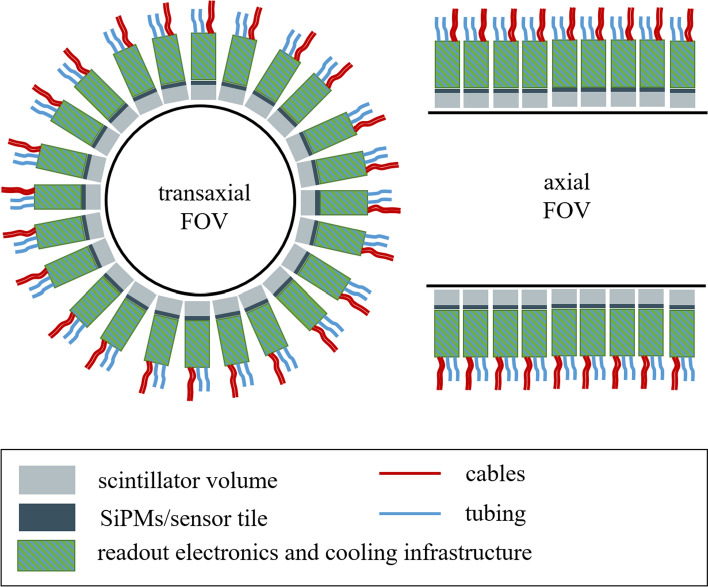
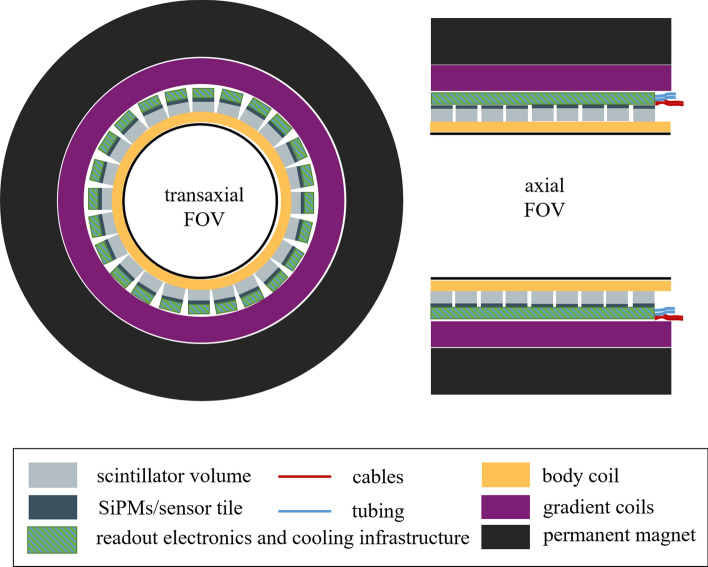
Designing positron emission tomography (PET) scanners involves several significant challenges. These include the precise measurement of the time of arrival of signals, accurate integration of the pulse shape, maintaining low power consumption, and supporting the readout of thousands of channels. To address these challenges, researchers and engineers frequently develop application-specific integrated circuits (ASICs), which are custom-designed readout electronics optimized for specific tasks. As a result, a wide range of ASIC solutions has emerged in PET applications. However, there is currently no comprehensive or standardized comparison of these ASIC designs across the field.
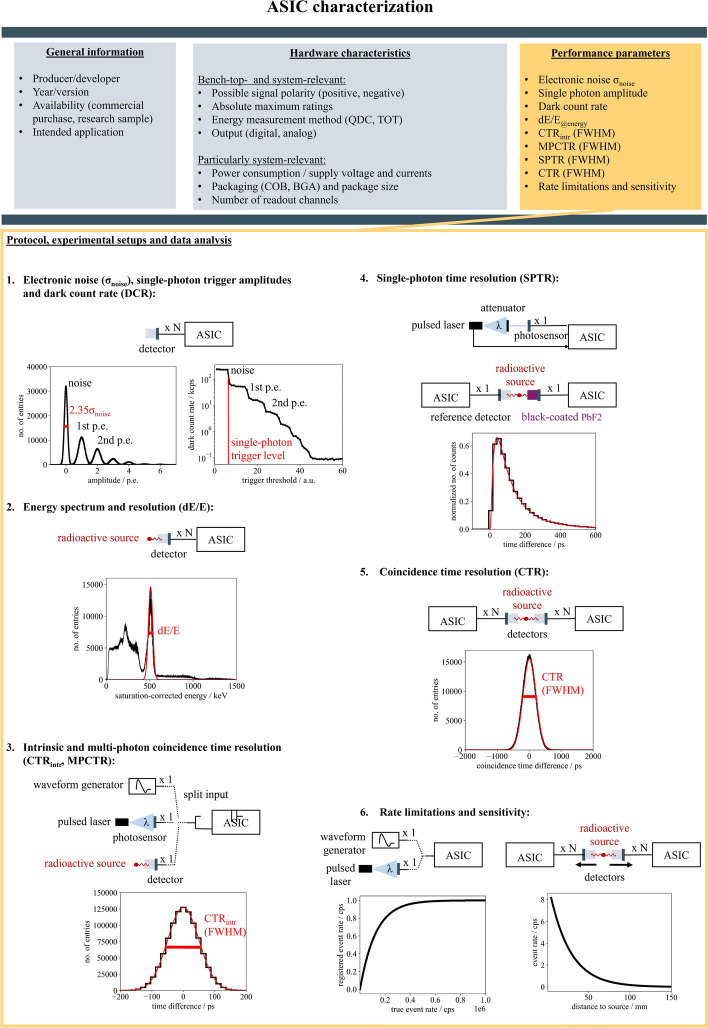
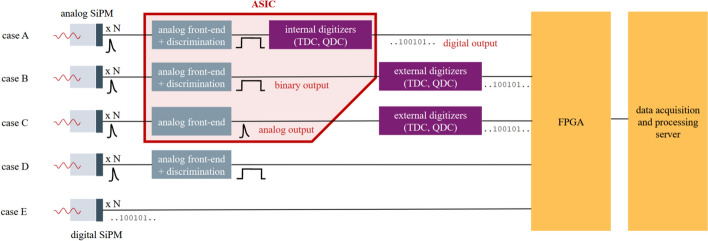
In this paper, we evaluate the requirements posed to readout electronics in the field of PET, give an overview of the most important ASICs available for PET applications and discuss how to characterize their essential features and performance parameters. We thoroughly review the hardware characteristics of the different circuits, such as the number of readout channels provided, their power consumption, input and output design. Furthermore, we summarize their performance as characterized in literature.
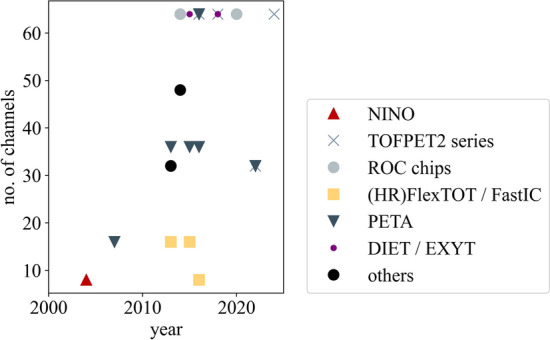
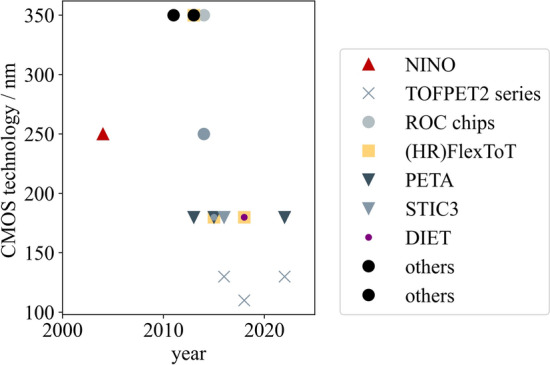
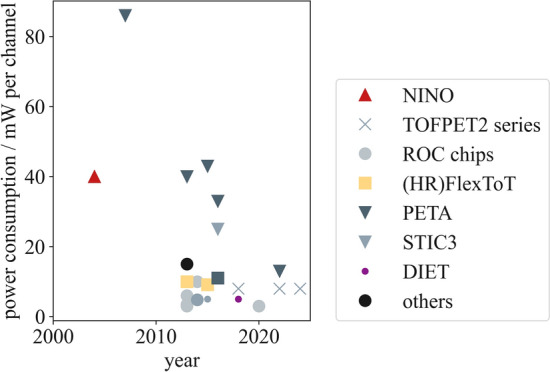
While the ASICs described show common trends towards lower power consumption or a higher number of readout channels over the past two decades, their characteristics and also their performance assessment by the developers, producers and vendors differ in many aspects. To cope with the challenge of selecting a suitable ASIC for a given purpose and PET application from the varying information available, this article suggests a protocol to assess an ASIC's performance parameters and characteristics.
ASICs developed for PET applications are versatile. With novel benchmarks set for the impact of scintillator and photosensor on the time-of-flight performance, the pressure on ASICs to deliver higher timing resolution and cope with an even higher data rate is enormous. Latest developments promise new circuits and improvements in time-of-flight performance. This article provides an overview on existing and emerging readout solutions in PET over the past 20 years, which is currently lacking in literature.
设计正电子发射断层扫描(PET)扫描仪面临若干重大挑战。这些挑战包括信号到达时间的精确测量、脉冲形状的精确积分、保持低功耗以及支持数千个通道的读出。为应对这些挑战,研究人员和工程师经常开发专用集成电路(ASIC),即针对特定任务定制设计的读出电子设备。因此,PET应用中出现了各种各样的ASIC解决方案。然而,目前该领域尚无对这些ASIC设计的全面或标准化比较。
在本文中,我们评估了PET领域对读出电子设备提出的要求,概述了可用于PET应用的最重要的ASIC,并讨论了如何表征其基本特征和性能参数。我们全面回顾了不同电路的硬件特性,如提供的读出通道数量、功耗、输入和输出设计。此外,我们总结了文献中所描述的它们的性能。
虽然过去二十年来所描述的ASIC呈现出朝着更低功耗或更多读出通道发展的共同趋势,但它们的特性以及开发者、生产商和供应商对其性能的评估在许多方面存在差异。为应对从可用的各种信息中为特定目的和PET应用选择合适ASIC的挑战,本文提出了一种评估ASIC性能参数和特性的方案。
为PET应用开发的ASIC具有通用性。随着为闪烁体和光电传感器对飞行时间性能的影响设定了新的基准,ASIC要提供更高的时间分辨率并应对更高的数据速率,压力巨大。最新进展有望带来新的电路并改善飞行时间性能。本文概述了过去20年PET领域现有的和新兴的读出解决方案,而目前文献中缺乏这方面的内容。