Xu Yifeng, Yan Zhaoqi, Li Keke, Liu Liangji, Xu Lei
School of Clinical Medicine, Jiangxi University of Chinese Medicine, Nanchang, Jiangxi, China.
Guang'anmen Hospital, China Academy of Chinese Medical Sciences, Beijing, China.
Front Public Health. 2025 Jan 29;12:1393119. doi: 10.3389/fpubh.2024.1393119. eCollection 2024.
Numerous studies have indicated that a diet rich in antioxidants can prevent Chronic Obstructive Pulmonary Disease (COPD). However, the relationship between combined dietary antioxidant intake and the risk of COPD remains unclear. The Comprehensive Dietary Antioxidant Index (CDAI) is a composite score of various dietary antioxidants, including vitamins A, C, E, zinc, selenium, and carotenoids. In this study, we examined the independent and joint associations of CDAI with the risk of COPD and all-cause mortality.
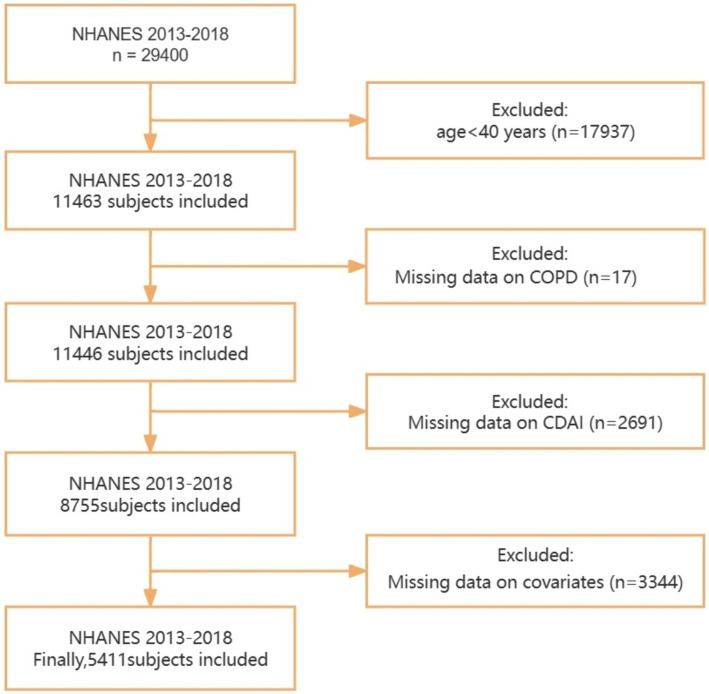
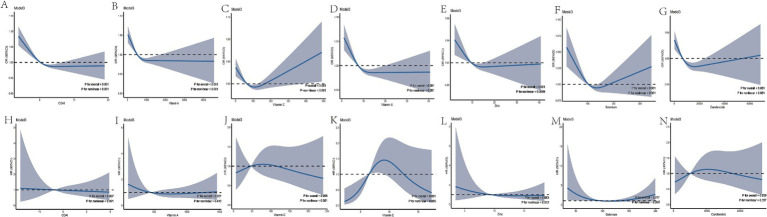
The analysis was conducted using data from the National Health and Nutrition Examination Survey (NHANES) spanning from 2013 to 2018. Multivariable weighted logistic and Cox regression models were employed to evaluate the correlations of CDAI (including vitamins A, C, E, zinc, selenium, and carotenoids) with the risk of COPD and all-cause mortality. Restricted cubic spline models were used to examine potential non-linear relationships. Sensitivity and stratified analyses were conducted to assess the robustness of the results.
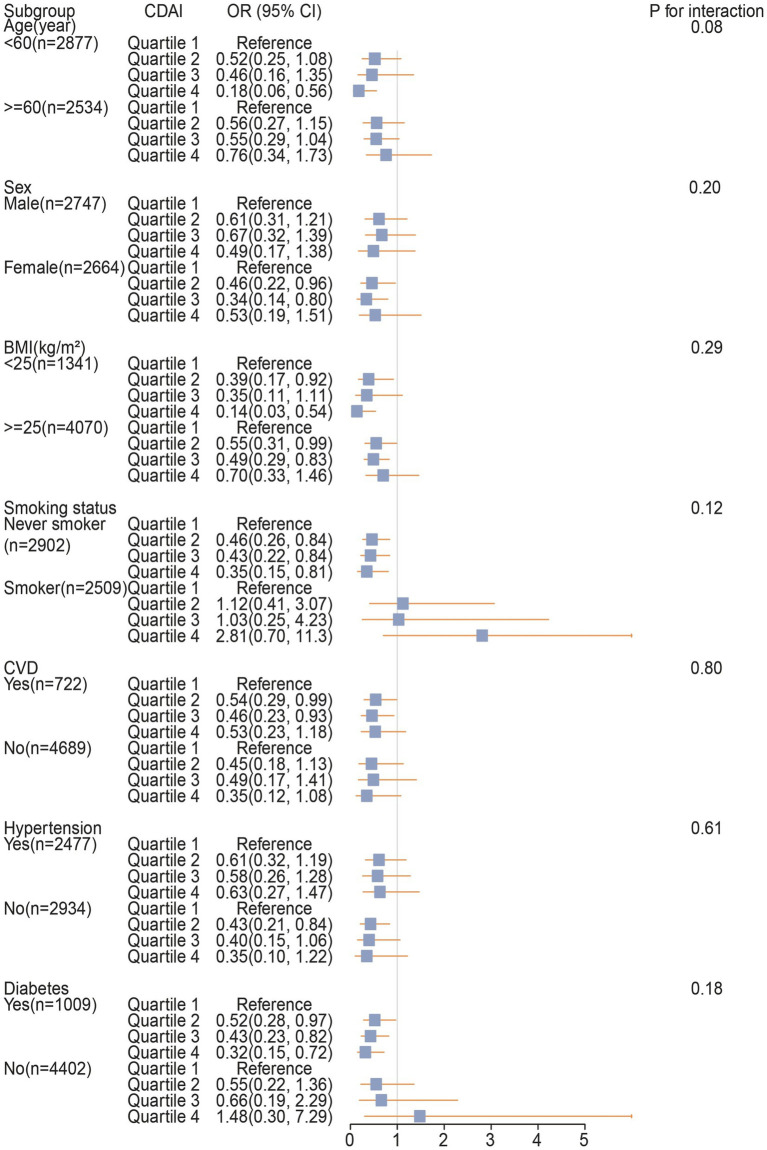
In this study, compared to the lowest quartile, the highest quartile of CDAI levels was significantly negatively associated with the risk of COPD (Odds Ratio [OR]: 0.47; 95% Confidence Interval [CI]: 0.22-0.97), exhibiting a non-linear relationship. Additionally, vitamins A, C, E, zinc, selenium, and carotenoids were also negatively associated with the risk of COPD. Furthermore, dietary antioxidant zinc in the second quartile (Hazard Ratio [HR]: 0.25; 95% CI: 0.10-0.62) was negatively associated with the risk of all-cause mortality compared to the lowest quartile. Subgroup analysis results remained stable, and sensitivity analysis did not support the association between selenium and the risk of COPD, with no substantial changes in the remaining associations.
Higher CDAI is inversely associated with the risk of COPD, and appropriate intake of the dietary antioxidant zinc may reduce all-cause mortality in COPD patients.
众多研究表明,富含抗氧化剂的饮食可预防慢性阻塞性肺疾病(COPD)。然而,饮食中抗氧化剂的综合摄入量与COPD风险之间的关系仍不明确。综合饮食抗氧化指数(CDAI)是多种饮食抗氧化剂的综合评分,包括维生素A、C、E、锌、硒和类胡萝卜素。在本研究中,我们考察了CDAI与COPD风险及全因死亡率的独立关联和联合关联。
使用2013年至2018年美国国家健康与营养检查调查(NHANES)的数据进行分析。采用多变量加权逻辑回归和Cox回归模型评估CDAI(包括维生素A、C、E、锌、硒和类胡萝卜素)与COPD风险及全因死亡率的相关性。使用受限立方样条模型检验潜在的非线性关系。进行敏感性和分层分析以评估结果的稳健性。
在本研究中,与最低四分位数相比,CDAI水平的最高四分位数与COPD风险显著负相关(优势比[OR]:0.47;95%置信区间[CI]:0.22 - 0.97),呈现非线性关系。此外,维生素A、C、E、锌、硒和类胡萝卜素也与COPD风险负相关。此外,与最低四分位数相比,第二四分位数的饮食抗氧化剂锌(风险比[HR]:0.25;95%CI:0.10 - 0.62)与全因死亡率风险负相关。亚组分析结果保持稳定,敏感性分析不支持硒与COPD风险之间的关联,其余关联无实质性变化。
较高的CDAI与COPD风险呈负相关,适当摄入饮食抗氧化剂锌可能降低COPD患者的全因死亡率。