The Second School of Clinical Medicine, Southern Medical University, Guangzhou, China.
Department of Teaching and Research Section of Internal Medicine, Zhujiang Hospital, Southern Medical University, Guangzhou, China.
BMC Public Health. 2024 Aug 17;24(1):2240. doi: 10.1186/s12889-024-19794-y.
Epilepsy is a major global health challenge, affecting approximately 50 million people across the globe and resulting in significant economic impacts on individuals and society. Oxidative stress is implicated in the pathogenesis of epilepsy, highlighting the potential of antioxidant-rich dietary patterns in offering preventive and protective benefits by mitigating oxidative stress. The Composite Dietary Antioxidant Index (CDAI) provides a measure for assessing dietary antioxidant intake, yet its link to epilepsy remains unexplored.
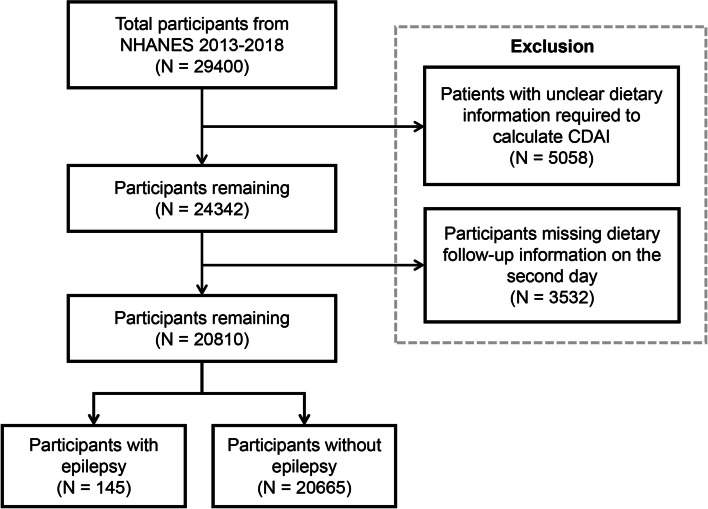
Our analysis utilized data from the National Health and Nutrition Examination Survey (NHANES) spanning 2013 to 2018, including 20,180 screened participants. Weighted logistic regression models were employed to examine the association between the CDAI and epilepsy prevalence. Non-linear associations were explored through restricted cubic splines (RCS), and the relationships between individual antioxidant components within the CDAI and epilepsy were also assessed.
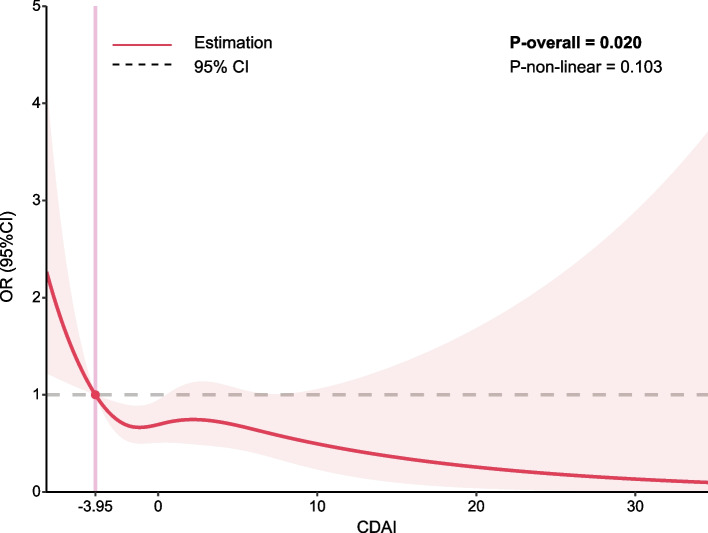
After adjusting for potential confounders, a negative association between the CDAI and epilepsy was suggested (OR = 0.991; p = 0.087, 95% CI [0.819,1.014]). Stratification of CDAI into quartiles revealed a significantly reduced risk of epilepsy in higher CDAI quartiles (Q3 and Q4) compared to the lowest quartile (Q1) (Q3: OR = 0.419; p = 0.030, 95% CI [0.192, 0.914]; Q4: OR = 0.421; p = 0.004, 95% CI [0.239, 0.742]), with a significant trend observed across quartiles (p for trend = 0.013). RCS analysis suggested a nonlinear association between CDAI levels and epilepsy (non-linear p = 0.049), which, however, was not statistically significant after full adjustment (non-linear p = 0.103). Additionally, significant negative correlations with epilepsy were observed for vitamin A and zinc (Vitamin A: OR = 0.999; p = 0.012, 95% CI [0.998, 1.000]; Zinc: OR = 0.931; p = 0.042, 95% CI [0.869, 0.997]).
Our research indicates a correlation where higher CDAI levels correspond to a reduced risk of epilepsy. Therefore, embracing a diet rich in antioxidants could be beneficial in preventing epilepsy. This finding holds considerable potential for shaping future strategies in both epilepsy prevention and treatment.
癫痫是一个全球性的重大健康挑战,影响着全球约 5000 万人,给个人和社会带来了重大的经济影响。氧化应激与癫痫的发病机制有关,这凸显了富含抗氧化剂的饮食模式通过减轻氧化应激来提供预防和保护作用的潜力。复合膳食抗氧化剂指数(CDAI)提供了一种评估膳食抗氧化剂摄入量的方法,但它与癫痫的关系尚未得到探索。
我们的分析利用了 2013 年至 2018 年全国健康和营养检查调查(NHANES)的数据,包括 20180 名筛查参与者。采用加权逻辑回归模型来研究 CDAI 与癫痫患病率之间的关联。通过限制性立方样条(RCS)探索非线性关联,还评估了 CDAI 中各个抗氧化剂成分与癫痫之间的关系。
在调整了潜在混杂因素后,CDAI 与癫痫之间存在负相关(OR=0.991;p=0.087,95%CI[0.819,1.014])。将 CDAI 分为四分位组后,与最低四分位组(Q1)相比,CDAI 较高的四分位组(Q3 和 Q4)癫痫的风险显著降低(Q3:OR=0.419;p=0.030,95%CI[0.192,0.914];Q4:OR=0.421;p=0.004,95%CI[0.239,0.742]),四分位组之间存在显著的趋势(趋势检验 p=0.013)。RCS 分析表明 CDAI 水平与癫痫之间存在非线性关联(非线性 p=0.049),但在完全调整后,这种关联并不具有统计学意义(非线性 p=0.103)。此外,维生素 A 和锌与癫痫呈显著负相关(维生素 A:OR=0.999;p=0.012,95%CI[0.998,1.000];锌:OR=0.931;p=0.042,95%CI[0.869,0.997])。
我们的研究表明,CDAI 水平越高,癫痫的风险越低。因此,采用富含抗氧化剂的饮食可能有助于预防癫痫。这一发现为制定未来的癫痫预防和治疗策略提供了重要参考。