Blok Sebastiaan, Gielen Willem, Piek Martijn A, Hoeksema Wiert F, Tulevski Igor, Somsen G Aernout, Winter Michiel M
Department of Cardiology, Cardiology Centers of the Netherlands, Utrecht, The Netherlands.
Department of Vascular Medicine, Internal medicine, Amsterdam UMC, University of Amsterdam, Amsterdam Cardiovascular Sciences, Amsterdam, The Netherlands.
Mhealth. 2025 Jan 14;11:5. doi: 10.21037/mhealth-24-10. eCollection 2025.
Atrial fibrillation (AF) is a prevalent arrhythmia with significant public health implications, including increased risk of stroke and mortality. Early detection is challenging but crucial for managing complications. Wearable technology with photoplethysmography (PPG) offers a potential solution for long-term, non-invasive monitoring. This study aims to evaluate the performance of three artificial intelligence (AI) algorithms (Happitech, Preventicus, and Philips Biosensing AF) in detecting AF using PPG signals from a medical smartband and compare it with the gold standard electrocardiogram (ECG).
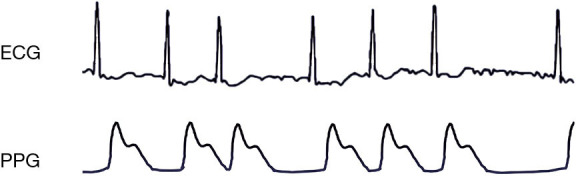
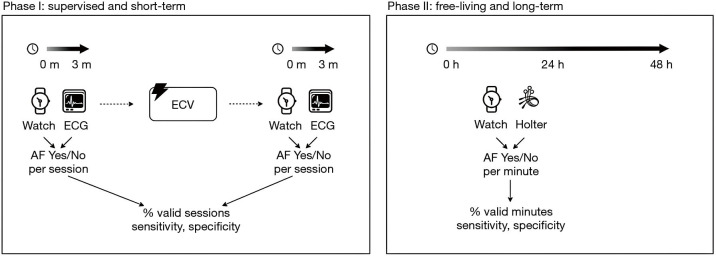
A medical smartband equipped with PPG technology was used to collect cardiovascular data from patients with and without AF. The sensitivity and specificity of the algorithm for detecting AF were determined by comparing their output to a trained technician's examination of concurrent ECG recordings.
Seventy two participants (42% female, 57±17 years old) were included in this study. The medical smartband provided continuous PPG signals, with AI algorithms evaluating the data for AF episodes. The accuracy of AF detection by the algorithms was compared with that of the concurrent ECG recordings. Sensitivity varied between 80.0% (62.5-97.5%) and 97.6% (97.6-97.6%), specificity between 90.6% (80.5-100%) and 96.9% (90.8-100%).
This study demonstrates the potential of medical smartbands combined with PPG technology and AI algorithms for reliable AF detection. The findings suggest a promising direction for remote AF monitoring and early intervention, potentially reducing AF-related complications and healthcare costs.
心房颤动(AF)是一种常见的心律失常,对公众健康有重大影响,包括中风风险和死亡率增加。早期检测具有挑战性,但对于管理并发症至关重要。带有光电容积脉搏波描记术(PPG)的可穿戴技术为长期、非侵入性监测提供了一种潜在的解决方案。本研究旨在评估三种人工智能(AI)算法(Happitech、Preventicus和飞利浦生物传感房颤算法)利用医疗智能手环的PPG信号检测房颤的性能,并将其与金标准心电图(ECG)进行比较。
使用配备PPG技术的医疗智能手环收集有或无房颤患者的心血管数据。通过将算法输出与训练有素的技术人员对同步ECG记录的检查结果进行比较,确定算法检测房颤的敏感性和特异性。
本研究纳入了72名参与者(42%为女性,年龄57±17岁)。医疗智能手环提供连续的PPG信号,AI算法评估房颤发作的数据。将算法检测房颤的准确性与同步ECG记录的准确性进行比较。敏感性在80.0%(62.5 - 97.5%)至97.6%(97.6 - 97.6%)之间,特异性在90.6%(80.5 - 100%)至96.9%(90.8 - 100%)之间。
本研究证明了医疗智能手环结合PPG技术和AI算法用于可靠检测房颤的潜力。研究结果为远程房颤监测和早期干预指明了一个有前景的方向,有可能减少与房颤相关的并发症和医疗成本。