van Vliet Mariska, Monnink Stefan H J, Kuiper Mathijs J, Constandse Jan C, Hoftijzer Dieke, Ronner Eelko
Department of Cardiology, Reinier de Graaf Hospital, Reinier de Graafweg 5, 2625 AD Delft, The Netherlands.
Corsano Health B.V., Wilhelmina van Pruisenweg 35, 2595 AN The Hague, The Netherlands.
Eur Heart J Digit Health. 2024 Feb 8;5(3):335-343. doi: 10.1093/ehjdh/ztae006. eCollection 2024 May.
Elevated blood pressure (BP) is a key risk factor in cardiovascular diseases. However, obtaining reliable and reproducible BP remains a challenge. This study, therefore, aimed to evaluate a novel cuffless wristband, based on photoplethysmography (PPG), for continuous BP monitoring.
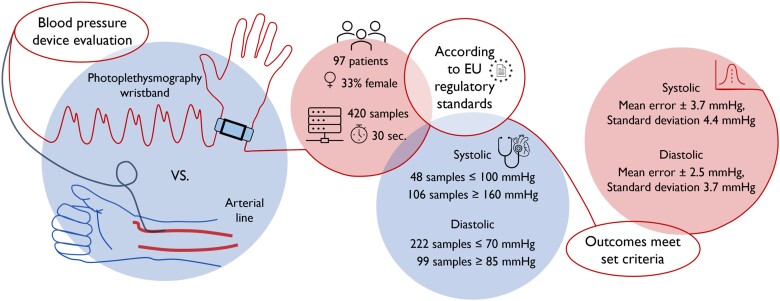
Predictions by a PPG-guided algorithm were compared to arterial BP measurements (in the sub-clavian artery), obtained during cardiac catheterization. Eligible patients were included and screened based on AAMI/European Society of Hypertension (ESH)/ISO Universal Standard requirements. The machine learning-based BP algorithm required three cuff-based initialization measurements in combination with ∼100 features (signal-derived and patient demographic-based). Ninety-seven patients and 420 samples were included. Mean age, weight, and height were 67.1 years (SD 11.1), 83.4 kg (SD 16.1), and 174 cm (SD 10), respectively. Systolic BP was ≤100 mmHg in 48 samples (11%) and ≥160 mmHg in 106 samples (25%). Diastolic BP was ≤70 mmHg in 222 samples (53%) and ≥85 mmHg in 99 samples (24%). The algorithm showed mean errors of ±3.7 mmHg (SD 4.4 mmHg) and ±2.5 mmHg (SD 3.7 mmHg) for systolic and diastolic BP, respectively. Similar results were observed across all genders and skin colours (Fitzpatrick I-VI).
This study provides initial evidence for the accuracy of a PPG-based BP algorithm in combination with a cuffless wristband across a range of BP distributions. This research complies with the AAMI/ESH/ISO Universal Standard, however, further research is required to evaluate the algorithms performance in light of the remaining European Society of Hypertension recommendations.
www.clinicaltrials.gov, NCT05566886.
血压升高是心血管疾病的关键危险因素。然而,获得可靠且可重复的血压仍然是一项挑战。因此,本研究旨在评估一种基于光电容积脉搏波描记法(PPG)的新型无袖带腕带,用于连续血压监测。
将PPG引导算法的预测结果与在心脏导管插入术期间获得的(锁骨下动脉的)动脉血压测量值进行比较。根据美国医疗仪器促进协会(AAMI)/欧洲高血压学会(ESH)/国际标准化组织(ISO)通用标准要求纳入并筛选符合条件的患者。基于机器学习的血压算法需要结合约100个特征(信号衍生特征和基于患者人口统计学特征)进行三次基于袖带的初始化测量。纳入了97名患者和420个样本。平均年龄、体重和身高分别为67.1岁(标准差11.1)、83.4千克(标准差16.1)和174厘米(标准差10)。收缩压在48个样本(11%)中≤100 mmHg,在106个样本(25%)中≥160 mmHg。舒张压在222个样本(53%)中≤70 mmHg,在99个样本(24%)中≥85 mmHg。该算法的收缩压和舒张压平均误差分别为±3.7 mmHg(标准差4.4 mmHg)和±2.5 mmHg(标准差3.7 mmHg)。在所有性别和肤色(菲茨帕特里克I - VI型)中均观察到类似结果。
本研究为基于PPG的血压算法结合无袖带腕带在一系列血压分布范围内的准确性提供了初步证据。本研究符合AAMI/ESH/ISO通用标准,然而,根据欧洲高血压学会的其余建议,还需要进一步研究来评估该算法的性能。