
一种利用多尺度特征融合和注意力机制的统一框架,用于胃镜成像中的胃息肉和隆起识别。
A unified framework harnessing multi-scale feature ensemble and attention mechanism for gastric polyp and protrusion identification in gastroscope imaging.
作者信息
He Chunyou, Zhang Jingda, Liang Yunxiao, Li Hao
机构信息
People's Hospital of Guangxi Zhuang Autonomous Region, Nanning, 530016, China.
出版信息
Sci Rep. 2025 Feb 17;15(1):5734. doi: 10.1038/s41598-025-90034-y.
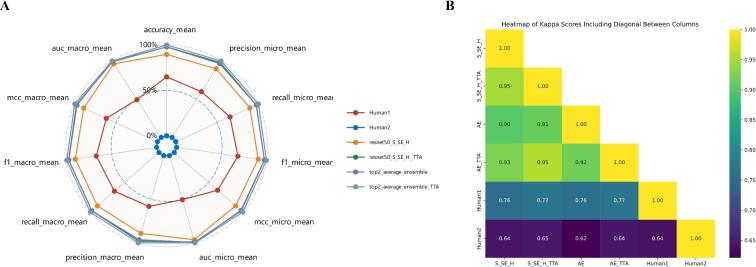
This study aims to address the diagnostic challenges in distinguishing gastric polyps from protrusions, emphasizing the need for accurate and cost-effective diagnosis strategies. It explores the application of Convolutional Neural Networks (CNNs) to improve diagnostic accuracy. This research introduces MultiAttentiveScopeNet, a deep learning model that incorporates multi-layer feature ensemble and attention mechanisms to enhance gastroscopy image analysis accuracy. A weakly supervised labeling strategy was employed to construct a large multi-class gastroscopy image dataset for training and validation. MultiAttentiveScopeNet demonstrates significant improvements in prediction accuracy and interpretability. The integrated attention mechanism effectively identifies critical areas in images to aid clinical decisions. Its multi-layer feature ensemble enables robust analysis of complex gastroscopy images. Comparative testing against human experts shows exceptional diagnostic performance, with accuracy, micro and macro precision, micro and macro recall, and micro and macro AUC reaching 0.9308, 0.9312, 0.9325, 0.9283, 0.9308, 0.9847 and 0.9853 respectively. This highlights its potential as an effective tool for primary healthcare settings. This study provides a comprehensive solution to address diagnostic challenges differentiating gastric polyps and protrusions. MultiAttentiveScopeNet improves accuracy and interpretability, demonstrating the potential of deep learning for gastroscopy image analysis. The constructed dataset facilitates continued model optimization and validation. The model shows promise in enhancing diagnostic outcomes in primary care.
本研究旨在应对区分胃息肉与隆起病变时的诊断挑战,强调需要准确且具成本效益的诊断策略。它探索了卷积神经网络(CNN)的应用以提高诊断准确性。本研究引入了多注意力范围网络(MultiAttentiveScopeNet),这是一种深度学习模型,它结合了多层特征集成和注意力机制以提高胃镜图像分析的准确性。采用了弱监督标注策略来构建一个大型多类别胃镜图像数据集用于训练和验证。多注意力范围网络在预测准确性和可解释性方面有显著提升。集成的注意力机制能有效识别图像中的关键区域以辅助临床决策。其多层特征集成能够对复杂的胃镜图像进行稳健分析。与人类专家的对比测试显示出卓越的诊断性能,准确率、微观和宏观精确率、微观和宏观召回率以及微观和宏观AUC分别达到0.9308、0.9312、0.9325、0.9283、0.9308、0.9847和0.9853。这凸显了其作为基层医疗环境中有效工具的潜力。本研究提供了一个全面的解决方案来应对区分胃息肉和隆起病变的诊断挑战。多注意力范围网络提高了准确性和可解释性,证明了深度学习在胃镜图像分析中的潜力。构建的数据集有助于持续的模型优化和验证。该模型在改善基层医疗诊断结果方面显示出前景。




 Zotero 插件