Steinhoff Bernhard J, Christensen Jakob, Doherty Colin P, Majoie Marian, Schulz Anne-Liv, Brock Fiona, Bourikas Dimitrios, Leunikava Iryna, Kelemen Anna, Rubio-Nazabal Eduardo
Kork Epilepsy Centre, Landstr. 1, 77694, Kehl-Kork, Germany.
Clinic for Neurology and Neurophysiology, University of Freiburg, Breisacher Str. 64, 79106, Freiburg, Germany.
Neurol Ther. 2025 Apr;14(2):627-642. doi: 10.1007/s40120-024-00697-4. Epub 2025 Feb 20.
Efficacy/tolerability of adjunctive brivaracetam (BRV) for focal-onset seizures (FOS) in patients aged ≥ 16 years was established in randomized controlled trials. This study aimed to evaluate the effectiveness of adjunctive BRV in patients (≥ 16 years) with FOS with/without focal to bilateral tonic-clonic seizures in daily clinical practice.
A 12-month, prospective, real-world, noninterventional study in nine European countries (EP0077/NCT02687711). BRV was prescribed per clinical practice and European Summary of Product Characteristics. Eligible patients had never received BRV before inclusion. Treating physicians made the decision to prescribe BRV, independently of study participation. Primary effectiveness outcome: BRV retention rate at 12 months; secondary effectiveness outcomes: 50% responder rate, seizure freedom.
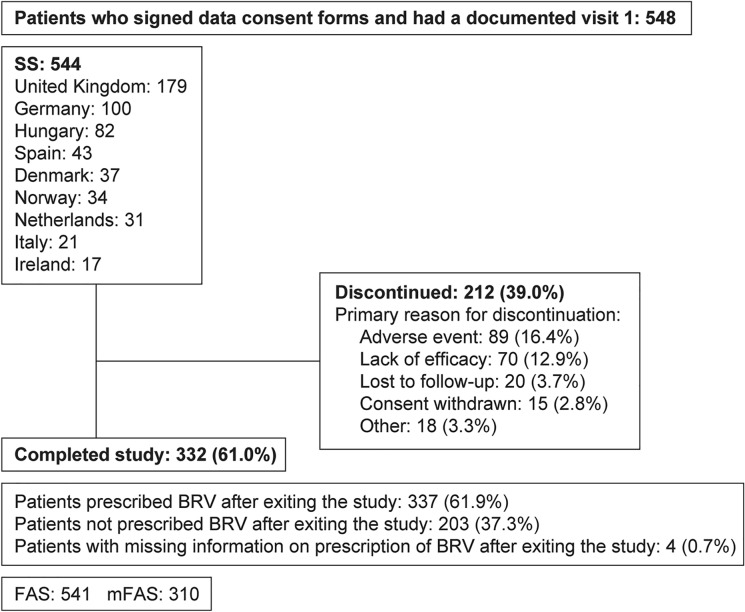
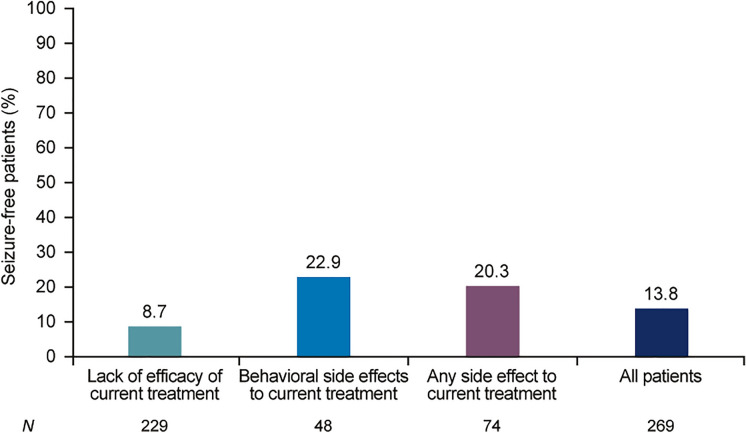
A total of 544 patients received ≥ 1 BRV dose (mean age: 43.6 years; 52.8% female; mean time since diagnosis: 22.7 years). Patients had a mean of 7.3 lifetime antiseizure medications (ASMs) and median of 3.7 FOS/28 days during 3-month retrospective baseline. Median total ASM drug load (including BRV) was 3.0 at BRV initiation (n = 539) and 3.3 at study end (n = 314). At 12 months, 57.7% of 541 patients remained on BRV, 60.4% of 230 were responders (≥ 50% seizure reduction since baseline), and 13.8% of 269 were seizure-free since BRV initiation. Historical levetiracetam use appeared not to impact retention rate (56.6% of 320 and 59.3% of 221 patients with and without historical levetiracetam use, respectively). 36.0% of 544 patients had drug-related treatment-emergent adverse events (TEAEs), mostly (≥ 5% of patients) drug ineffective (11.4%) and seizure (6.3%). The three most common drug-related TEAEs leading to permanent BRV discontinuation (of 544 patients) were drug ineffective (10.1%), seizure (5.1%), and behavior disorder (3.3%).
Adjunctive BRV was effective in clinical practice in patients with predominantly difficult-to-treat FOS, as shown by BRV retention rate of 57.7% at 12 months, which is in line with real-world retention rates for other new-generation ASMs.
在随机对照试验中已证实,辅助使用布瓦西坦(BRV)治疗≥16岁患者的局灶性发作(FOS)具有疗效/耐受性。本研究旨在评估在日常临床实践中,辅助使用BRV治疗伴有或不伴有局灶性至双侧强直阵挛发作的FOS患者(≥16岁)的有效性。
在9个欧洲国家进行了一项为期12个月的前瞻性、真实世界、非干预性研究(EP0077/NCT02687711)。BRV根据临床实践和欧洲产品特性摘要进行处方。符合条件的患者在纳入研究前从未接受过BRV治疗。治疗医生决定是否处方BRV,与研究参与情况无关。主要有效性结局:12个月时BRV保留率;次要有效性结局:50%缓解率、无癫痫发作。
共有544例患者接受了≥1剂BRV治疗(平均年龄:43.6岁;52.8%为女性;自诊断以来的平均时间:22.7年)。患者平均有7.3种终身抗癫痫药物(ASM),在3个月回顾性基线期内,FOS的中位数为3.7次/28天。开始使用BRV时(n = 539),ASM总药物负荷中位数(包括BRV)为3.0,研究结束时(n = 314)为3.3。12个月时,541例患者中有57.7%仍在使用BRV,230例患者中有60.4%为缓解者(自基线以来癫痫发作减少≥50%),269例患者中有13.8%自开始使用BRV后无癫痫发作。既往使用左乙拉西坦似乎不影响保留率(分别有320例和221例有或无既往左乙拉西坦使用史的患者,保留率分别为56.6%和59.3%)。544例患者中有36.0%发生药物相关的治疗中出现的不良事件(TEAE),主要是(≥5%的患者)药物无效(11.4%)和癫痫发作(6.3%)。导致永久性停用BRV(共544例患者)的三种最常见的药物相关TEAE为药物无效(10.1%)、癫痫发作(5.1%)和行为障碍(3.3%)。
辅助使用BRV在临床实践中对主要为难治性FOS的患者有效,12个月时BRV保留率为57.7%,这与其他新一代ASM的真实世界保留率一致。