Xiang Yanling, Xing Hui, Ran Yali, He Xiaoqiang, Cheng Yu
Department of Anesthesiology, University-Town Hospital of Chongqing Medical University, Chongqing, 401331, China.
Department of Nursing, University-Town Hospital of Chongqing Medical University, Chongqing, 401331, China.
BMC Musculoskelet Disord. 2025 Feb 25;26(1):189. doi: 10.1186/s12891-025-08308-5.
The incidence of deep vein thrombosis (DVT) on the first day of hospitalization in patients with hip fractures is as high as 42%, significantly impacting perioperative safety and, in severe cases, leading to patient mortality. This study aims to develop a diagnostic model based on the available demographic variables, comorbidities, and laboratory test results at admission in patients with hip fractures, and to evaluate its diagnostic performance.
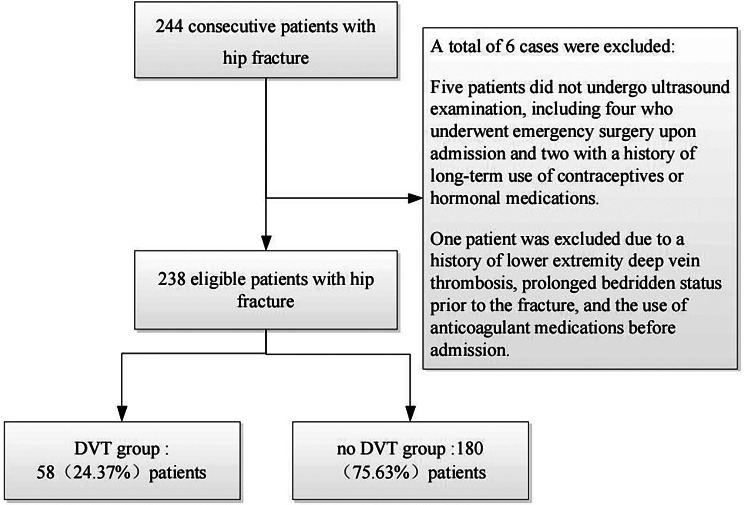
This study retrospectively collected clinical data from 238 patients with hip fractures admitted to the Third Affiliated Hospital of Chongqing Medical University between January 2019 and December 2021. The collected clinical data included demographic variables, medical history, comorbidities, laboratory test results, and Caprini scores. All patients were diagnosed with deep vein thrombosis (DVT) using ultrasonography. The multivariate logistic regression analysis was performed to identify risk factors for lower extremity DVT in hip fracture patients upon admission. The diagnostic performance of the model was evaluated using receiver operating characteristic (ROC) curve analysis. Additionally, the diagnostic effectiveness of different indicators was compared using the integrated discrimination improvement (IDI), net reclassification improvement (NRI), and decision curve analysis (DCA). A nomogram was further developed to provide a visual representation of the multivariate logistic regression model.
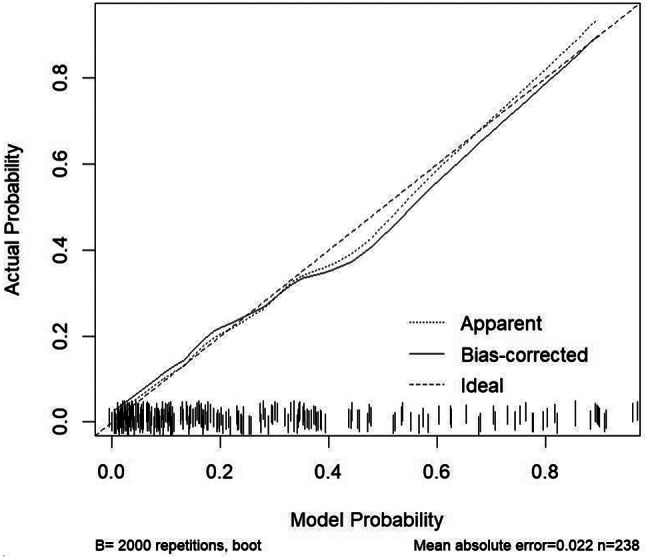
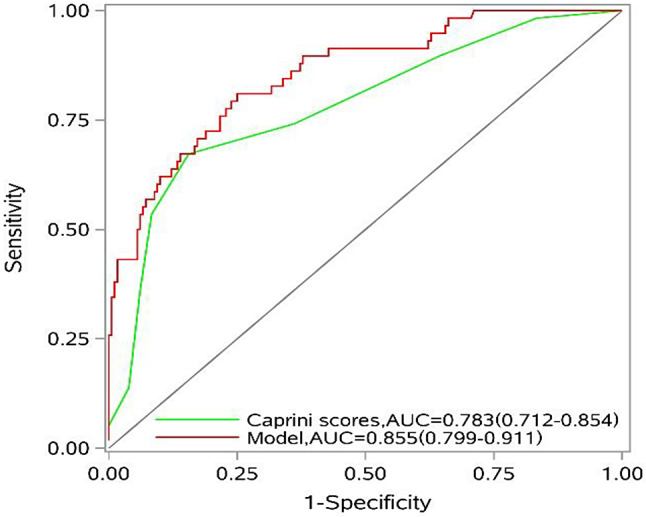
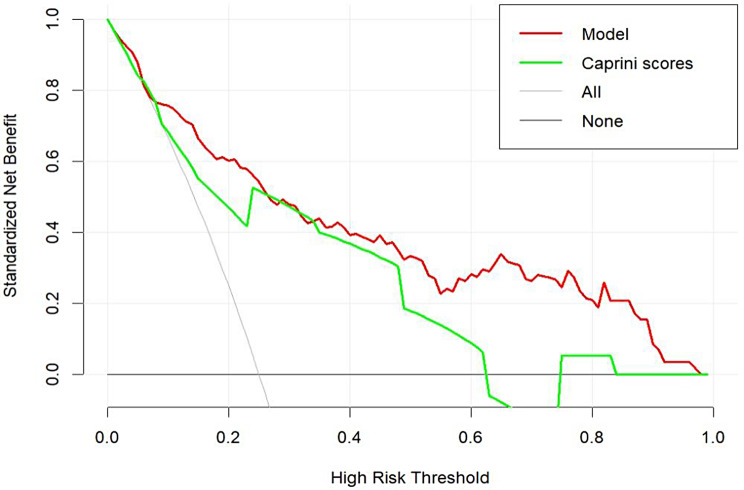
The multivariate logistic regression model identified female gender, cardiac arrhythmia, intertrochanteric fractures, fracture duration before admission (≥ 48 h), aPTT, and Caprini scores as factors associated with the occurrence of thrombosis upon admission in patients with hip fractures. Leave-one-out cross-validation demonstrated that the diagnostic model achieved an accuracy (Acc) of 76.47%, a sensitivity (Sen) of 81.03%, and a specificity (Spe) of 75.00%. When the risk probability was < 0.2, the thrombosis rate was 7.64%, whereas it increased significantly to 80.65% when the risk probability exceeded 0.6. Compared to the traditional Caprini score, the model showed an improvement in AUC (AUC difference = 0.072, 95% CI = 0.028-0.117). The Integrated Discrimination Improvement (IDI = 0.131, 95% CI = 0.074-0.187), Net Reclassification Improvement (NRI = 0.814, 95% CI = 0.544-1.084), and Decision Curve Analysis (DCA) at threshold probabilities of 0.10-0.22 and 0.35-1.00 demonstrated that the model outperformed the traditional Caprini score in diagnosing thrombosis. Finally, the diagnostic model constructed through multivariate logistic regression was visualized using a nomogram. After 2,000 bootstrap resampling validations, the model's C-index was 0.855, and the bias-corrected C-index was 0.836, indicating good discriminatory ability.
This study developed a nomogram model for deep vein thrombosis (DVT) that significantly outperforms the traditional Caprini score. The model can assist clinicians in rapidly identifying and screening high-risk patients with hip fractures for DVT, providing a valuable reference for timely preventive and therapeutic interventions.
髋部骨折患者住院首日深静脉血栓形成(DVT)的发生率高达42%,对围手术期安全有显著影响,严重时可导致患者死亡。本研究旨在基于髋部骨折患者入院时可用的人口统计学变量、合并症和实验室检查结果建立诊断模型,并评估其诊断性能。
本研究回顾性收集了2019年1月至2021年12月期间重庆医科大学附属第三医院收治的238例髋部骨折患者的临床资料。收集的临床资料包括人口统计学变量、病史、合并症、实验室检查结果和Caprini评分。所有患者均采用超声检查诊断深静脉血栓形成(DVT)。进行多因素logistic回归分析以确定髋部骨折患者入院时下肢DVT的危险因素。采用受试者工作特征(ROC)曲线分析评估模型的诊断性能。此外,使用综合判别改善(IDI)、净重新分类改善(NRI)和决策曲线分析(DCA)比较不同指标的诊断有效性。进一步绘制列线图以直观展示多因素logistic回归模型。
多因素logistic回归模型确定女性、心律失常、转子间骨折、入院前骨折持续时间(≥48小时)、活化部分凝血活酶时间(aPTT)和Caprini评分是髋部骨折患者入院时血栓形成的相关因素。留一法交叉验证表明,诊断模型的准确率(Acc)为76.47%,灵敏度(Sen)为81.03%,特异度(Spe)为75.00%。当风险概率<0.2时,血栓形成率为7.64%,而当风险概率超过0.6时,血栓形成率显著增加至80.65%。与传统的Caprini评分相比,该模型的曲线下面积(AUC)有所改善(AUC差异=0.072,95%可信区间=0.028-0.117)。在阈值概率为0.10-0.22和0.35-1.00时的综合判别改善(IDI=0.131,95%可信区间=0.074-0.187)、净重新分类改善(NRI=0.814,95%可信区间=0.544-1.084)和决策曲线分析(DCA)表明,该模型在诊断血栓形成方面优于传统的Caprini评分。最后,通过多因素logistic回归构建的诊断模型用列线图进行了可视化。经过2000次自抽样验证后,模型的C指数为0.855,偏差校正C指数为0.836,表明具有良好的区分能力。
本研究建立了一种用于深静脉血栓形成(DVT)的列线图模型,其性能显著优于传统的Caprini评分。该模型可帮助临床医生快速识别和筛查髋部骨折的高危DVT患者,为及时的预防和治疗干预提供有价值的参考。