Ansah Nana Akosua, Weibel Daniel, Oladokun Samuel Tomilola, Duah Enyonam, Ansah Patrick, Oduro Abraham, Sturkenboom Miriam
Navrongo Health Research Centre, Navrongo, Ghana.
Utrecht University, Utrecht, The Netherlands.
BMJ Public Health. 2023 Dec 13;1(1):e000077. doi: 10.1136/bmjph-2023-000077. eCollection 2023 Nov.
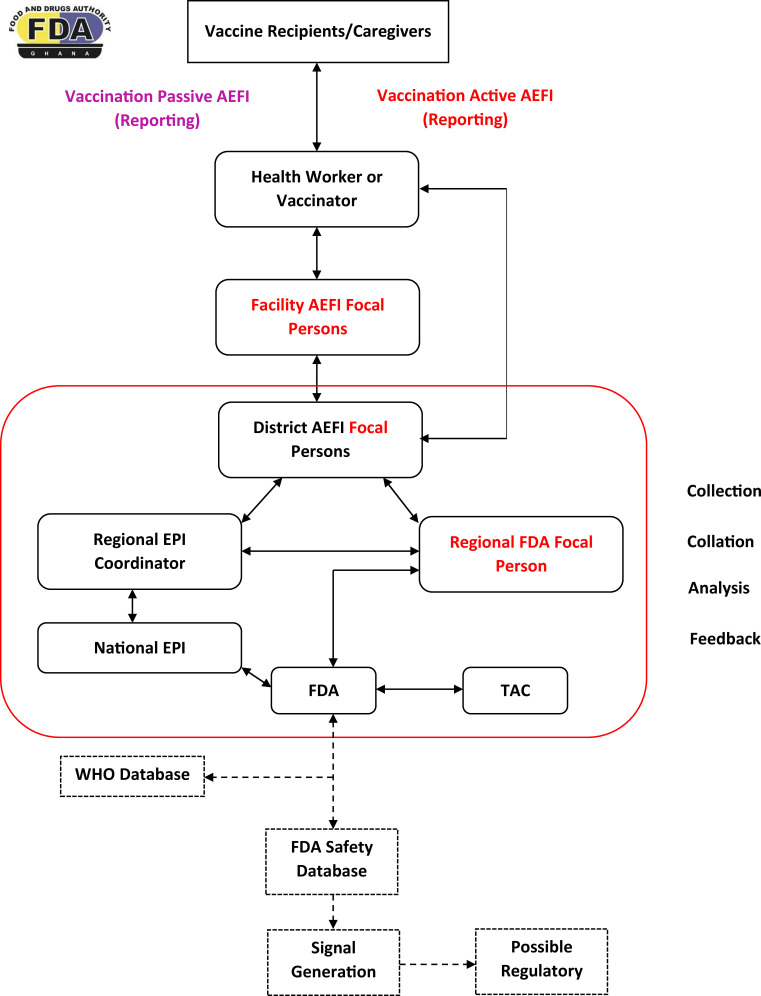
Immunisation remains an indispensable tool in preventing infectious diseases. A robust pharmacovigilance system assures the public of vaccine safety, particularly in countries like Ghana where there is relatively low reporting of adverse events following immunisation (AEFIs). We explored the experiences of health workers in Ghana to ascertain the existing capacity for data collection and information reporting flows for health events associated with vaccination in the country.
We conducted a cross-sectional quantitative survey among healthcare workers (HCWs) in Ghana between December 2020 and April 2021. We documented their experiences with regard to knowledge, perceptions and practice of reporting AEFIs to the national pharmacovigilance centre (Ghana Food and Drugs Authority).
Out of 851 participants, 49.2% said their institutions had processes for AEFI reporting. Additionally, 25% of participants had encountered an AEFI within the past year. Out of this number, 55% reported the AEFI. Only 31.2% of community health nurses (vaccinators) considered AEFI reporting part of their job description. Most HCWs (59.34%) had fair to poor knowledge of AEFIs. The main factors affecting AEFI reporting were heavy workload and lack of time (54.1%) and unavailability of reporting forms (57.5%). Only 2% of participants were aware AEFIs could be reported online. Logistic regression analysis revealed female gender as a negative factor influencing AEFI reporting. Training (p<0.0001) and profession (p=0.006) significantly influenced knowledge level of AEFIs. Results of the multiple binary logistic regression indicate that the age and profession of HCWs are the main factors influencing knowledge of reporting AEFIs.
The vaccine pharmacovigilance system in Ghana can be strengthened with targeted regular training on AEFI reporting, guidelines for reporting in all health facilities and prompt feedback from the national pharmacovigilance centre to health workers.
免疫接种仍然是预防传染病不可或缺的工具。一个强大的药物警戒系统能让公众放心疫苗的安全性,尤其是在像加纳这样免疫接种后不良事件(AEFI)报告率相对较低的国家。我们探究了加纳卫生工作者的经历,以确定该国与疫苗接种相关的健康事件的数据收集能力以及信息报告流程。
2020年12月至2021年4月期间,我们在加纳的医护人员(HCW)中进行了一项横断面定量调查。我们记录了他们在向国家药物警戒中心(加纳食品药品管理局)报告AEFI的知识、认知和实践方面的经历。
在851名参与者中,49.2%表示他们所在的机构有AEFI报告流程。此外,25%的参与者在过去一年中遇到过AEFI。在这些人中,55%报告了该AEFI。只有31.2%的社区卫生护士(疫苗接种者)认为AEFI报告是其工作职责的一部分。大多数医护人员(59.34%)对AEFI的了解程度一般或较差。影响AEFI报告的主要因素是工作量大且时间不足(54.1%)以及没有报告表格(57.5%)。只有2%的参与者知道AEFI可以在线报告。逻辑回归分析显示女性是影响AEFI报告的负面因素。培训(p<0.0001)和职业(p=0.006)对AEFI的知识水平有显著影响。多元二元逻辑回归结果表明,医护人员的年龄和职业是影响AEFI报告知识的主要因素。
加纳的疫苗药物警戒系统可以通过针对AEFI报告的定期定向培训、所有卫生机构的报告指南以及国家药物警戒中心对卫生工作者的及时反馈来加强。