Dessing Mark C, van den Broek Tim J, Hoevenaars Femke P M, van den Brink Willem J, Rundle Milena, Frost Gary, Afman Lydia, Wopereis Suzan
Netherlands Organization for Applied Scientific Research (TNO), 2333 BE, Leiden, The Netherlands.
Section of Nutrition, Department of Metabolism, Digestion and Reproduction, Faculty of Medicine, Imperial College London, London, UK.
Eur J Nutr. 2025 Mar 4;64(3):106. doi: 10.1007/s00394-025-03627-8.
Assessing the health impacts of nutritional interventions in metabolically compromised but otherwise healthy individuals is challenging, necessitating sensitive tools. Phenotypic flexibility offers an innovative way to measure homeostatic capacity during challenge tests. A composite biomarker of inflammatory resilience has proven useful in evaluating the health benefits of whole-grain wheat interventions in overweight and obese individuals. Expanding this method to other dietary interventions to combat low-grade inflammation is essential.
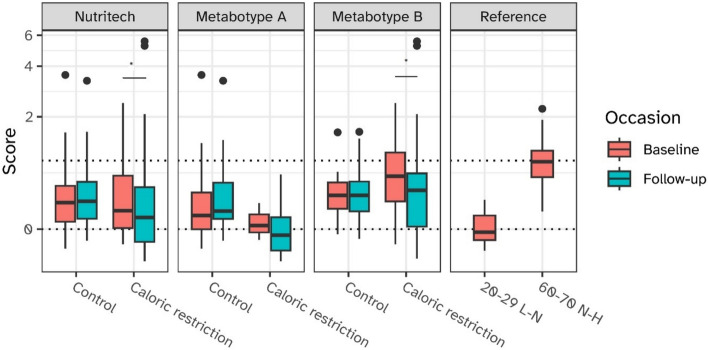
This study investigated the feasibility of a composite biomarker of inflammatory resilience through secondary analysis of samples from two independent energy restriction (ER) trials, Bellyfat (NCT02194504) and Nutritech (NCT01684917). In these trials, fasting and postprandial inflammation was analysed using a variety of markers. Four composite biomarker models were developed on the basis of postprandial inflammatory marker responses via the 'health space' model method. These models were statistically evaluated for their sensitivity in detecting the effects of 12 weeks of ER.
The minimal composite biomarkers, consisting of IL-6, IL-8, IL-10, and TNF-α, lacked the ability to detect postprandial intervention effects in both ER trials. However, in the Nutritech study, the extended, endothelial, and optimized composite biomarkers of inflammatory resilience displayed significant responses to the ER (all P < 0.005). In the latter 3 models, a reduction in the inflammatory score was correlated with a reduction in BMI and body fat percentage.
This study underscores the feasibility of employing a composite biomarker of inflammatory resilience to evaluate ER interventions. Further validation in additional nutritional intervention studies is necessary. Once validated, this composite biomarker could offer a novel approach for assessing low-grade inflammation and phenotypic flexibility.
评估营养干预对代谢功能受损但其他方面健康的个体的健康影响具有挑战性,因此需要灵敏的工具。表型灵活性为在应激试验期间测量体内稳态能力提供了一种创新方法。炎症恢复力的复合生物标志物已被证明有助于评估全麦小麦干预对超重和肥胖个体的健康益处。将这种方法扩展到其他饮食干预以对抗低度炎症至关重要。
本研究通过对来自两项独立的能量限制(ER)试验(腹部脂肪试验,NCT02194504;营养技术试验,NCT01684917)的样本进行二次分析,研究了炎症恢复力复合生物标志物的可行性。在这些试验中,使用多种标志物分析空腹和餐后炎症情况。通过“健康空间”模型方法,根据餐后炎症标志物反应建立了四个复合生物标志物模型。对这些模型检测12周能量限制效果的敏感性进行了统计学评估。
由白细胞介素-6、白细胞介素-8、白细胞介素-10和肿瘤坏死因子-α组成的最小复合生物标志物在两项能量限制试验中均无法检测到餐后干预效果。然而,在营养技术研究中,炎症恢复力的扩展、内皮和优化复合生物标志物对能量限制有显著反应(所有P<0.005)。在后三种模型中,炎症评分的降低与体重指数和体脂百分比的降低相关。
本研究强调了采用炎症恢复力复合生物标志物评估能量限制干预措施的可行性。有必要在更多营养干预研究中进行进一步验证。一旦得到验证,这种复合生物标志物可为评估低度炎症和表型灵活性提供一种新方法。