Dong Rui, Wang Gao T, DeWan Andrew T, Leal Suzanne M
Center for Statistical Genetics, Gertrude H. Sergievsky Center, and the Department of Neurology, Columbia University Medical Center, New York, NY, 10032, USA.
Department of Chronic Disease Epidemiology and Center for Perinatal, Pediatric and Environmental Epidemiology, Yale School of Public Health, 1 Church Street, New Haven, CT, 06510, USA.
BMC Genomics. 2025 Mar 6;26(1):222. doi: 10.1186/s12864-025-11318-1.
The case-only design is a powerful approach to identify gene gene and gene environment interactions for complex traits. It has been demonstrated that for the case-only design to be valid the genetic and environmental factors must be independent in the population. Additionally, there is a rare disease assumption for the case-only design, but the impact of disease prevalence and other factors, e.g., size of main effects, on type I and II error rates has not been investigated.
Through theoretical and extensive simulation studies, we investigated type I error, power, and bias of interaction term for a wide variety of disease prevalences, main and interaction effect sizes, sample sizes, and variant and environmental exposure frequencies.
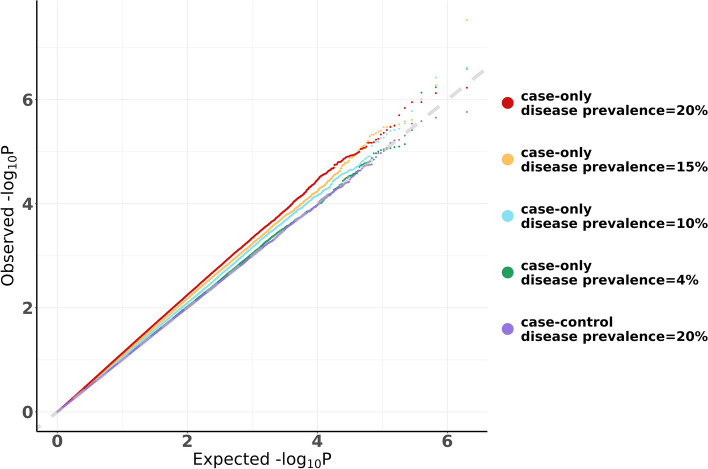
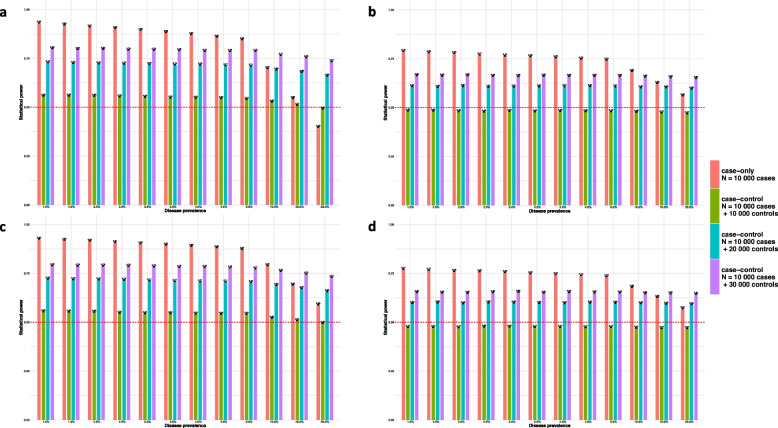
For diseases with prevalence 4%, the case-only design usually has well controlled type I error rates and is substantially more powerful to detect interactions than the case-control design, but for higher disease prevalences both type I and II error rates can be inflated and the estimate of interaction term biased. However, when one or both main effects are large there can be inflated type I error rate even for low disease prevalences, e.g., 1%, but if there is no or only one main effect, type I error rate is controlled regardless of the disease prevalence. Additionally, type I error rate can increase with sample size.
We determined the upper bound of the disease prevalence in order not to violate the rare disease assumption for the case-only design. To verify that a case-only design study does not have increased type I error rate, the bias of the interaction term should be estimated. Although the case-only design is a powerful method to detect interactions, prevalences for some complex traits are too high to implement this method without increasing type I error rates.
病例对照设计是识别复杂性状基因-基因和基因-环境相互作用的有效方法。已证明,要使病例对照设计有效,遗传和环境因素在人群中必须独立。此外,病例对照设计存在罕见病假设,但疾病患病率和其他因素(如主效应大小)对I型和II型错误率的影响尚未得到研究。
通过理论和广泛的模拟研究,我们调查了各种疾病患病率、主效应和交互效应大小、样本量以及变异和环境暴露频率下交互项的I型错误、检验效能和偏差。
对于患病率≤4%的疾病,病例对照设计通常能很好地控制I型错误率,并且在检测相互作用方面比病例对照设计更具检验效能,但对于较高的疾病患病率,I型和II型错误率可能都会升高,并且交互项的估计会有偏差。然而,当一个或两个主效应较大时,即使疾病患病率较低(如1%),I型错误率也可能会升高,但如果没有主效应或只有一个主效应,无论疾病患病率如何,I型错误率都能得到控制。此外,I型错误率可能会随着样本量的增加而增加。
我们确定了疾病患病率的上限,以不违反病例对照设计的罕见病假设。为了验证病例对照设计研究没有增加I型错误率,应该估计交互项的偏差。虽然病例对照设计是检测相互作用的有效方法,但对于一些复杂性状,其患病率过高,若不增加I型错误率则无法采用该方法。