Kebede Destaw, Shiferaw Yeromnesh, Kebede Edosa, Demsiss Wondmagegn
Department of Medical Laboratory Science, Medical Microbiology Unit, Amhara Public Health Institute (APHI), Debre Markos City, Amhara Regional State, Ethiopia.
Department of Medical Laboratory Science, Metema General Hospital, Metema City, Amhara Regional State, Ethiopia.
BMC Microbiol. 2025 Mar 8;25(1):126. doi: 10.1186/s12866-025-03842-7.
Urinary tract infection (UTI) is one of the most common bacterial infections encountered by clinicians in developing countries, affecting the urethra, bladder, and kidneys. It is a prevalent infectious disease among outpatients and hospitalized patients, leading to morbidity and mortality. Antibiotic resistance among uropathogens varies geographically, but empirical treatment is common in our study area. Therefore, this study aimed to evaluate antimicrobial susceptibility and risk factors of uropathogens in symptomatic UTI cases at Dessie Referral Hospital in northeast Ethiopia.
A hospital-based cross-sectional study design was utilized to examine 256 participants with urinary tract complaints from February 1, 2024, to May 30, 2024. Consecutive convenience sampling was used to select participants. Midstream urine samples were collected, and bacteriological tests, including culture, Gram stain, biochemical tests, and antimicrobial susceptibility tests, were conducted following standard procedures. The data were entered into EpiData version 3.1 and analyzed using SPSS version 20 software. Bivariate and multivariate logistic regressions were carried out to identify potential risk factors associated with urinary tract infection.
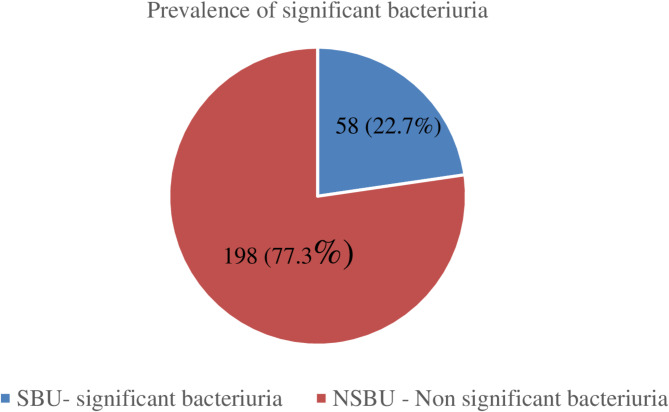
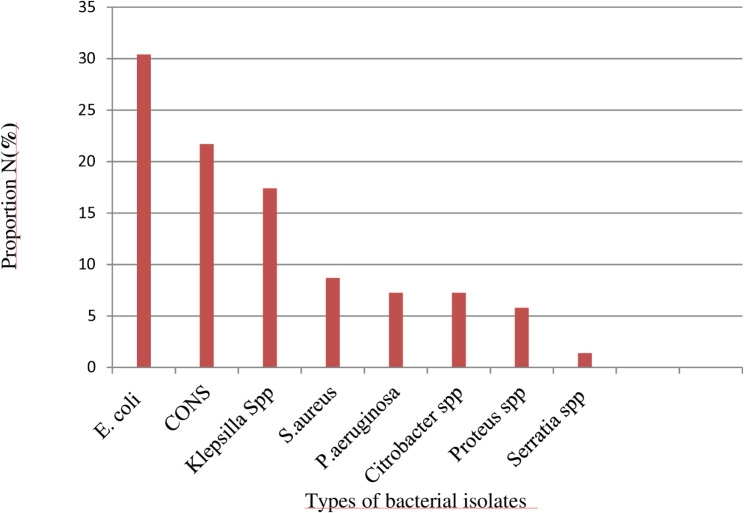
The overall prevalence of bacteriuria was 22.7%. Escherichia coli (E. coli) accounted for the highest proportion 21(30.4%), followed by Coagulase-negative Staphylococcus (CoNS) at 15(21.7%) and Klebsiella spp 12(17.4%). Most Gram-positive bacteria were susceptible to gentamicin 19(90.5%) but less sensitive to trimethoprim-sulfamethoxazole 16(76.2%) and nitrofurantoin 18(85.7%). High resistance rates were observed for penicillin 9(60%) and cefoxitin 14(66.7%). On the other hand, amikacin (83.3%), gentamicin (81.3%), and nitrofurantoin (89.7%) were effective against Gram-negative bacteria. Resistance to tetracycline and ampicillin was reported at 53.8% against both groups of bacteria. Female sex (AOR = 4.21; 95% CI = 1.43-8.29, P = 0.002), diabetes mellitus (AOR = 14.786; 95% CI = 3.91-70.72, P = 0.001), and human immunodeficiency virus positivity (AOR = 5.273; 95% CI = 2.596-17.410, P = 0.002) were identified as significant risk factors for bacteriuria.
The prevalence of UTI among syptomatic patients was 22.7%. E. coli and coagulase negative Staphylococcus were the predominant isolates. The identified bacteria were resistant to commonly use antimicrobials. Therefore, there should be continuous surveillance of UTI and antimicrobial susceptibility testing to minimize urinary tract infection and antibiotic resistance in our study setting.
尿路感染(UTI)是发展中国家临床医生遇到的最常见细菌感染之一,会影响尿道、膀胱和肾脏。它是门诊患者和住院患者中普遍存在的传染病,会导致发病和死亡。尿路病原体的抗生素耐药性因地区而异,但在我们的研究区域,经验性治疗很常见。因此,本研究旨在评估埃塞俄比亚东北部德西转诊医院有症状的尿路感染病例中尿路病原体的抗菌药敏性和危险因素。
采用基于医院的横断面研究设计,对2024年2月1日至2024年5月30日期间256名有尿路症状的参与者进行检查。采用连续便利抽样法选择参与者。收集中段尿样本,并按照标准程序进行细菌学检测,包括培养、革兰氏染色、生化检测和抗菌药敏试验。数据录入EpiData 3.1版本,并使用SPSS 20软件进行分析。进行二元和多因素逻辑回归以确定与尿路感染相关的潜在危险因素。
菌尿的总体患病率为22.7%。大肠埃希菌(E. coli)占比最高,为21例(30.4%),其次是凝固酶阴性葡萄球菌(CoNS),为15例(21.7%),克雷伯菌属为12例(17.4%)。大多数革兰氏阳性菌对庆大霉素敏感,为19例(90.5%),但对甲氧苄啶-磺胺甲恶唑敏感性较低,为16例(76.2%),对呋喃妥因敏感性为18例(85.7%)。青霉素的耐药率为9例(60%),头孢西丁的耐药率为14例(66.7%)。另一方面,阿米卡星(83.3%)、庆大霉素(81.3%)和呋喃妥因(89.7%)对革兰氏阴性菌有效。两组细菌对四环素和氨苄西林均有53.8%的耐药率。女性(优势比[AOR]=4.21;95%置信区间[CI]=1.43-8.29,P=0.002)、糖尿病(AOR=14.786;95%CI=3.91-70.72,P=0.001)和人类免疫缺陷病毒阳性(AOR=5.273;95%CI=2.596-17.410,P=0.002)被确定为菌尿的重要危险因素。
有症状患者中尿路感染的患病率为22.7%。大肠埃希菌和凝固酶阴性葡萄球菌是主要分离株。所鉴定的细菌对常用抗菌药物耐药。因此,应持续监测尿路感染和抗菌药敏试验,以尽量减少我们研究环境中的尿路感染和抗生素耐药性。