Mladoňová Michaela, Fedorová Katarína, Jor Ondřej, Slonková Jana, Kondé Adéla, Komínek Pavel, Matoušek Petr
Department of Otorhinolaryngology and Head and Neck Surgery, University Hospital Ostrava, 17. Listopadu 1790, 70800, Ostrava, Czech Republic.
Faculty of Medicine, University of Ostrava, Ostrava, 70800, Czech Republic.
Eur Arch Otorhinolaryngol. 2025 May;282(5):2709-2717. doi: 10.1007/s00405-025-09314-y. Epub 2025 Mar 10.
This study aimed to assess the impact of positional changes on upper airway obstruction patterns during drug-induced sleep endoscopy (DISE) in patients with obstructive sleep apnea (OSA) and identify the airway regions most responsive to this change. Special focus was placed on the tongue base, a critical area in OSA pathophysiology.
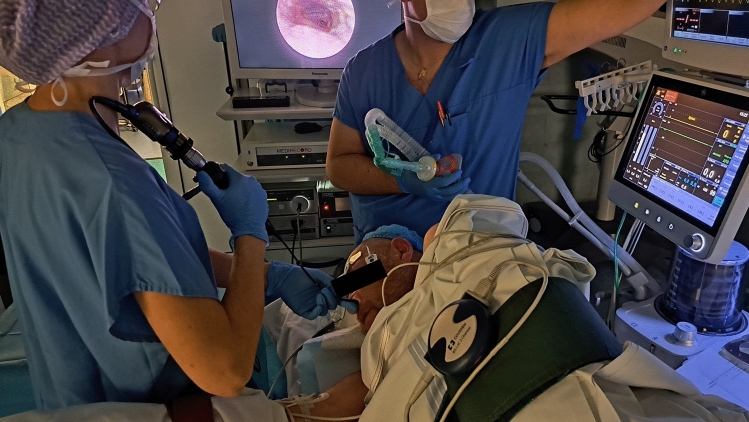
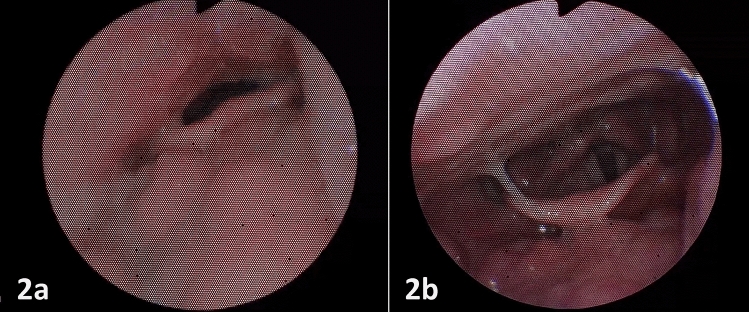
This prospective study was conducted from June 2021 to June 2024. DISE was performed in patients with obstructive sleep apnea (OSA) in supine and lateral positions to simulate the effect of positional therapy. Findings were evaluated using the VOTE classification.
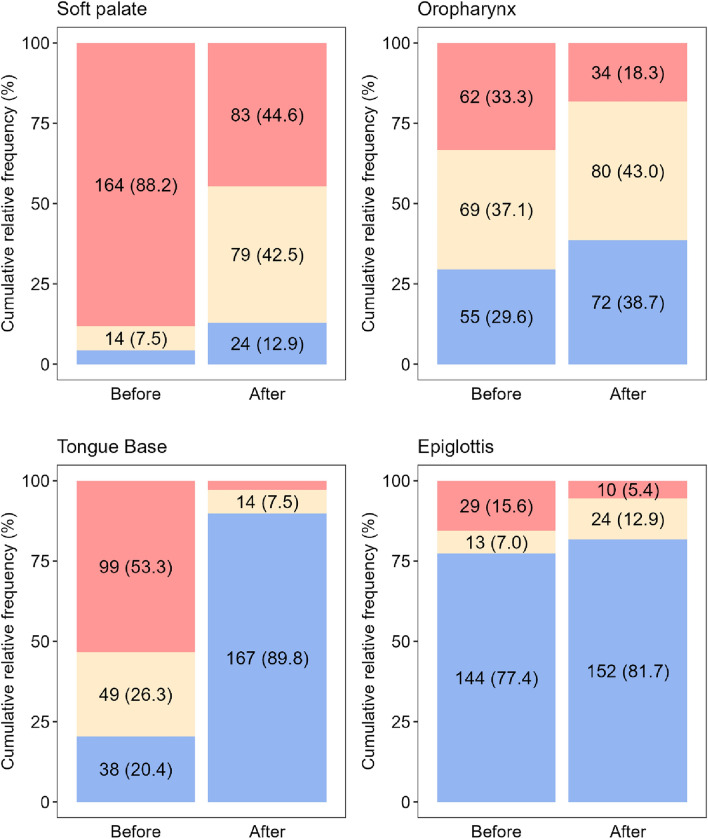
The examination was performed on 186 patients, with a median Apnea-Hypopnea Index (AHI) of 19.3. In the supine position, complete obstructions were noted at the soft palate (88.2%), oropharynx (33.3%), tongue base (53.2%), and epiglottis (15.6%). Lateral positioning significantly reduced obstructions, particularly at the tongue base, where obstruction resolved in 94/99 of cases (94.9%). This improvement was significantly more pronounced at the tongue base than at other sites (p < 0.001).
These results suggest that DISE can identify airway regions responsive to positional changes, potentially guiding clinical decisions on positional therapy. The findings show a significant reduction in tongue base obstruction during lateral positioning in DISE. Since tongue base obstruction is a key contributor to airway collapse in OSA, this improvement suggests a practical, non-invasive treatment approach. While these findings highlight an acute association between lateral positioning and reduced obstruction, further studies are needed to evaluate its long-term clinical efficacy.
本研究旨在评估阻塞性睡眠呼吸暂停(OSA)患者在药物诱导睡眠内镜检查(DISE)期间体位变化对上气道阻塞模式的影响,并确定对这种变化最敏感的气道区域。特别关注舌根,这是OSA病理生理学中的一个关键区域。
本前瞻性研究于2021年6月至2024年6月进行。对阻塞性睡眠呼吸暂停(OSA)患者进行仰卧位和侧卧位的DISE,以模拟体位治疗的效果。使用VOTE分类法评估结果。
对186例患者进行了检查,中位呼吸暂停低通气指数(AHI)为19.3。在仰卧位时,软腭(88.2%)、口咽(33.3%)、舌根(53.2%)和声门(15.6%)出现完全阻塞。侧卧位显著减少了阻塞,特别是在舌根处,94/99例(94.9%)的阻塞得到缓解。舌根处的改善比其他部位更为明显(p<0.001)。
这些结果表明,DISE可以识别对体位变化有反应的气道区域,可能为体位治疗的临床决策提供指导。研究结果显示,在DISE中侧卧位时舌根阻塞显著减少。由于舌根阻塞是OSA气道塌陷的关键因素,这种改善提示了一种实用的非侵入性治疗方法。虽然这些发现突出了侧卧位与减少阻塞之间的急性关联,但仍需要进一步研究来评估其长期临床疗效。