Hothi Harneet, Paolone Arianna R, Pezeshki Matteen, Griffith Lauren E, Kennedy Courtney C, Leong Darryl P, Marcucci Maura, Papaioannou Alexandra, Lee Justin
Temerty Faculty of Medicine, University of Toronto, Toronto, Canada.
Centre for Integrated Care, St. Joseph's Health System, Hamilton, Canada.
J Am Geriatr Soc. 2025 Aug;73(8):2571-2578. doi: 10.1111/jgs.19438. Epub 2025 Mar 15.
Frailty is a syndrome of increased vulnerability to health stressors that is associated with adverse health outcomes. There is no universally accepted method of measuring frailty, and choosing among the many tools is often confusing for clinicians. Moreover, the acute care setting presents unique challenges to the operationalization of frailty measurement, and implementation into daily clinical practice has been variable. The objective of this scoping review was to map out and synthesize how frailty is being measured and used in the acute care setting.
We used Arksey and O'Malley's methodological framework for scoping reviews. We searched MEDLINE, EMBASE, CINAHL, SCOPUS, and Google Scholar for primary studies assessing frailty in the acute care setting from inception to May 2023.
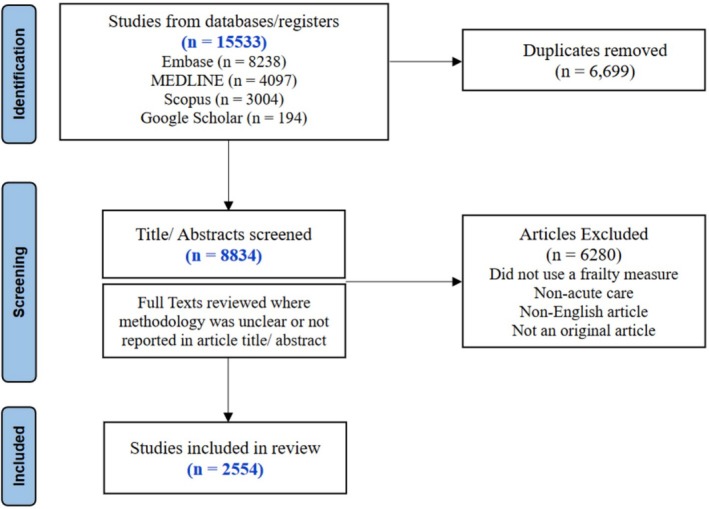
Our search resulted in 8834 articles, of which 2554 met inclusion criteria. Most articles (75%) were published in the last 5 years. The top three most frequently used methods of frailty measurement were the Frailty Index (41.0%), the Clinical Frailty Scale (23.3%), and the Fried Frailty Phenotype (9.3%). More than one frailty assessment tool was used in 11.2% of studies. While 99.6% of studies measured frailty assessment to evaluate the association of frailty with adverse outcomes or the validity of specific frailty tools, only 0.4% measured frailty to prospectively adapt healthcare provision.
There is an abundance of evidence demonstrating that frailty in acute care is associated with adverse health outcomes, with relatively scarce evidence on the effect of frailty assessment on prospectively adapting care. Future research focusing on the prospective management of frailty in acute care is needed.
衰弱是一种对健康应激源易感性增加的综合征,与不良健康结局相关。目前尚无普遍接受的测量衰弱的方法,临床医生在众多工具中进行选择时往往感到困惑。此外,急性护理环境给衰弱测量的实施带来了独特的挑战,在日常临床实践中的应用情况也各不相同。本范围综述的目的是梳理和综合急性护理环境中衰弱的测量和应用方式。
我们使用了阿克西和奥马利的范围综述方法框架。我们检索了MEDLINE、EMBASE、CINAHL、SCOPUS和谷歌学术,以查找从创刊到2023年5月评估急性护理环境中衰弱情况的原始研究。
我们的检索共得到8834篇文章,其中2554篇符合纳入标准。大多数文章(75%)发表于过去5年。最常用的三种衰弱测量方法是衰弱指数(41.0%)、临床衰弱量表(23.3%)和弗里德衰弱表型(9.3%)。11.2%的研究使用了不止一种衰弱评估工具。虽然99.6%的研究测量衰弱评估是为了评估衰弱与不良结局的关联或特定衰弱工具的有效性,但只有0.4%的研究测量衰弱是为了前瞻性地调整医疗服务。
有大量证据表明急性护理中的衰弱与不良健康结局相关,而关于衰弱评估对前瞻性调整护理的效果的证据相对较少。未来需要开展聚焦于急性护理中衰弱前瞻性管理的研究。