Shepherd Jonti Evan, Kanner Ori, Amir Or, Efrati Bar, Ben-Dor Eyal
The Remote Sensing Laboratory, Porter School of Environment and Earth Science, Faculty of Exact Science, Tel Aviv University, Tel Aviv, Israel.
Sci Rep. 2025 Mar 17;15(1):9068. doi: 10.1038/s41598-025-93792-x.
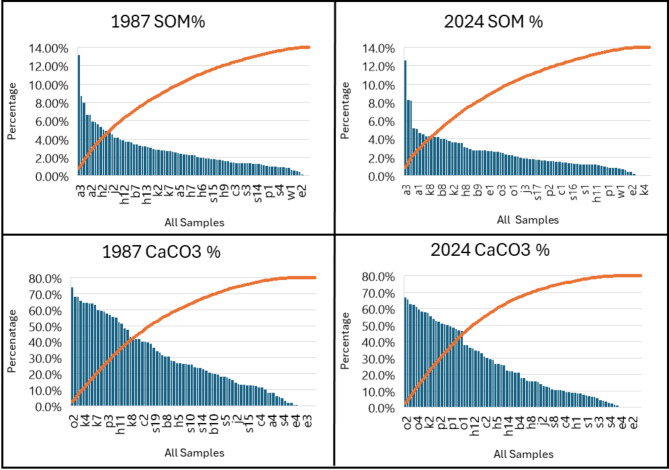
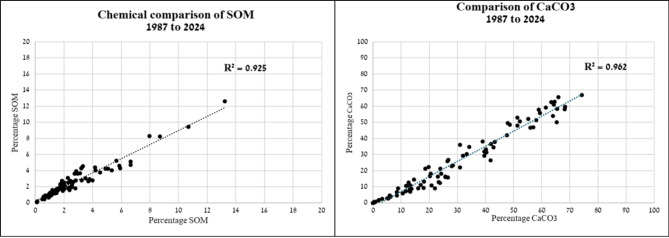
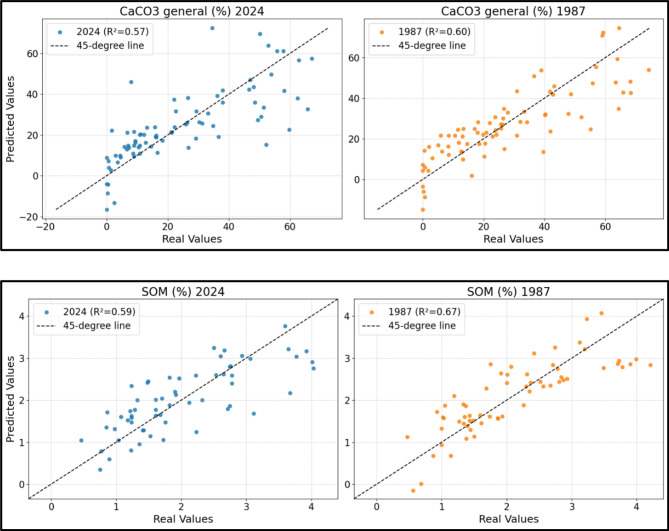
Soil spectral libraries (SSLs) are physical soil samples that are stored under different conditions by many users for decades. Yet the long-term stability of soil properties under these stored conditions remains largely unexplored. This study investigates the chemical and spectral stability of the Israeli legacy SSL, established in 1987, stored under uncontrolled indoor conditions for 34-37 years. Ninety-one Mediterranean soils from this collection were reanalyzed for soil organic matter (SOM), calcium carbonate (CaCO), using identical protocols and spectroscopic methods in 1987 and 2024 (chemical) and 2004 and 2024 (spectral). Results demonstrate minimal changes in SOM and CaCO, supported by strong linear correlations between historical and contemporary datasets (R of 0.925 and 0.962 for SOM and CaCO respectively). Spectroscopic analysis showed superior precision and reliability compared to wet chemistry. Additionally, spectral stability over time was confirmed using the modified average spectral difference stability (mASDS) metric, Principal Component Analysis (PCA) and partial least squares regression (PLSR), underscoring the robustness of spectroscopic approaches. Spectral modeling of the chemical data from both years revealed outliers which we assume emerged from analytical accuracy differences and not from spectroscopy errors. This study highlights that Mediterranean soils stored under simple un-controlled conditions maintain their physical and chemical integrity, enabling reliable longitudinal studies. These findings advocate for broader SSL archiving efforts to support soil health monitoring, climate change studies, and sustainable land management practices by utilizing old collections of stored soils that can be measured spectrally to enrich SSLs worldwide. Future research should focus on other climatic regions and soil types to generalize these findings and address possible microbial activity impacts during storage. This work underscores SSLs as critical resources for soil science, offering insights into temporal soil dynamics and facilitating global soil monitoring efforts.
土壤光谱库(SSLs)是由许多用户在不同条件下存储了数十年的物理土壤样本。然而,这些存储条件下土壤性质的长期稳定性在很大程度上仍未得到探索。本研究调查了1987年建立的以色列传统SSL的化学和光谱稳定性,该光谱库在不受控制的室内条件下存储了34 - 37年。对该样本集中的91种地中海土壤重新分析了土壤有机质(SOM)、碳酸钙(CaCO),在1987年和2024年(化学分析)以及2004年和2024年(光谱分析)使用相同的方案和光谱方法。结果表明,SOM和CaCO的变化极小,历史数据集与当代数据集之间具有很强的线性相关性(SOM和CaCO的R分别为0.925和0.962)。光谱分析显示,与湿化学相比,具有更高的精度和可靠性。此外,使用改进的平均光谱差异稳定性(mASDS)指标、主成分分析(PCA)和偏最小二乘回归(PLSR)证实了光谱随时间的稳定性,强调了光谱方法的稳健性。对这两年化学数据的光谱建模揭示了异常值,我们认为这些异常值是由分析精度差异而非光谱误差产生的。本研究强调,在简单不受控制的条件下存储的地中海土壤保持了其物理和化学完整性,从而能够进行可靠的纵向研究。这些发现提倡进行更广泛的SSL存档工作,以通过利用可进行光谱测量的旧土壤样本集丰富全球SSLs,来支持土壤健康监测、气候变化研究和可持续土地管理实践。未来的研究应关注其他气候区域和土壤类型,以推广这些发现并解决存储期间可能的微生物活动影响。这项工作强调了SSLs作为土壤科学关键资源的重要性,为土壤时间动态提供了见解,并促进了全球土壤监测工作。