El-Azab Heba-Allah Ibrahim, Swief R A, El-Amary Noha H, Temraz H K
Faculty of Engineering, Ahram Canadian University (ACU), Giza, Egypt.
Faculty of Engineering, Ain Shams University, Cairo, 11517, Egypt.
Sci Rep. 2025 Mar 18;15(1):9252. doi: 10.1038/s41598-025-91878-0.
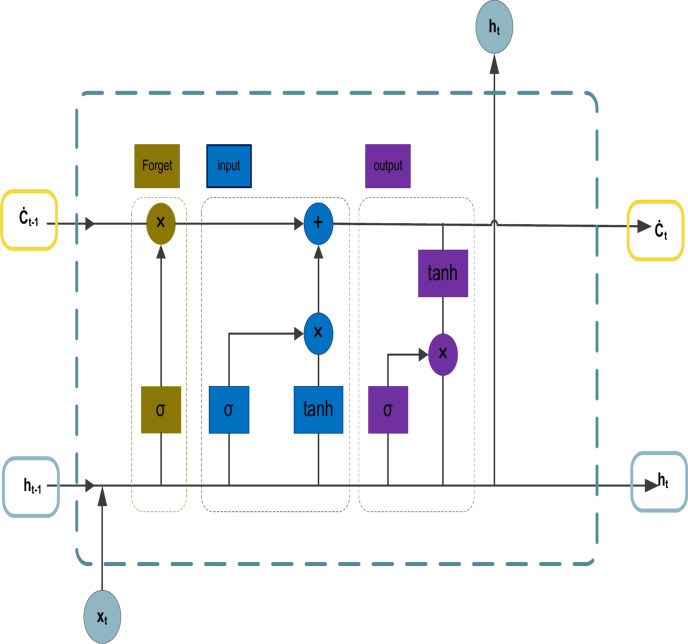
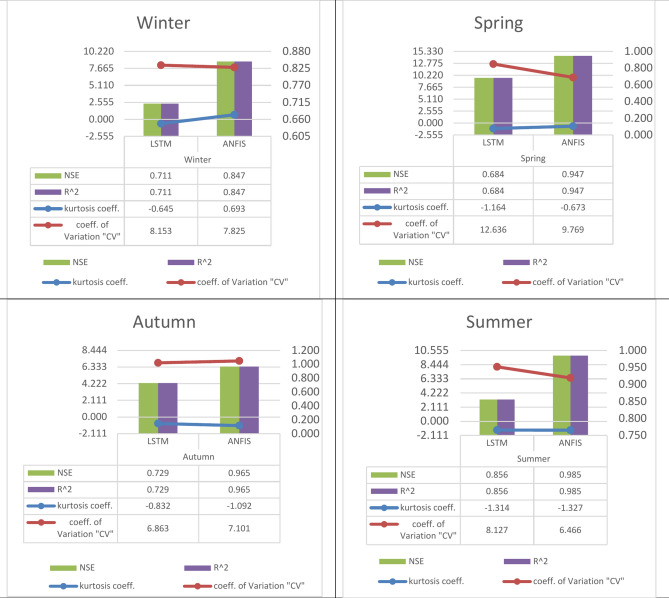
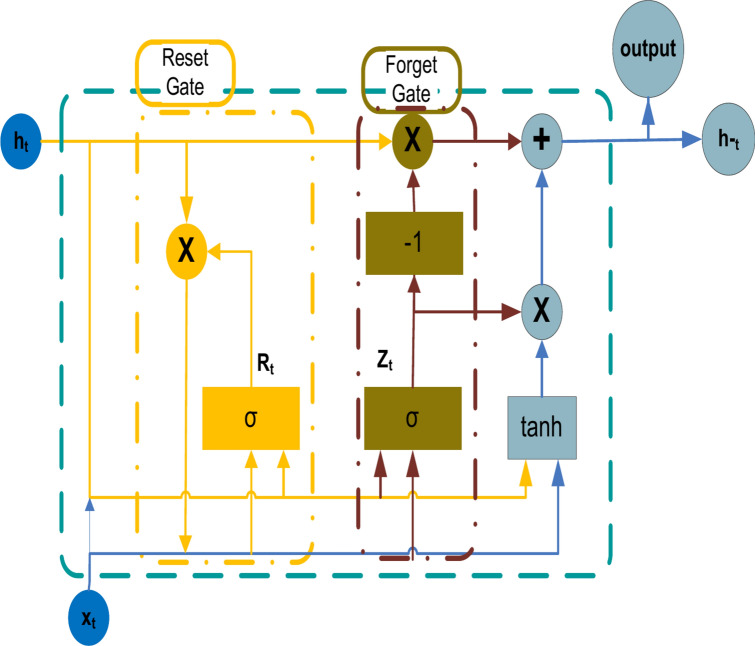
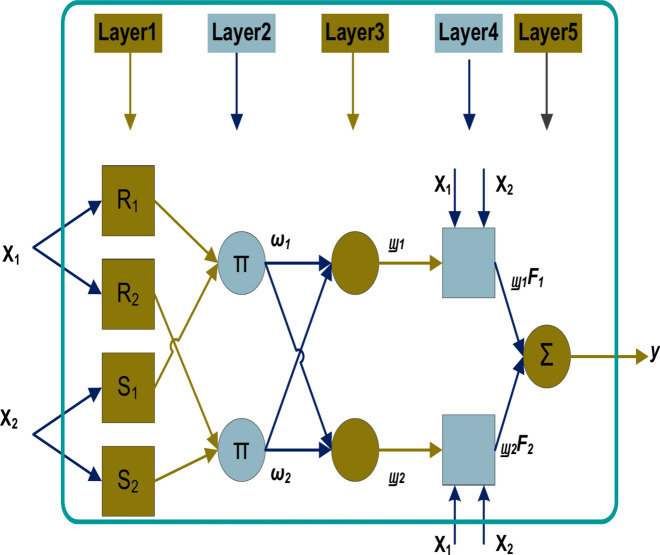
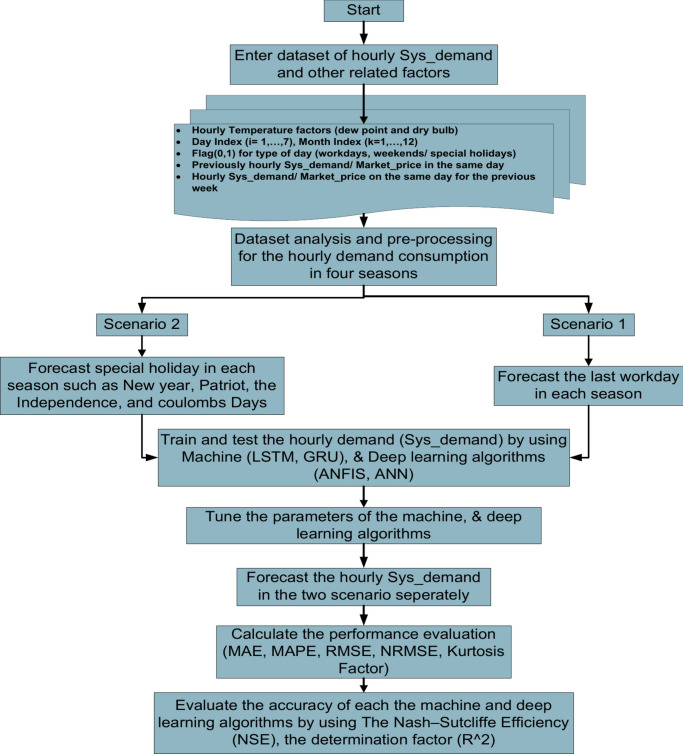
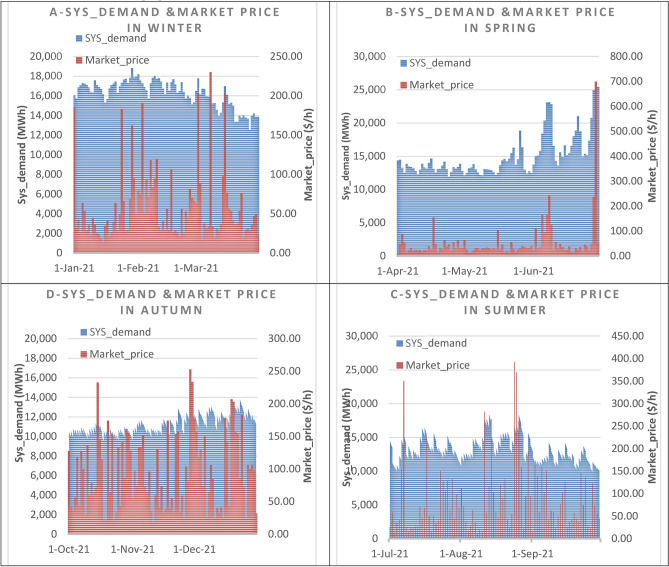
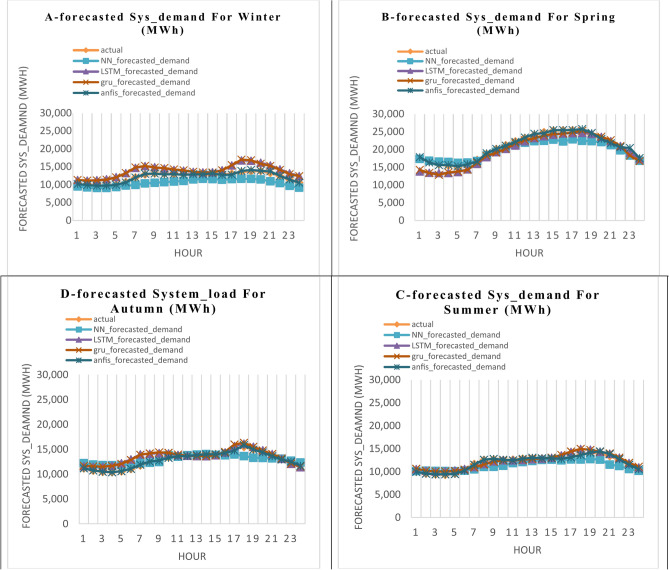
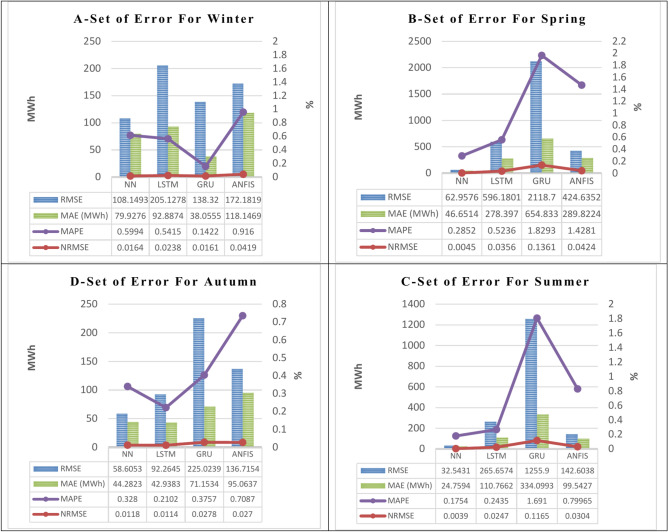
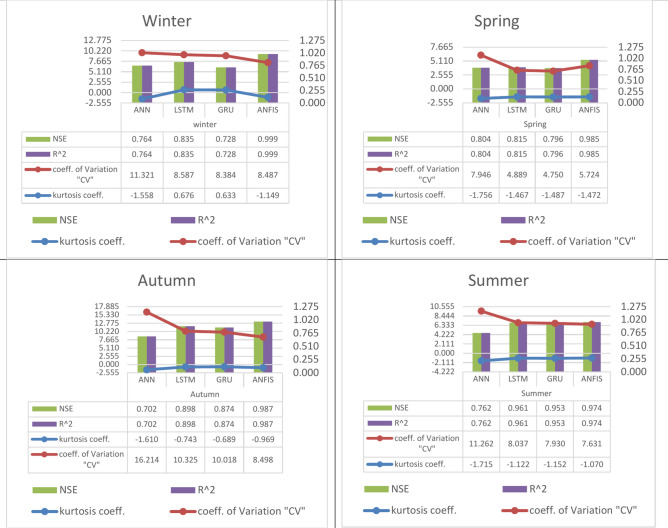
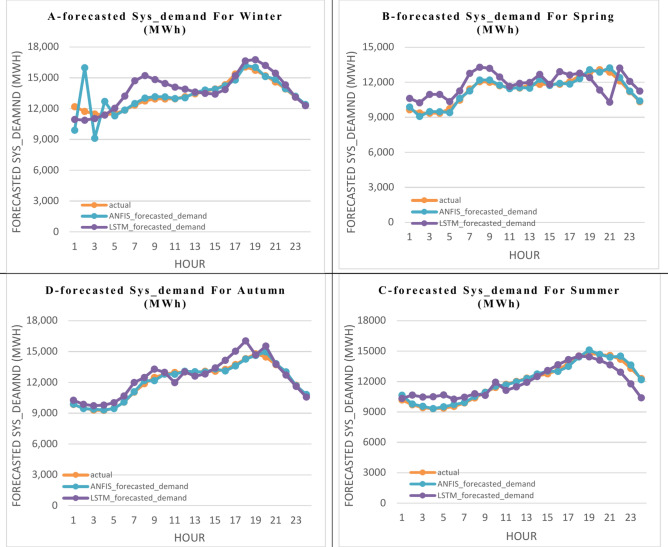
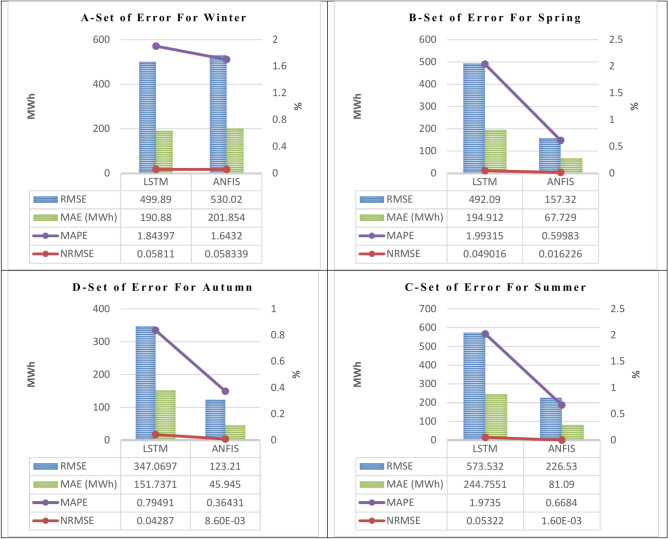
The purpose of this paper is to suggest short-term Seasonal forecasting for hourly electricity demand in the New England Control Area (ISO-NE-CA). Precision improvements are also considered when creating a model. Where the whole database is split into four seasons based on demand patterns. This article's integrated model is built on techniques for machine and deep learning methods: Adaptive Neural-based Fuzzy Inference System, Long Short-Term Memory, Gated Recurrent Units, and Artificial Neural Networks. The linear relationship between temperature and electricity consumption makes the relationship noteworthy. Comparing the temperature effect in a working day and a temperature effect on a weekend day where at night, the marginal effects of temperature on the demand in a working day for power are likewise at their highest. However, there are significant effects of temperature on the demand for a holiday, even a weekend or special holiday. Two scenarios are used to get the results by using machine and deep learning techniques in four seasons. The first scenario is to forecast a working day, and the second scenario is to forecast a holiday (weekend or special holiday) under the effect of the temperature in each of the four seasons and the cost of electricity. To clarify the four techniques' performance and effectiveness, the results were compared using the Mean Absolute Error (MAE), Root Mean Squared Error (RMSE), Normalized Root Mean Squared Error (NRMSE), and Mean Absolute Percentage Error (MAPE) values. The forecasting model shows that the four highlighted algorithms perform well with minimal inaccuracy. Where the highest and the lowest accuracy for the first scenario are (99.90%) in the winter by simulating an Adaptive Neural-based Fuzzy Inference System and (70.20%) in the autumn by simulating Artificial Neural Network. For the second scenario, the highest and the lowest accuracy are (96.50%) in the autumn by simulating Adaptive Neural-based Fuzzy Inference System and (68.40%) in the spring by simulating Long Short-Term Memory. In addition, the highest and the lowest values of Mean Absolute Error (MAE) for the first scenario are (46.6514, and 24.759 MWh) in the spring, and the summer by simulating Artificial Neural Networks. The highest and the lowest values of Mean Absolute Error (MAE) for the second scenario are (190.880, and 45.945 MWh) in the winter, and the autumn by simulating Long Short-Term Memory, and Adaptive Neural-based Fuzzy Inference System.
本文旨在为新英格兰控制区(ISO-NE-CA)的每小时电力需求提供短期季节性预测。在创建模型时,还考虑了精度的提高。整个数据库根据需求模式分为四个季节。本文的集成模型基于机器学习和深度学习方法构建:自适应神经模糊推理系统、长短期记忆网络、门控循环单元和人工神经网络。温度与电力消耗之间的线性关系使得这种关系值得关注。比较工作日的温度效应和周末夜晚的温度效应,温度对工作日电力需求的边际效应同样处于最高水平。然而,温度对节假日(即使是周末或特殊节日)的需求也有显著影响。通过在四个季节中使用机器学习和深度学习技术来得出结果,采用了两种情景。第一种情景是预测工作日,第二种情景是在四个季节中每个季节的温度和电价影响下预测节假日(周末或特殊节日)。为了阐明这四种技术的性能和有效性,使用平均绝对误差(MAE)、均方根误差(RMSE)、归一化均方根误差(NRMSE)和平均绝对百分比误差(MAPE)值对结果进行了比较。预测模型表明,这四种突出的算法表现良好,误差极小。第一种情景下,通过模拟自适应神经模糊推理系统,冬季的最高准确率为(99.90%),秋季通过模拟人工神经网络的最低准确率为(70.20%)。对于第二种情景,通过模拟自适应神经模糊推理系统,秋季的最高准确率为(96.50%),春季通过模拟长短期记忆网络的最低准确率为(68.40%)。此外,第一种情景下平均绝对误差(MAE)的最高值和最低值分别为春季和夏季通过模拟人工神经网络时的(46.6514和24.759兆瓦时)。第二种情景下平均绝对误差(MAE)的最高值和最低值分别为冬季和秋季通过模拟长短期记忆网络和自适应神经模糊推理系统时的(190.880和45.945兆瓦时)。