Gruber Nicole, Jockisch Alfred
Department of Culture, Speech and Language, Universität Regensburg, Regensburg, Germany.
Department of Information Technology, UKR Regensburg, Regensburg, Germany.
Front Artif Intell. 2020 Jun 30;3:40. doi: 10.3389/frai.2020.00040. eCollection 2020.
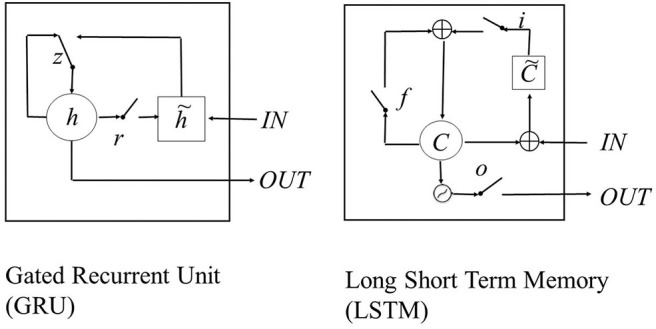
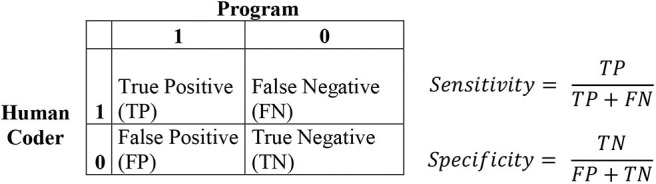
In the Thematic Apperception Test, a picture story exercise (TAT/PSE; Heckhausen, 1963), it is assumed that unconscious motives can be detected in the text someone is telling about pictures shown in the test. Therefore, this text is classified by trained experts regarding evaluation rules. We tried to automate this coding and used a recurrent neuronal network (RNN) because of the sequential input data. There are two different cell types to improve recurrent neural networks regarding long-term dependencies in sequential input data: long-short-term-memory cells (LSTMs) and gated-recurrent units (GRUs). Some results indicate that GRUs can outperform LSTMs; others show the opposite. So the question remains when to use GRU or LSTM cells. The results show ( = 18000 data, 10-fold cross-validated) that the GRUs outperform LSTMs (accuracy = .85 vs. .82) for overall motive coding. Further analysis showed that GRUs have higher specificity (true negative rate) and learn better less prevalent content. LSTMs have higher sensitivity (true positive rate) and learn better high prevalent content. A closer look at a picture x category matrix reveals that LSTMs outperform GRUs only where deep context understanding is important. As these both techniques do not clearly present a major advantage over one another in the domain investigated here, an interesting topic for future work is to develop a method that combines their strengths.
在主题统觉测验(一种图片故事练习,即TAT/PSE;赫克豪森,1963年)中,人们假定可以从受试者针对测验中所展示图片讲述的文本中检测到无意识动机。因此,训练有素的专家会依据评估规则对这段文本进行分类。由于输入数据具有序列性,我们尝试将这种编码自动化,并使用了循环神经网络(RNN)。为了在序列输入数据中处理长期依赖关系,有两种不同的细胞类型可用于改进循环神经网络:长短期记忆细胞(LSTM)和门控循环单元(GRU)。一些结果表明GRU的性能优于LSTM;另一些结果则相反。所以问题依然存在,即何时使用GRU或LSTM细胞。结果显示( = 18000个数据,10折交叉验证),在整体动机编码方面,GRU的表现优于LSTM(准确率分别为0.85和0.82)。进一步分析表明,GRU具有更高的特异性(真阴性率),并且在学习较少出现的内容方面表现更好。LSTM具有更高的敏感性(真阳性率),并且在学习高频出现的内容方面表现更好。仔细观察图片x类别矩阵会发现,只有在深度上下文理解很重要的情况下,LSTM的表现才优于GRU。由于在本文所研究的领域中,这两种技术都没有明显地展现出相对于彼此的主要优势,因此未来工作的一个有趣课题是开发一种结合它们优势的方法。