Cakar Merve, Kadioglu Hasibe
Duzce University, Faculty of Health Sciences, Nursing Department, Düzce, Turkey.
Marmara University, Faculty of Health Sciences, Nursing Department, İstanbul, Turkey.
BMC Psychol. 2025 Mar 22;13(1):289. doi: 10.1186/s40359-025-02583-6.
Participation in recreational activities supports continuity of activity and psychological well-being in old age. Games are one of these recreational activities. This study aims to measure the influence of recreational games on somatisation, loneliness, happiness and life satisfaction among elderly individuals.
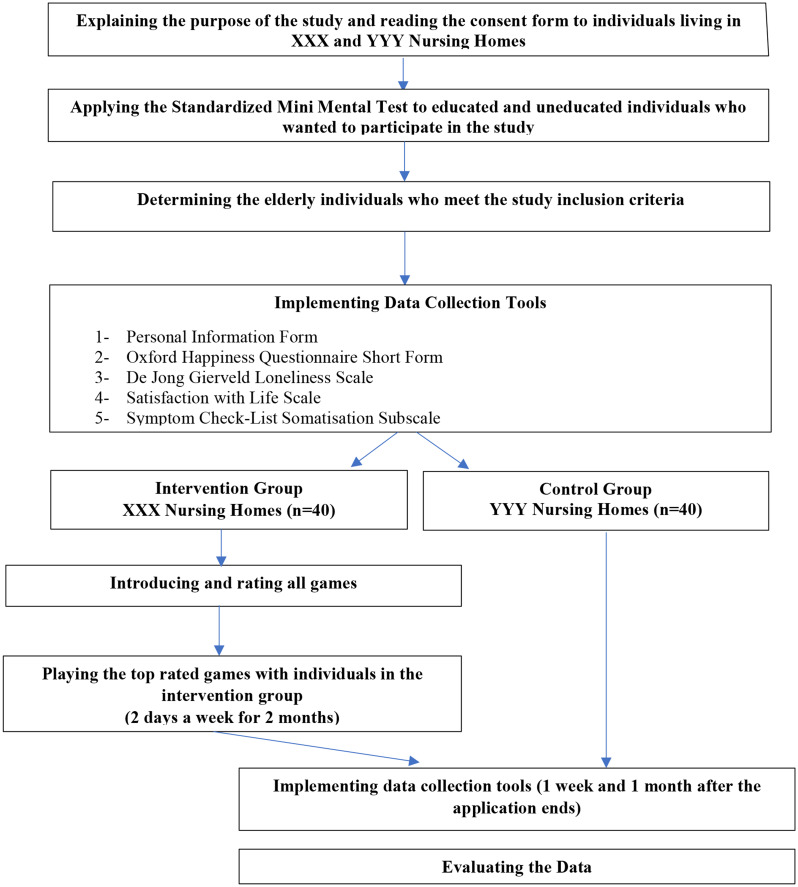
This non-randomized quasi-experimental study involved 80 individuals from two nursing homes, allocated to intervention (n = 40) and control (n = 40) groups. Participants, aged 65 or older, met cognitive eligibility criteria based on the Standardized Mini-Mental State Examination. The intervention group selected 4 games (hot-and-cold, word challenge, bingo, matching pairs) from a set of 15 and played twice weekly for two months in smaller groups. The control group maintained their usual leisure activities. Data were collected using the Oxford Happiness Questionnaire Short Form, Satisfaction with Life Scale, De Jong Gierveld Loneliness Scale, and Symptom Checklist-90-Revised Somatization Subscale at baseline, 1 week, and 1 month post-intervention.
The intervention group (IG) showed significant improvements compared to the control group (CG). Happiness (η² = 0.93) and life satisfaction (η² = 0.92) increased significantly in the IG (p < 0.0001), with higher scores than the CG in both the post-test (r ≈ -0.246 to -0.212, p < 0.05) and follow-up (r ≈ -0.273 to -0.309, p < 0.01). Loneliness, including emotional and social loneliness, decreased significantly in the IG (η² = 0.94, p < 0.0001), with greater reductions than the CG in the post-test and follow-up (r ≈ -0.503 to -0.593, p < 0.0001). Somatization did not change significantly within the IG but showed a reduction compared to the CG in the post-test and follow-up (r ≈ -0.226 to -0.280, p < 0.05).
Recreational games may give psychological benefits to older adults. Yet, results of the study need to be interpreted with caution and need to be replicated.
ClinicalTrials.gov identifier: NCT06505070 (retrospectively registered, Protocol ID: Duzce-U-merve0003, Last Update Posted: 2024-08-02). https://ctv.veeva.com/study/the-effect-of-recreational-games-on-happiness-life-satisfaction-loneliness-and-somatisation-in-el?comeFrom=study-search .
参与娱乐活动有助于老年人保持活动的连续性并促进心理健康。游戏是这些娱乐活动之一。本研究旨在衡量娱乐游戏对老年人躯体化、孤独感、幸福感和生活满意度的影响。
这项非随机准实验研究涉及来自两家养老院的80名老人,分为干预组(n = 40)和对照组(n = 40)。参与者年龄在65岁及以上,根据标准化简易精神状态检查表符合认知资格标准。干预组从15种游戏中挑选了4种(热与冷、单词挑战、宾果游戏、配对游戏),以小组形式每周玩两次,为期两个月。对照组维持其平常的休闲活动。在基线、干预后1周和1个月时,使用牛津幸福问卷简表、生活满意度量表、德容格维尔德孤独感量表和症状自评量表90修订版的躯体化分量表收集数据。
与对照组相比,干预组有显著改善。干预组的幸福感(η² = 0.93)和生活满意度(η² = 0.92)显著提高(p < 0.0001),在后测(r ≈ -0.246至-0.212,p < 0.05)和随访(r ≈ -0.273至-0.309,p < 0.01)中的得分均高于对照组。干预组的孤独感,包括情感孤独和社交孤独,显著降低(η² = 0.94,p < 0.0001),在后测和随访中的降低幅度大于对照组(r ≈ -0.503至-0.593,p < 0.0001)。干预组内躯体化没有显著变化,但在后测和随访中与对照组相比有所降低(r ≈ -0.226至-0.280,p < 0.05)。
娱乐游戏可能对老年人有心理益处。然而,该研究结果需要谨慎解读且需重复验证。
ClinicalTrials.gov标识符:NCT06505070(回顾性注册,方案编号:Duzce-U-merve0003,最后更新日期:2024-08-02)。https://ctv.veeva.com/study/the-effect-of-recreational-games-on-happiness-life-satisfaction-loneliness-and-somatisation-in-el?comeFrom=study-search 。