• 文献检索
  • 文档翻译
  • 深度研究
  • 学术资讯
  • Suppr Zotero 插件Zotero 插件
  • 邀请有礼
  • 套餐&价格
  • 历史记录
应用&插件
Suppr Zotero 插件Zotero 插件浏览器插件Mac 客户端Windows 客户端微信小程序
定价
高级版会员购买积分包购买API积分包
服务
文献检索文档翻译深度研究API 文档MCP 服务
关于我们
关于 Suppr公司介绍联系我们用户协议隐私条款
关注我们

Suppr 超能文献

核心技术专利:CN118964589B侵权必究
粤ICP备2023148730 号-1Suppr @ 2026

文献检索

告别复杂PubMed语法,用中文像聊天一样搜索,搜遍4000万医学文献。AI智能推荐,让科研检索更轻松。

立即免费搜索

文件翻译

保留排版,准确专业,支持PDF/Word/PPT等文件格式,支持 12+语言互译。

免费翻译文档

深度研究

AI帮你快速写综述,25分钟生成高质量综述,智能提取关键信息,辅助科研写作。

立即免费体验

生物与工程的交织:纺织品及其在组织工程中的应用简介。

Interlacing biology and engineering: An introduction to textiles and their application in tissue engineering.

作者信息

Scholpp S, Hoffmann L A, Schätzlein E, Gries T, Emonts C, Blaeser A

机构信息

Institute for BioMedical Printing Technology, Technical University of Darmstadt, Darmstadt, Germany.

Institut für Textiltechnik, RWTH Aachen University, Aachen, Germany.

出版信息

Mater Today Bio. 2025 Feb 25;31:101617. doi: 10.1016/j.mtbio.2025.101617. eCollection 2025 Apr.

DOI:10.1016/j.mtbio.2025.101617
PMID:40124339
原文链接:https://pmc.ncbi.nlm.nih.gov/articles/PMC11926717/
Abstract

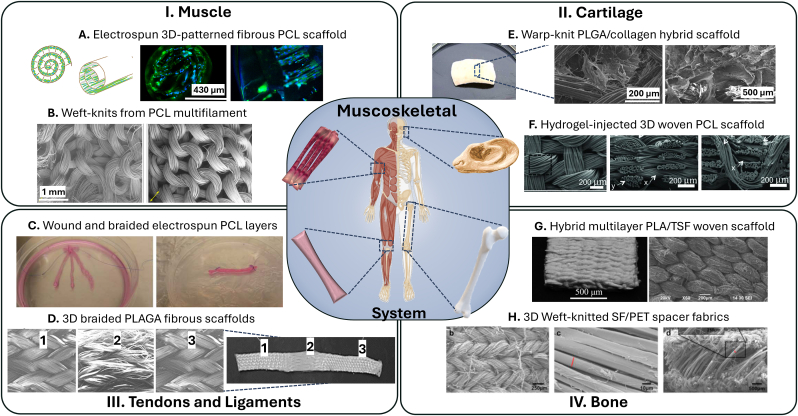
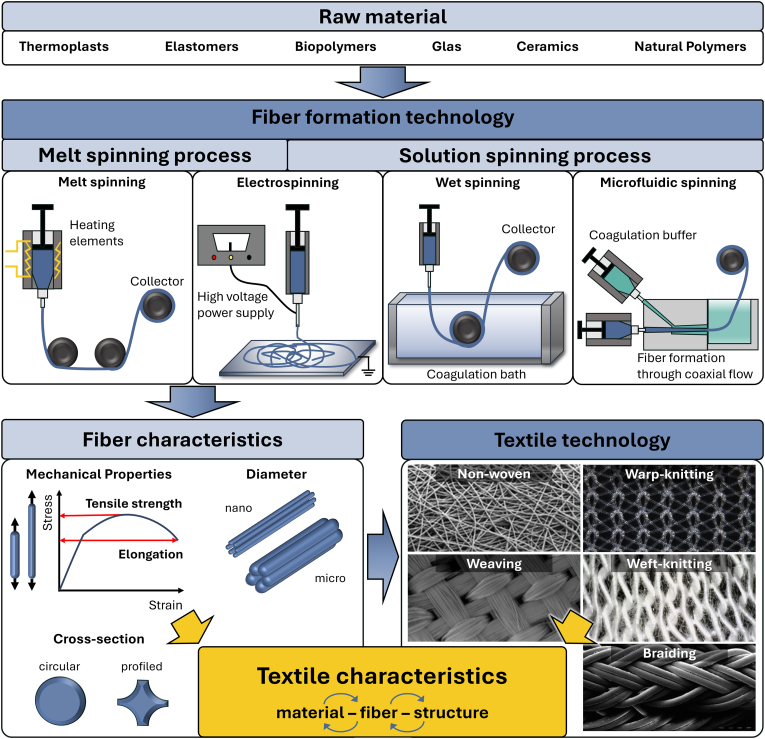
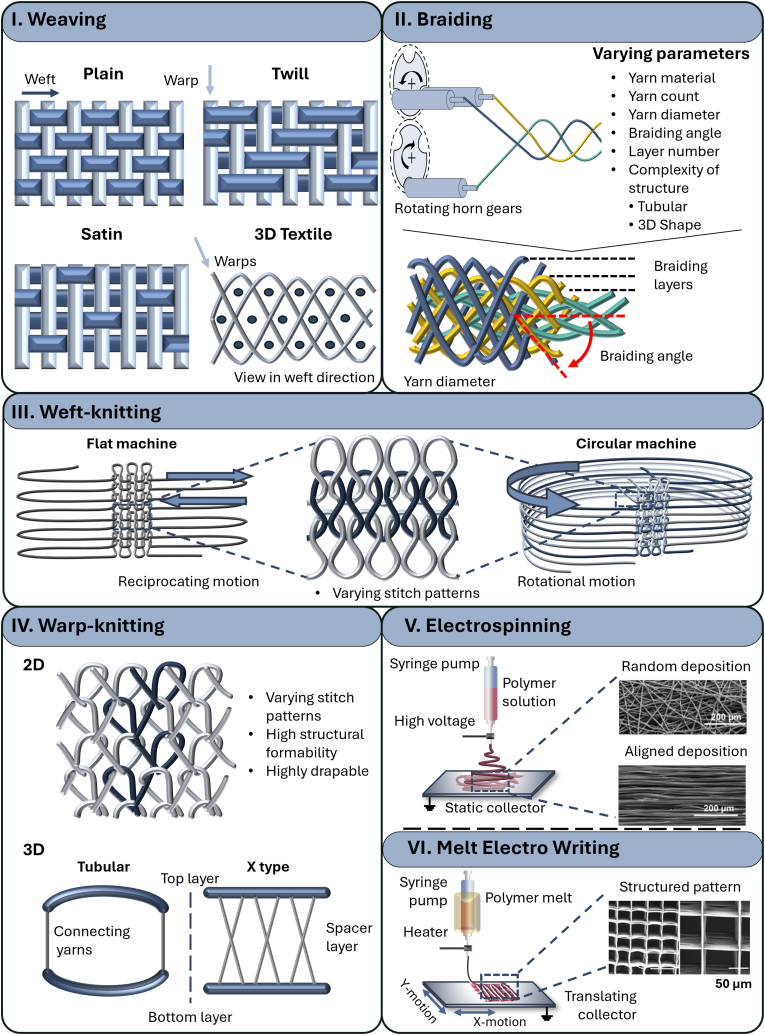
Tissue engineering (TE) aims to provide personalized solutions for tissue loss caused by trauma, tumors, or congenital defects. While traditional methods like autologous and homologous tissue transplants face challenges such as donor shortages and risk of donor site morbidity, TE provides a viable alternative using scaffolds, cells, and biologically active molecules. Textiles represent a promising scaffold option for both and TE applications. Textile engineering is a broad field and can be divided into fiber-based textiles and yarn-based textiles. In fiber-based textiles the textile fabric is produced in the same step as the fibers (e.g. non-wovens, electrospun mats and 3D-printed). For yarn-based textiles, yarns are produced from fibers or filaments first and then, a textile fabric is produced (e.g. woven, weft-knitted, warp-knitted and braided fabrics). The selection of textile scaffold technology depends on the target tissue, mechanical requirements, and fabrication methods, with each approach offering distinct advantages. Braided scaffolds, with their high tensile strength, are ideal for load-bearing tissues like tendons and ligaments, while their ability to form stable hollow lumens makes them suitable for vascular applications. Weaving, weft-, and warp-knitting provide tunable structural properties, with warp-knitting offering the greatest design flexibility. Spacer fabrics enable complex 3D architecture, benefiting applications such as skin grafts and multilayered tissues. Electrospinning, though highly effective in mimicking the ECM, is structurally limited. The complex interactions between materials, fiber properties, and textile technologies allows for scaffolds with a wide range of morphological and mechanical characteristics (e.g., tensile strength of woven textiles ranging from 0.64 to 180.4 N/mm). With in-depth knowledge, textiles can be tailored to obtain specific mechanical properties as accurately as possible and aid the formation of functional tissue. However, as textile structures inherently differ from biological tissues, careful optimization is required to enhance cell behavior, mechanical performance, and clinical applicability. This review is intended for TE experts interested in using textiles as scaffolds and provides a detailed analysis of the available options, their characteristics and known applications. For this, first the major fiber formation methods are introduced, then subsequent used automated textile technologies are presented, highlighting their strengths and limitations. Finally, we analyze how these textile and fiber structures are utilized in TE, organized by the use of textiles in TE across major organ systems, including the nervous, skin, cardiovascular, respiratory, urinary, digestive, and musculoskeletal systems.

摘要

组织工程学(TE)旨在为因创伤、肿瘤或先天性缺陷导致的组织缺损提供个性化解决方案。虽然自体和同种异体组织移植等传统方法面临供体短缺和供体部位发病风险等挑战,但组织工程学利用支架、细胞和生物活性分子提供了一种可行的替代方案。纺织品是用于组织工程学和再生医学应用的一种很有前景的支架选择。纺织工程是一个广泛的领域,可分为基于纤维的纺织品和基于纱线的纺织品。在基于纤维的纺织品中,织物与纤维在同一步骤中生产(例如非织造布、电纺垫和3D打印织物)。对于基于纱线的纺织品,首先由纤维或长丝制成纱线,然后生产织物(例如机织物、纬编织物、经编织物和编织物)。纺织支架技术的选择取决于目标组织、机械要求和制造方法,每种方法都有其独特的优势。编织支架具有高拉伸强度,是肌腱和韧带等承重组织的理想选择,而其形成稳定中空管腔的能力使其适用于血管应用。机织、纬编和经编提供了可调的结构特性,其中经编具有最大的设计灵活性。间隔织物能够实现复杂的三维结构,有利于皮肤移植和多层组织等应用。静电纺丝虽然在模拟细胞外基质方面非常有效,但在结构上存在局限性。材料、纤维特性和纺织技术之间的复杂相互作用使得能够制造出具有广泛形态和机械特性的支架(例如,机织纺织品的拉伸强度范围为0.64至180.4 N/mm)。有了深入的知识,就可以对纺织品进行定制,以尽可能准确地获得特定的机械性能,并有助于功能性组织的形成。然而,由于纺织结构与生物组织本质上不同,需要仔细优化以增强细胞行为、机械性能和临床适用性。本综述面向有兴趣使用纺织品作为支架的组织工程学专家,详细分析了可用的选项、它们的特性和已知应用。为此,首先介绍主要的纤维形成方法,然后介绍随后使用的自动化纺织技术,突出它们的优点和局限性。最后,我们分析这些纺织和纤维结构如何在组织工程学中得到利用,按照纺织品在组织工程学中跨主要器官系统的应用进行组织,包括神经、皮肤、心血管、呼吸、泌尿、消化和肌肉骨骼系统。

https://cdn.ncbi.nlm.nih.gov/pmc/blobs/ba1e/11926717/f917dbfec4ce/gr7.jpg
https://cdn.ncbi.nlm.nih.gov/pmc/blobs/ba1e/11926717/cdbdc68bcf76/ga1.jpg
https://cdn.ncbi.nlm.nih.gov/pmc/blobs/ba1e/11926717/4472c678f5a2/gr1.jpg
https://cdn.ncbi.nlm.nih.gov/pmc/blobs/ba1e/11926717/c96ff3ed9646/gr2.jpg
https://cdn.ncbi.nlm.nih.gov/pmc/blobs/ba1e/11926717/f6da8dcc45c6/gr3.jpg
https://cdn.ncbi.nlm.nih.gov/pmc/blobs/ba1e/11926717/73a7d4006316/gr4.jpg
https://cdn.ncbi.nlm.nih.gov/pmc/blobs/ba1e/11926717/8d0c54aefbb8/gr5.jpg
https://cdn.ncbi.nlm.nih.gov/pmc/blobs/ba1e/11926717/f0d4641f9661/gr6.jpg
https://cdn.ncbi.nlm.nih.gov/pmc/blobs/ba1e/11926717/f917dbfec4ce/gr7.jpg
https://cdn.ncbi.nlm.nih.gov/pmc/blobs/ba1e/11926717/cdbdc68bcf76/ga1.jpg
https://cdn.ncbi.nlm.nih.gov/pmc/blobs/ba1e/11926717/4472c678f5a2/gr1.jpg
https://cdn.ncbi.nlm.nih.gov/pmc/blobs/ba1e/11926717/c96ff3ed9646/gr2.jpg
https://cdn.ncbi.nlm.nih.gov/pmc/blobs/ba1e/11926717/f6da8dcc45c6/gr3.jpg
https://cdn.ncbi.nlm.nih.gov/pmc/blobs/ba1e/11926717/73a7d4006316/gr4.jpg
https://cdn.ncbi.nlm.nih.gov/pmc/blobs/ba1e/11926717/8d0c54aefbb8/gr5.jpg
https://cdn.ncbi.nlm.nih.gov/pmc/blobs/ba1e/11926717/f0d4641f9661/gr6.jpg
https://cdn.ncbi.nlm.nih.gov/pmc/blobs/ba1e/11926717/f917dbfec4ce/gr7.jpg

相似文献

1
Interlacing biology and engineering: An introduction to textiles and their application in tissue engineering.生物与工程的交织:纺织品及其在组织工程中的应用简介。
Mater Today Bio. 2025 Feb 25;31:101617. doi: 10.1016/j.mtbio.2025.101617. eCollection 2025 Apr.
2
Living nanofiber yarn-based woven biotextiles for tendon tissue engineering using cell tri-culture and mechanical stimulation.基于活纳米纤维纱线的编织型生物纺织品,用于使用细胞三培养和机械刺激的肌腱组织工程。
Acta Biomater. 2017 Oct 15;62:102-115. doi: 10.1016/j.actbio.2017.08.043. Epub 2017 Aug 30.
3
Automated model discovery for textile structures: The unique mechanical signature of warp knitted fabrics.纺织品结构的自动化模型发现:经编针织物的独特力学特征。
Acta Biomater. 2024 Nov;189:461-477. doi: 10.1016/j.actbio.2024.09.051. Epub 2024 Oct 3.
4
Manufacturing, characterization, and degradation of a poly(lactic acid) warp-knitted spacer fabric scaffold as a candidate for tissue engineering applications.一种作为组织工程应用候选材料的聚乳酸经编间隔织物支架的制造、表征及降解
Biomater Sci. 2022 Jul 12;10(14):3793-3807. doi: 10.1039/d1bm02027g.
5
Application of textile technology in tissue engineering: A review.纺织技术在组织工程中的应用:综述。
Acta Biomater. 2021 Jul 1;128:60-76. doi: 10.1016/j.actbio.2021.04.047. Epub 2021 May 5.
6
Textile Technologies and Tissue Engineering: A Path Toward Organ Weaving.纺织技术与组织工程:通往器官编织之路
Adv Healthc Mater. 2016 Apr 6;5(7):751-66. doi: 10.1002/adhm.201500517. Epub 2016 Feb 29.
7
Construction and application of textile-based tissue engineering scaffolds: a review.基于纺织的组织工程支架的构建与应用:综述。
Biomater Sci. 2020 Jul 7;8(13):3574-3600. doi: 10.1039/d0bm00157k. Epub 2020 Jun 18.
8
Textile-based sandwich scaffold using wet electrospun yarns for skin tissue engineering.基于湿纺静电纺丝纱线的用于皮肤组织工程的纺织三明治支架。
J Mech Behav Biomed Mater. 2021 Jul;119:104499. doi: 10.1016/j.jmbbm.2021.104499. Epub 2021 Apr 8.
9
Using Wet Electrospun PCL/Gelatin/CNT Yarns to Fabricate Textile-Based Scaffolds for Vascular Tissue Engineering.利用湿法静电纺丝的 PCL/明胶/碳纳米管纱线制备用于血管组织工程的基于纺织的支架。
ACS Biomater Sci Eng. 2021 Jun 14;7(6):2627-2637. doi: 10.1021/acsbiomaterials.1c00097. Epub 2021 Apr 6.
10
Fabricated tropoelastin-silk yarns and woven textiles for diverse tissue engineering applications.用于各种组织工程应用的纤维原弹性蛋白-丝纱和机织纺织品。
Acta Biomater. 2019 Jun;91:112-122. doi: 10.1016/j.actbio.2019.04.029. Epub 2019 Apr 17.

引用本文的文献

1
Engineering the Future of Stem Cells in Vascular Reconstruction: A Leap Towards Functional Endothelialized Tissue-Engineered Vascular Conduits.构建血管重建中干细胞的未来:迈向功能性内皮化组织工程血管导管的飞跃。
Stem Cell Rev Rep. 2025 Sep 4. doi: 10.1007/s12015-025-10968-8.
2
Material and biological characterization of 3D knitted bioresorbable poly (D,L-lactide) (PLA) and polycaprolactone (PCL) scaffolds for soft tissue regeneration: from fabrication to in vivo performance.用于软组织再生的三维针织生物可吸收聚(D,L-丙交酯)(PLA)和聚己内酯(PCL)支架的材料与生物学特性:从制造到体内性能
J Biol Eng. 2025 Jun 4;19(1):53. doi: 10.1186/s13036-025-00504-0.

本文引用的文献

1
Electrospun microfibers to enhance nutrient supply in bioinks and 3D-bioprinted tissue precursors.用于增强生物墨水和3D生物打印组织前体中营养供应的电纺微纤维。
Biofabrication. 2024 Dec 27;17(1). doi: 10.1088/1758-5090/ad9d7a.
2
Digital nerve reconstruction with a new composite silk fibroin nerve conduit.采用新型复合丝素蛋白神经导管进行指神经重建。
J Peripher Nerv Syst. 2025 Mar;30(1):e12675. doi: 10.1111/jns.12675. Epub 2024 Nov 26.
3
"Bamboo-like" strong and tough sodium alginate/polyacrylate hydrogel fiber with directional controlled release for wound healing promotion.
“竹节状”高强韧海藻酸钠/聚丙烯酸水凝胶纤维,具有定向控释功能,可促进伤口愈合。
Carbohydr Polym. 2025 Jan 1;347:122761. doi: 10.1016/j.carbpol.2024.122761. Epub 2024 Sep 17.
4
Mechanical, Biological and In Vitro Degradation Investigation of Braided Scaffolds for Tendon and Ligament Tissue Engineering Based on Different Polycaprolactone Materials with Chitosan-Graft-PCL Surface Modification.基于壳聚糖接枝聚己内酯表面改性的不同聚己内酯材料的编织支架用于肌腱和韧带组织工程的机械、生物学及体外降解研究
Polymers (Basel). 2024 Aug 20;16(16):2349. doi: 10.3390/polym16162349.
5
Melt-electrowriting-enabled anisotropic scaffolds loaded with valve interstitial cells for heart valve tissue Engineering.熔融静电纺丝法制备负载心脏瓣膜间质细胞的各向异性支架用于心脏瓣膜组织工程。
J Nanobiotechnology. 2024 Jun 28;22(1):378. doi: 10.1186/s12951-024-02656-5.
6
In vitro and in vivo evaluation of biohybrid tissue-engineered vascular grafts with transformative H/F MRI traceable scaffolds.采用变革性 H/F MRI 可追踪支架的体外和体内评估生物杂交组织工程血管移植物。
Biomaterials. 2024 Dec;311:122669. doi: 10.1016/j.biomaterials.2024.122669. Epub 2024 Jun 17.
7
Decellularized tissues as platforms for digestive system cancer models.脱细胞组织作为消化系统癌症模型的平台。
Heliyon. 2024 May 21;10(11):e31589. doi: 10.1016/j.heliyon.2024.e31589. eCollection 2024 Jun 15.
8
Conductive and alignment-optimized porous fiber conduits with electrical stimulation for peripheral nerve regeneration.用于周围神经再生的具有电刺激功能的传导性和排列优化的多孔纤维导管。
Mater Today Bio. 2024 Apr 18;26:101064. doi: 10.1016/j.mtbio.2024.101064. eCollection 2024 Jun.
9
Applications, advancements, and challenges of 3D bioprinting in organ transplantation.3D生物打印在器官移植中的应用、进展与挑战
Biomater Sci. 2024 Mar 12;12(6):1425-1448. doi: 10.1039/d3bm01934a.
10
Biofabrication's Contribution to the Evolution of Cultured Meat.生物制造对培养肉发展的贡献。
Adv Healthc Mater. 2024 May;13(13):e2304058. doi: 10.1002/adhm.202304058. Epub 2024 Feb 17.