Chen Long, Zheng Wei, Wei Caiyun, Ling Jiayu, Kong Qingtao
Key Laboratory of Adolescent Health Assessment and Exercise Intervention of Ministry of Education, East China Normal University, Shanghai, China.
School of Physical Education and Health, East China Normal University, Shanghai, China.
Front Nutr. 2025 Mar 10;12:1505491. doi: 10.3389/fnut.2025.1505491. eCollection 2025.
Adolescent psychosocial symptoms continue to rise, negatively affecting academic performance and future achievement, and have become an important public health issue of common concern worldwide. However, few studies have been conducted on the association between body roundness index (BRI) and sugar-sweetened beverage (SSB) consumption and psychological symptoms in Chinese adolescents. The present study may provide implications for the intervention and prevention of psychological symptoms in Chinese adolescents.
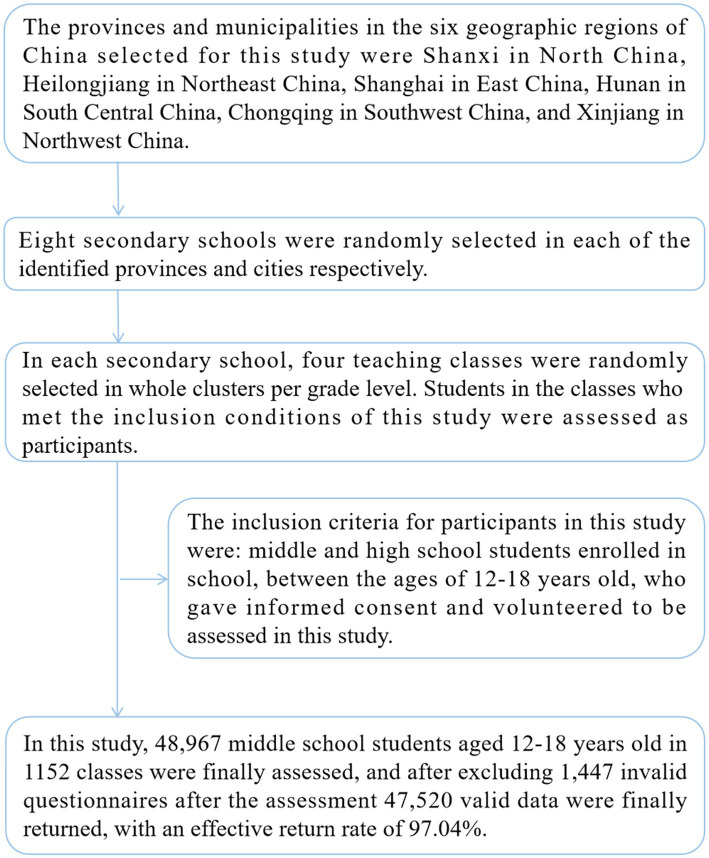
In this study, 47,520 adolescents aged 12-18 years from six geographic regions of China were assessed cross-sectionally for BRI, SSB consumption, and psychological symptoms in 2023. Independent samples t-tests, chi-square tests, logistic regression analyses, and ordered logistic regression analyses were used to compare and analyze the associations that existed between BRI and SSB consumption and psychological symptoms among Chinese adolescents.
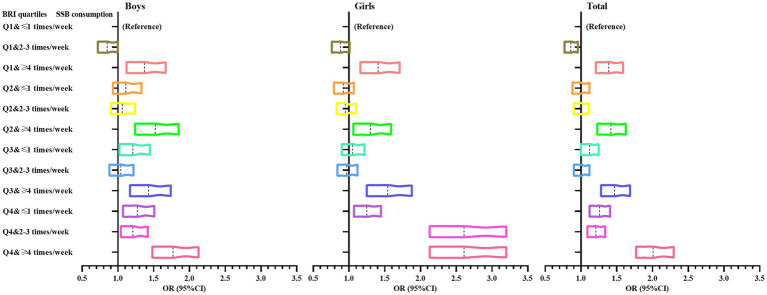
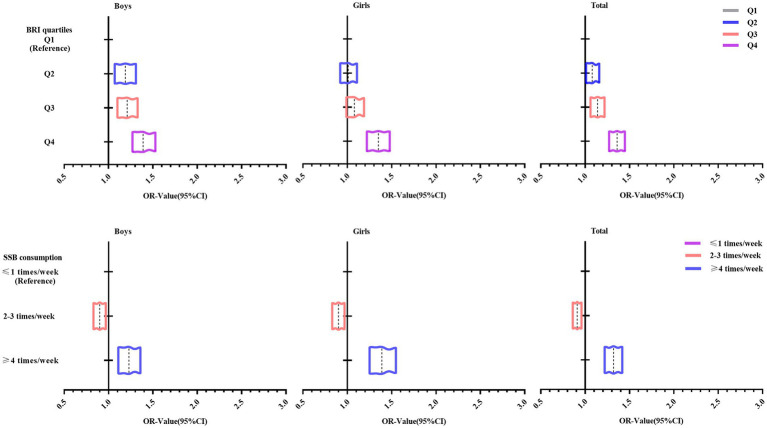
The BRI of Chinese adolescents aged 12-18 years was (2.03 ± 0.94). The proportions of adolescents with SSB consumption ≤1 times/week, 2-3 times/week, and ≥ 4 times/week were 33.2, 52.0, and 14.7%, respectively, and the differences were statistically significant in comparison ( value of 597.860, < 0.001). The prevalence of psychological symptoms among Chinese adolescents was 19.2%. The prevalence rates of emotional problems, behavioral problems, and social adjustment difficulties were 26.1, 25.2, and 16.1%, respectively. After adjusting for relevant covariates, ordered logistic regression analysis showed that with BRI quartiles Q1 and SSB consumption ≤1 times/week as the reference group, the adolescents in the group with BRI quartiles of Q4 and SSB consumption ≥4 times/week (OR = 2.01, 95% CI: 1.77-2.30) had the highest risk of developing psychological symptoms ( < 0.001).
There is an association between BRI and SSB consumption with psychological symptoms in Chinese adolescents. Chinese adolescents with higher BRI and SSB consumption were at higher risk of developing psychological symptoms. In the future, the increase in BRI and SSB consumption should be effectively controlled to prevent or reduce the occurrence of psychological symptoms.
青少年心理社会症状持续上升,对学业成绩和未来成就产生负面影响,已成为全球共同关注的重要公共卫生问题。然而,关于中国青少年身体圆润度指数(BRI)与含糖饮料(SSB)消费及心理症状之间的关联研究较少。本研究可能为中国青少年心理症状的干预和预防提供启示。
本研究于2023年对来自中国六个地理区域的47520名12 - 18岁青少年进行了横断面评估,以了解其BRI、SSB消费情况和心理症状。采用独立样本t检验、卡方检验、逻辑回归分析和有序逻辑回归分析,对中国青少年中BRI与SSB消费及心理症状之间的关联进行比较和分析。
12 - 18岁中国青少年的BRI为(2.03±0.94)。SSB消费频率≤1次/周、2 - 3次/周和≥4次/周的青少年比例分别为33.2%、52.0%和14.7%,差异具有统计学意义( 值为597.860,<0.001)。中国青少年心理症状的患病率为19.2%。情绪问题、行为问题和社会适应困难的患病率分别为26.1%、25.2%和16.1%。在调整相关协变量后,有序逻辑回归分析显示,以BRI四分位数Q1和SSB消费频率≤1次/周为参照组,BRI四分位数为Q4且SSB消费频率≥4次/周的青少年组(OR = 2.01,95% CI:1.77 - 2.30)出现心理症状的风险最高(<0.001)。
中国青少年的BRI和SSB消费与心理症状之间存在关联。BRI较高且SSB消费较多的中国青少年出现心理症状的风险更高。未来,应有效控制BRI和SSB消费的增加,以预防或减少心理症状的发生。