Moore Jacksen, Nguyen Khanh, Dennis Brody, Chaudhry Mahad, Elfar Annes, Oldham Eli, Paul Eli, Cohn Jacob, Ford Alicia Ito, Vassar Matthew
Oklahoma State University Center for Health Sciences, Tulsa, Oklahoma, USA
Oklahoma State University Center for Health Sciences, Tulsa, Oklahoma, USA.
BMJ Open. 2025 Mar 25;15(3):e092490. doi: 10.1136/bmjopen-2024-092490.
To examine the current state of data-sharing practices in gastroenterology literature, focusing on data-sharing statements (DSS) and identifying influential factors on DSS inclusion.
High-quality, reproducible research is crucial in addressing the widespread prevalence of gastrointestinal diseases. Data-sharing practices enable researchers to access studies more easily, enhancing reproducibility. Our study aims to analyse the inclusion and influence of DSS in top gastroenterology journals.
We conducted a cross-sectional analysis to examine the use and contents of DSS in gastroenterology clinical trials. Using Clarivate's Journal Citation Reports, we selected five leading gastroenterology journals. Then, we searched MEDLINE (PubMed) for original research articles published between 1 January 2018 and 31 December 2023. In a double-blind, duplicate manner, data were extracted on DSS presence, funding source, study design and open-access status. We then conducted a thematic analysis of all DSS. Additionally, authors were contacted and given 14 days to respond or share data to investigate adherence to their DSS.
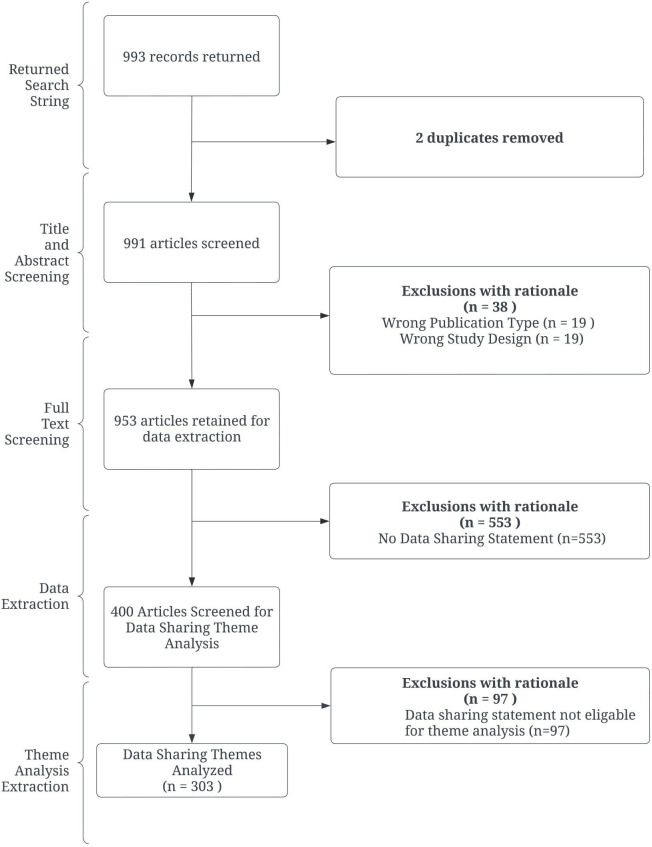
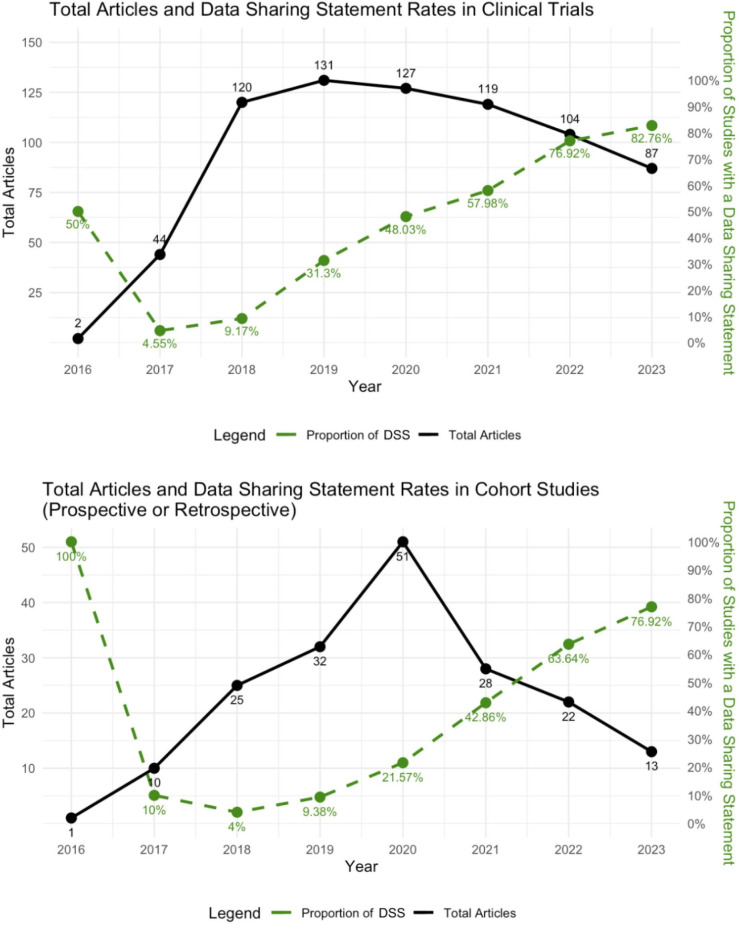
Of the 953 articles that met inclusion criteria, 400 (400/953; 42.0%) contained a DSS. Open-access articles had a higher likelihood of containing DSS (estimate=0·413; p<0.05). has the highest percentage of DSS (159/194; 82.0%), while has the lowest percentage of DSS (33/256; 12.9%). Impact factor is a significant indicator for DSS (estimate=0.138, p=0.01). Finally, 'conditional data availability' was the most common data theme in our study (225/303; 74.3%). Over half (153/284; 53.9%) of the authors contacted did not respond to our request for sharing data.
Our findings reveal significant variability in DSS inclusion and adherence among top gastroenterology journals. Journals with mandatory data-sharing policies demonstrated higher compliance, while open-access status and journal impact factor were positively associated with data-sharing practices. However, a notable gap remains in authors' follow-through on stated data-sharing commitments.
研究胃肠病学文献中数据共享实践的现状,重点关注数据共享声明(DSS),并确定影响DSS纳入的因素。
高质量、可重复的研究对于应对胃肠道疾病的广泛流行至关重要。数据共享实践使研究人员能够更轻松地获取研究,提高可重复性。我们的研究旨在分析顶级胃肠病学杂志中DSS的纳入情况及其影响。
我们进行了一项横断面分析,以研究胃肠病学临床试验中DSS的使用情况和内容。利用科睿唯安的《期刊引证报告》,我们选择了五本领先的胃肠病学杂志。然后,我们在MEDLINE(PubMed)中搜索了2018年1月1日至2023年12月31日期间发表的原创研究文章。以双盲、重复的方式,提取了关于DSS存在情况、资金来源、研究设计和开放获取状态的数据。然后,我们对所有DSS进行了主题分析。此外,我们还联系了作者,并给予他们14天时间回复或共享数据,以调查他们对DSS的遵守情况。
在符合纳入标准的953篇文章中,400篇(400/953;42.0%)包含DSS。开放获取文章包含DSS的可能性更高(估计值=0·413;p<0.05)。[具体杂志名称1]的DSS比例最高(159/194;82.0%),而[具体杂志名称2]的DSS比例最低(33/256;12.9%)。影响因子是DSS的一个重要指标(估计值=0.138,p=0.01)。最后,“有条件的数据可用性”是我们研究中最常见的数据主题(225/303;74.3%)。超过一半(153/284;53.9%)被联系的作者未回应我们的数据共享请求。
我们的研究结果显示,顶级胃肠病学杂志在DSS纳入和遵守方面存在显著差异。有强制数据共享政策的杂志表现出更高的合规性,而开放获取状态和杂志影响因子与数据共享实践呈正相关。然而,作者在履行声明的数据共享承诺方面仍存在明显差距。