Wang Karen S, Smeyers Julie, Eggan Kevin, Budnik Bogdan, Mordes Daniel A
Institute for Neurodegenerative Diseases, University of California, San Francisco, CA, USA.
Department of Pathology, University of California, San Francisco, CA, USA.
Acta Neuropathol Commun. 2025 Mar 26;13(1):67. doi: 10.1186/s40478-025-01977-2.
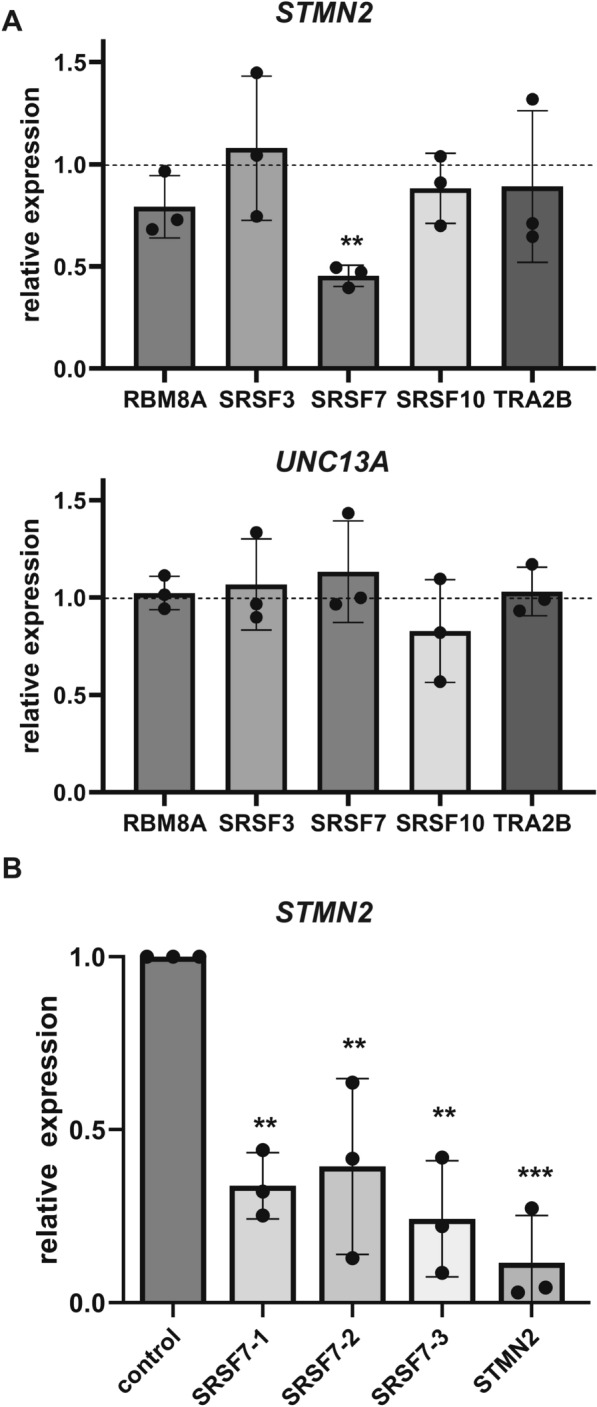
A hexanucleotide repeat expansion in C9ORF72 is the most common genetic cause of amyotrophic lateral sclerosis (ALS), frontotemporal dementia (FTD), and combined ALS/FTD. The repeat is transcribed in the sense and the antisense directions to produce several dipeptide repeat proteins (DPRs) that have toxic gain-of-function effects; however, the mechanisms by which DPRs lead to neural dysfunction remain unresolved. Here, we observed that poly-proline-arginine (poly-PR) was sufficient to inhibit axonal regeneration of human induced pluripotent stem cell (iPSC)-derived neurons. Global phospho-proteomics revealed that poly-PR selectively perturbs nuclear RNA binding proteins (RBPs). In neurons, we found that depletion of one of these RBPs, SRSF7 (serine/arginine-rich splicing factor 7), resulted in decreased abundance of STMN2 (stathmin-2), though not TDP-43. STMN2 supports axon maintenance and repair and has been recently implicated in the pathogenesis of ALS/FTD. We observed that depletion of SRSF7 impaired axonal regeneration, a phenotype that could be rescued by exogenous STMN2. We propose that antisense repeat-encoded poly-PR perturbs RBPs, particularly SRSF7, resulting in reduced STMN2 and axonal repair defects in neurons. Hence, we provide a potential link between DPRs gain-of-function effects and STMN2 loss-of-function phenotypes in neurodegeneration.
C9ORF72基因中的六核苷酸重复序列扩增是肌萎缩侧索硬化症(ALS)、额颞叶痴呆(FTD)以及合并性ALS/FTD最常见的遗传病因。该重复序列以正向和反向转录,产生几种具有毒性功能获得效应的二肽重复蛋白(DPRs);然而,DPRs导致神经功能障碍的机制仍未明确。在此,我们观察到聚脯氨酸 - 精氨酸(poly-PR)足以抑制人诱导多能干细胞(iPSC)衍生神经元的轴突再生。全局磷酸化蛋白质组学显示,poly-PR选择性地扰乱核RNA结合蛋白(RBPs)。在神经元中,我们发现这些RBPs之一的SRSF7(富含丝氨酸/精氨酸的剪接因子7)缺失,导致STMN2(微管相关蛋白2)丰度降低,而TDP-43未受影响。STMN2支持轴突维持和修复,最近被认为与ALS/FTD的发病机制有关。我们观察到SRSF7缺失会损害轴突再生,这种表型可通过外源性STMN2挽救。我们提出,反义重复序列编码的poly-PR扰乱RBPs,特别是SRSF7,导致神经元中STMN2减少和轴突修复缺陷。因此,我们在神经退行性变中DPRs的功能获得效应和STMN2的功能丧失表型之间提供了一个潜在联系。