Savy Virginia, Stein Paula, Delker Don, Estermann Martín A, Papas Brian N, Xu Zongli, Radonova Lenka, Williams Carmen J
Reproductive Medicine Group, National Institute of Environmental Health Sciences, National Institutes of Health, Research Triangle Park, NC 27709, USA.
Integrative Bioinformatics, National Institute of Environmental Health Sciences, National Institutes of Health, Research Triangle Park, NC 27709, USA.
bioRxiv. 2025 Mar 16:2025.03.14.643362. doi: 10.1101/2025.03.14.643362.
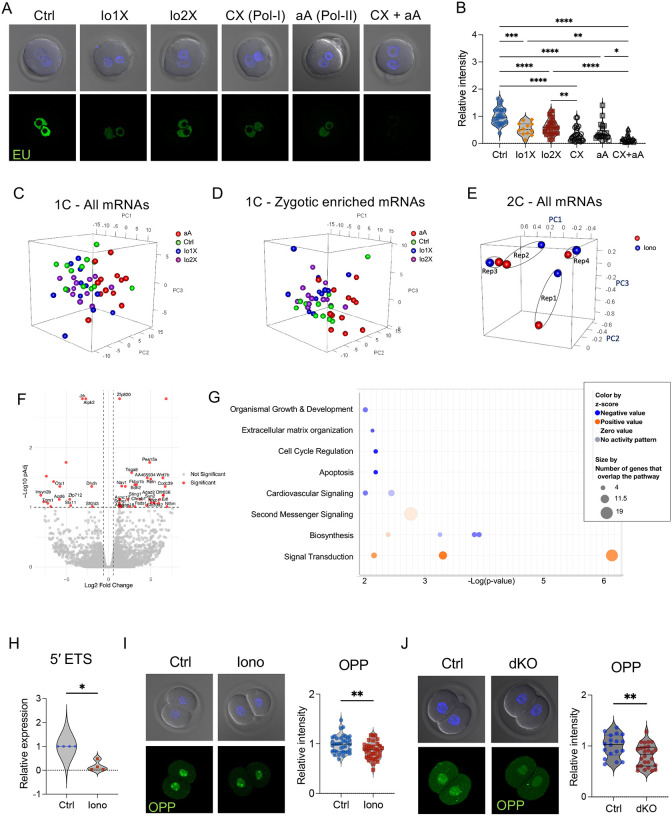
The use of assisted reproductive technologies (ART) has enabled the birth of over 9 million babies; but it is associated with increased risks of negative metabolic outcomes in offspring. Yet, the underlying mechanism remains unknown. Calcium (Ca) signals, which initiate embryo development at fertilization, are frequently disrupted in human ART. In mice, abnormal Ca signals at fertilization impair embryo development and adult offspring metabolism. Changes in intracellular Ca drive mitochondrial activity and production of metabolites used by the epigenetic machinery. For example, acetyl-CoA (derived mainly from pyruvate) and lactyl-CoA (derived from lactate) are used for writing H3K27ac and H3K18la marks that orchestrate initiation of development. Using both a genetic mouse model and treatment with ionomycin to raise intracellular Ca of wild-type fertilized eggs, we found that excess Ca at fertilization changes metabolic substrate availability, causing epigenetic changes that impact embryo development and offspring health. Specifically, increased Ca exposure at fertilization led to increased H3K27ac levels and decreased H3K18la levels at the 1-cell (1C) stage, that persisted until the 2-cell (2C) stage. Ultralow input CUT&Tag revealed significant differences in H3K27ac and H3K18la genomic profiles between control and ionomycin groups. In addition, increased Ca exposure resulted in a marked reduction in global transcription at the 1C stage that persisted through the 2C stage due to diminished activity of RNA polymerase I. Excess Ca following fertilization increased pyruvate dehydrogenase activity (enzyme that converts pyruvate to acetyl-CoA) and decreased total lactate levels. Provision of exogenous lactyl-CoA before ionomycin treatment restored H3K18la levels at the 1C and 2C stages and rescued global transcription to control levels. Our findings demonstrate conclusively that Ca dynamics drive metabolic regulation of epigenetic reprogramming at fertilization and alter EGA.
辅助生殖技术(ART)的应用已使超过900万婴儿得以出生;但它与后代出现负面代谢结果的风险增加有关。然而,其潜在机制仍不清楚。钙(Ca)信号在受精时启动胚胎发育,在人类ART中经常受到干扰。在小鼠中,受精时异常的Ca信号会损害胚胎发育和成年后代的新陈代谢。细胞内Ca的变化驱动线粒体活性以及表观遗传机制所使用的代谢物的产生。例如,乙酰辅酶A(主要来源于丙酮酸)和乳酰辅酶A(来源于乳酸)用于书写协调发育起始的H3K27ac和H3K18la标记。利用基因小鼠模型以及用离子霉素处理来提高野生型受精卵的细胞内Ca,我们发现受精时过量的Ca会改变代谢底物的可用性,导致表观遗传变化,从而影响胚胎发育和后代健康。具体而言,受精时增加Ca暴露会导致1细胞(1C)阶段H3K27ac水平升高和H3K18la水平降低,这种情况一直持续到2细胞(2C)阶段。超低输入CUT&Tag显示,对照和离子霉素处理组之间H3K27ac和H3K18la基因组图谱存在显著差异。此外,增加Ca暴露导致1C阶段的整体转录显著减少,由于RNA聚合酶I活性降低,这种情况一直持续到2C阶段。受精后过量的Ca会增加丙酮酸脱氢酶活性(将丙酮酸转化为乙酰辅酶A的酶)并降低总乳酸水平。在离子霉素处理前提供外源性乳酰辅酶A可恢复1C和2C阶段的H3K18la水平,并将整体转录挽救至对照水平。我们的研究结果确凿地表明,Ca动态变化在受精时驱动表观遗传重编程的代谢调节并改变合子基因组激活(EGA)。