Xu Xiaoyang, Sun Yuke, Zhu Dong
Wushu School, Shanghai University of Sport, Shanghai, China.
Sci Rep. 2025 Mar 31;15(1):10958. doi: 10.1038/s41598-025-96264-4.
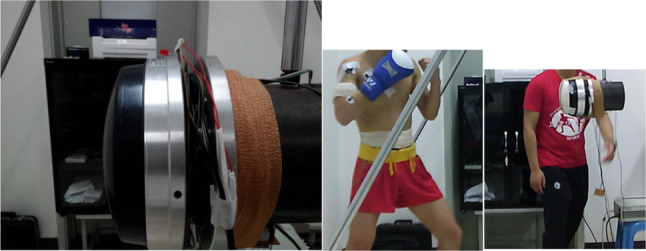
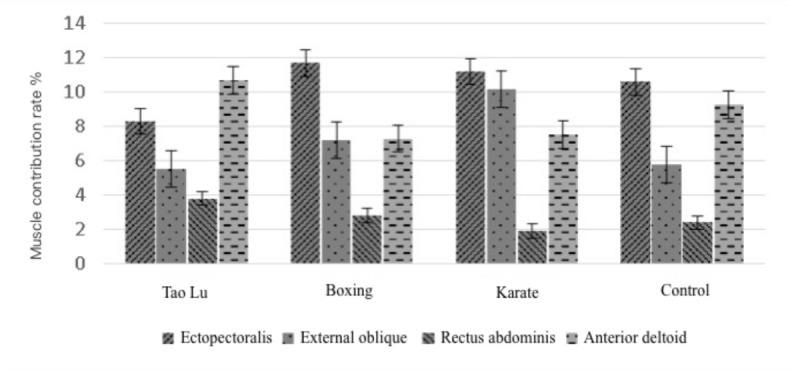
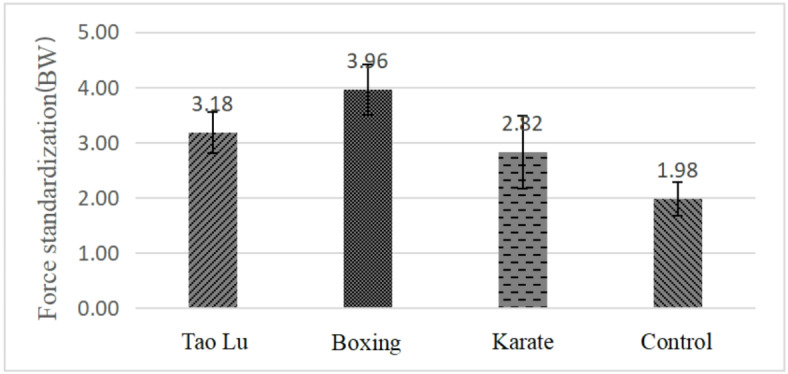
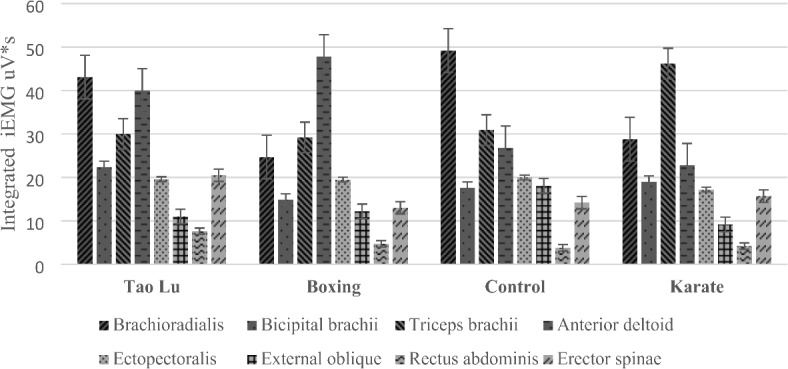
Despite the prevalence of combat sports research, a comparative analysis of backward straight punches and sEMG activation across different martial arts disciplines remains unexplored. This study examines the impact force and sEMG characteristics of backward straight punches among athletes from Boxing, Tao Lu (Chinese Wushu), Karate, and a control group (Physical Education students) under randomized signal stimulation. Twenty-eight participants performed backward straight punches while impact force and muscle activation were recorded using a pendulum system and a 16-channel Noraxon wireless sEMG system. Results indicate that the Boxing group exhibited the highest impact force (3.96 ± 0.45 times body weight), followed by the Tao Lu, Karate, and Control groups. Muscle activation patterns varied significantly among groups, with a moderate positive correlation between impact force and the deltoid (r = 0.535) and brachioradialis (r = 0.365) muscle groups. The findings highlight differences in combat philosophies, with Boxing emphasizing effectiveness, Wushu and Karate focusing on controlled strikes, and Tao Lu prioritizing precision. These insights provide a biomechanical understanding of combat sports techniques, suggesting tailored training strategies for optimizing striking performance.
尽管格斗运动研究很普遍,但不同武术流派中后直拳及其表面肌电激活的对比分析仍未得到探索。本研究考察了拳击、套路(中国武术)、空手道运动员以及对照组(体育专业学生)在随机信号刺激下后直拳的冲击力和表面肌电特征。28名参与者进行后直拳动作,同时使用摆锤系统和16通道Noraxon无线表面肌电系统记录冲击力和肌肉激活情况。结果表明,拳击组的冲击力最高(为体重的3.96±0.45倍),其次是套路组、空手道组和对照组。各组之间的肌肉激活模式差异显著,冲击力与三角肌(r = 0.535)和桡侧腕短伸肌(r = 0.365)肌群之间存在中度正相关。研究结果突出了格斗理念的差异,拳击强调有效性,武术和空手道注重可控打击,而套路则优先考虑精准度。这些见解为格斗运动技术提供了生物力学理解,为优化打击表现提出了针对性的训练策略。