Department of Radiology, Perelman School of Medicine, University of Pennsylvania, Philadelphia, PA, USA.
Department of Diagnostic Imaging, Rhode Island Hospital and Warren Alpert Medical School of Brown University, Providence, RI, USA.
Lancet Digit Health. 2021 May;3(5):e286-e294. doi: 10.1016/S2589-7500(21)00039-X. Epub 2021 Mar 24.
Chest x-ray is a relatively accessible, inexpensive, fast imaging modality that might be valuable in the prognostication of patients with COVID-19. We aimed to develop and evaluate an artificial intelligence system using chest x-rays and clinical data to predict disease severity and progression in patients with COVID-19.
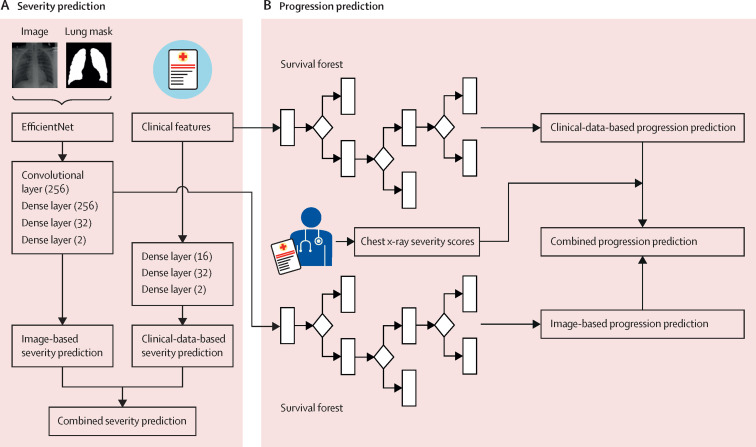
We did a retrospective study in multiple hospitals in the University of Pennsylvania Health System in Philadelphia, PA, USA, and Brown University affiliated hospitals in Providence, RI, USA. Patients who presented to a hospital in the University of Pennsylvania Health System via the emergency department, with a diagnosis of COVID-19 confirmed by RT-PCR and with an available chest x-ray from their initial presentation or admission, were retrospectively identified and randomly divided into training, validation, and test sets (7:1:2). Using the chest x-rays as input to an EfficientNet deep neural network and clinical data, models were trained to predict the binary outcome of disease severity (ie, critical or non-critical). The deep-learning features extracted from the model and clinical data were used to build time-to-event models to predict the risk of disease progression. The models were externally tested on patients who presented to an independent multicentre institution, Brown University affiliated hospitals, and compared with severity scores provided by radiologists.
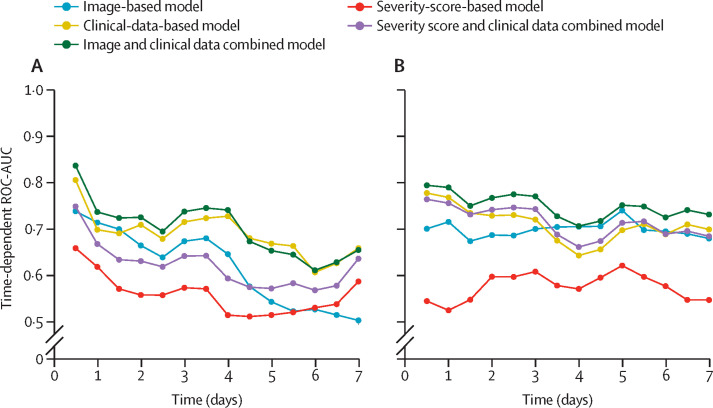
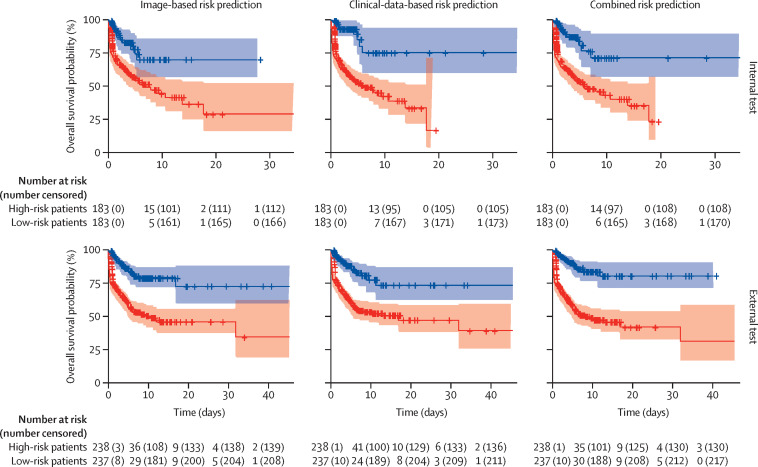
1834 patients who presented via the University of Pennsylvania Health System between March 9 and July 20, 2020, were identified and assigned to the model training (n=1285), validation (n=183), or testing (n=366) sets. 475 patients who presented via the Brown University affiliated hospitals between March 1 and July 18, 2020, were identified for external testing of the models. When chest x-rays were added to clinical data for severity prediction, area under the receiver operating characteristic curve (ROC-AUC) increased from 0·821 (95% CI 0·796-0·828) to 0·846 (0·815-0·852; p<0·0001) on internal testing and 0·731 (0·712-0·738) to 0·792 (0·780-0 ·803; p<0·0001) on external testing. When deep-learning features were added to clinical data for progression prediction, the concordance index (C-index) increased from 0·769 (0·755-0·786) to 0·805 (0·800-0·820; p<0·0001) on internal testing and 0·707 (0·695-0·729) to 0·752 (0·739-0·764; p<0·0001) on external testing. The image and clinical data combined model had significantly better prognostic performance than combined severity scores and clinical data on internal testing (C-index 0·805 vs 0·781; p=0·0002) and external testing (C-index 0·752 vs 0·715; p<0·0001).
In patients with COVID-19, artificial intelligence based on chest x-rays had better prognostic performance than clinical data or radiologist-derived severity scores. Using artificial intelligence, chest x-rays can augment clinical data in predicting the risk of progression to critical illness in patients with COVID-19.
Brown University, Amazon Web Services Diagnostic Development Initiative, Radiological Society of North America, National Cancer Institute and National Institute of Biomedical Imaging and Bioengineering of the National Institutes of Health.
胸部 X 光是一种相对容易获得、价格低廉、快速的成像方式,可能对预测 COVID-19 患者的预后有价值。我们旨在开发和评估一种人工智能系统,该系统使用胸部 X 光和临床数据来预测 COVID-19 患者的疾病严重程度和进展。
我们在美国宾夕法尼亚大学卫生系统的多个医院和美国罗德岛州普罗维登斯的布朗大学附属医院进行了一项回顾性研究。通过急诊室就诊于宾夕法尼亚大学卫生系统医院、通过 RT-PCR 确诊 COVID-19 且初次就诊或入院时可获得胸部 X 光的患者被回顾性识别并随机分为训练集、验证集和测试集(7:1:2)。使用胸部 X 光作为输入到 EfficientNet 深度神经网络和临床数据,训练模型以预测疾病严重程度(即危急或非危急)的二项结局。从模型和临床数据中提取的深度学习特征用于构建预测疾病进展风险的生存时间模型。该模型在宾夕法尼亚大学卫生系统以外的一家独立多中心机构布朗大学附属医院的患者中进行了外部测试,并与放射科医生提供的严重程度评分进行了比较。
2020 年 3 月 9 日至 7 月 20 日期间,通过宾夕法尼亚大学卫生系统就诊的 1834 名患者被确定并分配到模型训练(n=1285)、验证(n=183)或测试(n=366)组。2020 年 3 月 1 日至 7 月 18 日期间,通过布朗大学附属医院就诊的 475 名患者被确定用于模型的外部测试。当胸部 X 光与临床数据一起用于严重程度预测时,内部测试中曲线下面积(ROC-AUC)从 0.821(95%CI 0.796-0.828)增加到 0.846(0.815-0.852;p<0.0001),外部测试中从 0.731(0.712-0.738)增加到 0.792(0.780-0.803;p<0.0001)。当深度学习特征与临床数据一起用于进展预测时,内部测试中的一致性指数(C-index)从 0.769(0.755-0.786)增加到 0.805(0.800-0.820;p<0.0001),外部测试中从 0.707(0.695-0.729)增加到 0.752(0.739-0.764;p<0.0001)。图像和临床数据联合模型在内部测试(C-index 0.805 与 0.781;p=0.0002)和外部测试(C-index 0.752 与 0.715;p<0.0001)中的预后性能均显著优于联合严重程度评分和临床数据。
在 COVID-19 患者中,基于胸部 X 光的人工智能具有比临床数据或放射科医生严重程度评分更好的预后性能。使用人工智能,胸部 X 光可以增强临床数据,以预测 COVID-19 患者向危急疾病进展的风险。
布朗大学、亚马逊网络服务诊断开发倡议、北美放射学会、美国国立卫生研究院国家癌症研究所和国家生物医学成像和生物工程研究所。