Li Yongyao, Lan Anjun, Xiong Kangning, Zhang Wenfang, Xiang Shuai, Zhang Baoshan
Schools of Karst Science and Geography/State Engineering Technology Institute for Karst Desertfication Control Guizhou Normal University Guiyang China.
Bijie Institute of Science and Technology Information Bijie Science and Technology Bureau Bijie China.
Ecol Evol. 2025 Mar 27;15(4):e71168. doi: 10.1002/ece3.71168. eCollection 2025 Apr.
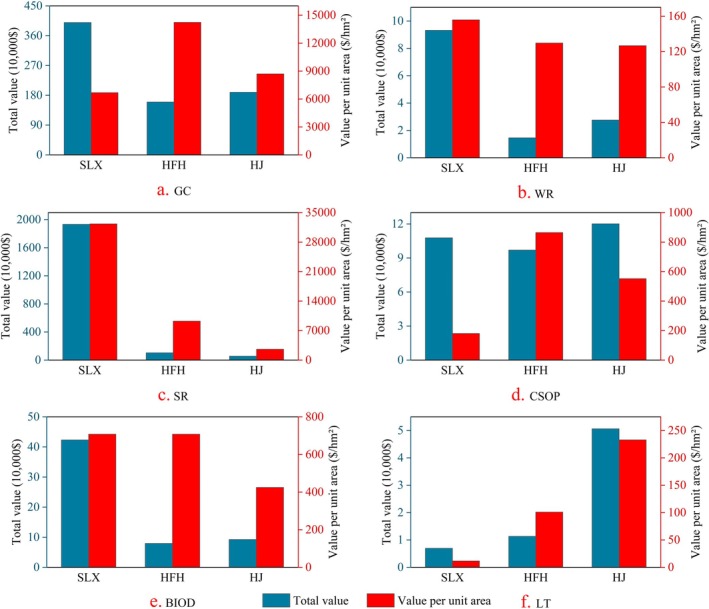
Transforming the ecological advantages of grassland ecosystems into economic benefits while ensuring their long-term health is an urgent but challenging question, particularly in karst areas characterized by significant spatial heterogeneity. This study selected three representative karst desertification control (KDC) areas within the South China Karst (SCK) as the research focus. Utilizing the quantified values of ecosystem products and their realization rates, we applied a random forest model to analyze the influencing factors. We found that: (1) The gross ecosystem products (GEP) of grassland per unit area increase with the severity of karst desertification. Conversely, the value realization rate decreases as the grade of karst desertification increases, contradicting the theoretical assumption that higher GEP correlates with a high value realization rate. (2) Water, soil, climate, and bare rock coupled with human activities (e.g., ecological engineering) affect the structure of the grassland GEP, which, in turn, affects the value realization rate of grassland ecosystem products in the KDC area. Based on our findings, we suggest that economic leapfrogging can be achieved through artificial grassland engineering in ecologically disadvantaged areas, challenging the conventional belief that a more fragile ecological environment results in poorer economic advantages. However, it is important to note that plant species diversity in artificial grassland in areas with severe karst desertification is low, and the trade-off and equity between ecology and economy must be carefully considered in future planning. Our findings can serve as a reference for subsequent phases of grassland ecosystem restoration for sustainability in ecologically fragile areas, particularly within the KDC regions.
在确保草原生态系统长期健康的同时,将其生态优势转化为经济效益是一个紧迫但具有挑战性的问题,特别是在具有显著空间异质性的喀斯特地区。本研究选取了中国南方喀斯特地区三个具有代表性的石漠化治理区作为研究重点。利用生态系统产品的量化值及其实现率,应用随机森林模型分析影响因素。我们发现:(1)单位面积草地的生态系统生产总值(GEP)随着石漠化程度的加重而增加。相反,随着石漠化等级的提高,价值实现率降低,这与GEP越高价值实现率越高的理论假设相矛盾。(2)水、土壤、气候、裸岩以及人类活动(如生态工程)影响草地GEP的结构,进而影响石漠化治理区草地生态系统产品的价值实现率。基于我们的研究结果,我们建议在生态劣势地区通过人工草地工程实现经济跨越发展,这挑战了传统观念中生态环境越脆弱经济优势越差的观点。然而,需要注意的是,石漠化严重地区人工草地的植物物种多样性较低,在未来规划中必须仔细考虑生态与经济之间的权衡和公平性。我们的研究结果可为生态脆弱地区,特别是石漠化治理区域草地生态系统恢复的后续阶段提供可持续性参考。