Wagh Rucha, Hatem Gad, Andersson Jonas, Kunte Pooja, Bandyopadhyay Souvik, Yajnik Chittaranjan S, Prasad Rashmi B
Diabetes Unit, Kamalnayan Bajaj Diabetology Research Centre, King Edward Memorial Hospital and Research Centre, Pune, India.
Symbiosis School of Biological Sciences, Symbiosis International (Deemed University), Pune, India.
Diabetologia. 2025 Jun;68(6):1298-1314. doi: 10.1007/s00125-025-06396-5. Epub 2025 Apr 2.
AIMS/HYPOTHESIS: Cardiometabolic traits are heritable, and some display parent-of-origin effects, which indicates preferential inheritance from one parent or parental bias. Most studies of these phenomena have focused on adult populations. We aimed to investigate the heritability and parent-of-origin effects on cardiometabolic traits in a birth cohort with serial measurements to determine whether these patterns emerged early in life.
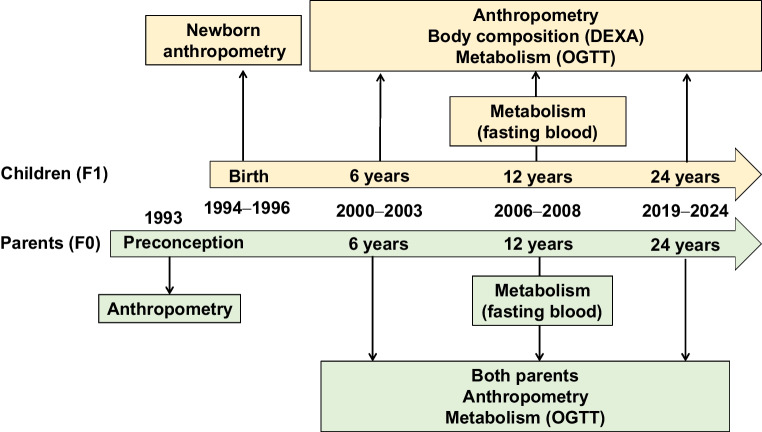
The Pune Maternal Nutrition Study comprises a birth cohort in which offspring and parents were studied from birth and followed up for 24 years. We investigated parent-of-origin effects on cardiometabolic traits cross-sectionally at available timepoints using linear regression, and longitudinally across the life course using mixed-effect regression. Maternal and paternal effects on offspring phenotype were modelled after adjusting for age, sex and BMI. Parent-of-origin effects were calculated based on the difference between maternal and paternal effects. We also investigated these effects in another birth cohort, that of the Pune Children's Study. Genetic parent-of-origin effects were assessed using generalised estimating equations after taking the parental origin of the alleles into account.
Birthweight showed a maternal parent-of-origin effect. At 24 years, maternal bias was seen for some obesity-related traits for daughters, while paternal bias was seen for WHR in sons. A shift from paternal bias at 6 years to maternal bias at 24 years for the skinfold thickness was observed in daughters. Fasting glucose and lipids showed maternal bias at 6, 12 and 24 years. For fasting insulin and HOMA2-S, a negative maternal effect at 6 years transitioned to a positive one at 12 years. For HOMA2-B, a paternal effect at 6 years transitioned to a maternal one at 12 years, and this remained so at 24 years. Some of these findings were also observed in the cohort from the Pune Children's Study. Longitudinal modelling revealed stronger paternal effects over time for fasting insulin and HOMA indices but maternal effects for glucose and lipids, reflecting their cumulative effect over time. Genetic variants at the KCNQ1 locus showed a maternal parent-of-origin effect on birthweight, on HOMA2-B at 12 years, and on lipids at 6 and 12 years.
CONCLUSIONS/INTERPRETATION: Our study provides proof of concept of the existence of parent-of-origin effects on cardiometabolic traits from birth, through childhood and puberty, until adult age. Our results indicate a predominantly maternal influence on intrauterine, pubertal and reproductive-age metabolism in the offspring. While the longitudinal analysis indicated a maternal bias for the macronutrients (glucose and lipids), and a paternal bias for glucose-insulin metabolism, the cross-sectional analysis revealed a transition between parental influence across physiological stages. This dynamic relationship may have its origins in the life-history theory of evolution, and could inform strategies for primordial prevention aimed at curbing the rising burden of cardiometabolic disease. Further studies are needed to determine the mechanisms underlying such effects.
目的/假设:心脏代谢特征具有遗传性,一些特征表现出亲代来源效应,即优先从一方亲本遗传或亲本偏向性。大多数关于这些现象的研究都集中在成年人群体。我们旨在调查一个出生队列中心脏代谢特征的遗传性和亲代来源效应,并进行系列测量,以确定这些模式是否在生命早期就已出现。
浦那孕产妇营养研究包括一个出生队列,对其后代和父母从出生开始进行研究,并随访24年。我们在可用时间点使用线性回归对心脏代谢特征的亲代来源效应进行横断面研究,并在整个生命过程中使用混合效应回归进行纵向研究。在调整年龄、性别和体重指数后,对母亲和父亲对后代表型的影响进行建模。基于母亲和父亲效应之间的差异计算亲代来源效应。我们还在另一个出生队列——浦那儿童研究队列中调查了这些效应。在考虑等位基因的亲本来源后,使用广义估计方程评估遗传亲代来源效应。
出生体重表现出母系亲代来源效应。在24岁时,女儿的一些肥胖相关特征存在母系偏向,而儿子的腰臀比存在父系偏向。在女儿中观察到皮褶厚度从6岁时的父系偏向转变为24岁时的母系偏向。空腹血糖和血脂在6岁、12岁和24岁时表现出母系偏向。对于空腹胰岛素和HOMA2-S,6岁时的负性母系效应在12岁时转变为正性效应。对于HOMA2-B,6岁时的父系效应在12岁时转变为母系效应,且在24岁时仍然如此。其中一些发现也在浦那儿童研究队列中观察到。纵向建模显示,随着时间的推移,空腹胰岛素和HOMA指数的父系效应更强,而葡萄糖和血脂的母系效应更强,这反映了它们随时间的累积效应。KCNQ1基因座的遗传变异对出生体重、12岁时的HOMA2-B以及6岁和12岁时的血脂表现出母系亲代来源效应。
结论/解读:我们的研究提供了概念证明,即从出生到儿童期、青春期直至成年期,亲代来源效应在心脏代谢特征中存在。我们的结果表明,后代在子宫内、青春期和生殖年龄的代谢主要受母亲影响。虽然纵向分析表明,常量营养素(葡萄糖和脂质)存在母系偏向,而葡萄糖-胰岛素代谢存在父系偏向,但横断面分析揭示了不同生理阶段父母影响之间的转变。这种动态关系可能源于进化的生命史理论,并可为旨在遏制心脏代谢疾病负担上升的初级预防策略提供参考。需要进一步研究以确定这些效应背后的机制。


